
Free Pre-Start Checklist (Roller) Template
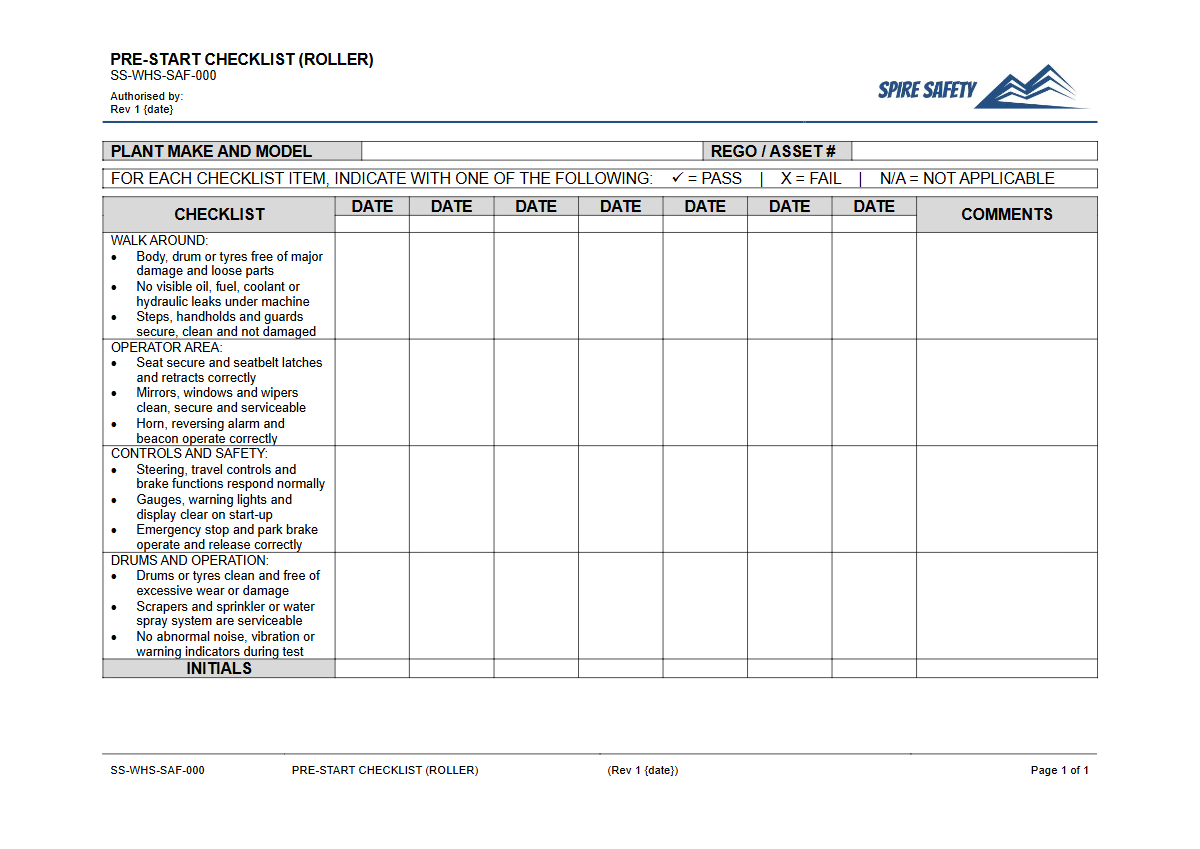
Download our free Pre-Start Checklist for Rollers. This structured template (DOCX & PDF) helps formalise daily equipment checks and manage WHS risks.
Free Pre-Start Checklist (Roller) Template
DOCX • 125 KB + PDF
Updated Oct 2026
No signup required
Purpose of the Free Pre-Start Checklist (Roller) Template
A roller, whether a smooth drum, padfoot, or multi-tyre pneumatic model, is powerful heavy machinery that presents significant risks if not properly maintained. Using a structured Free Pre-Start Checklist (Roller) Template is a fundamental safety practice that helps operators systematically inspect the machine before use.
The primary purpose is to identify any faults, damage, or wear and tear that could lead to an accident, equipment failure, or costly breakdown. Regular checks are a key part of an effective maintenance program, helping to ensure the roller remains in a safe and reliable condition for operation on construction sites, roadworks, and other industrial settings.
This document serves as a formal record that pre-operational inspections are being completed consistently. It demonstrates an organisation's commitment to proactive risk management and can form a crucial part of due diligence records.
By catching minor issues early, you prevent them from escalating into major hazards, protecting not only the operator but also other workers and the public. These documented checks are also vital for effective WHS management systems, providing a clear trail of inspection and fault reporting.
Video walkthrough
How to use the Free Pre-Start Checklist (Roller) Template
This checklist is provided as a user-friendly template in both DOCX and PDF formats. Operators should complete the checklist at the start of every shift or before using the roller for the first time that day.
The process involves visually inspecting and functionally testing each item listed, ticking off each point as it is confirmed to be in safe working order. Any defects, faults, or concerns must be immediately recorded in the comments section and reported to a supervisor or manager according to your workplace’s procedure.
A roller with a significant safety defect identified must be tagged out of service and not used until it is repaired by a competent person.
Customisation is Essential
While this template is a comprehensive starting point aligned with Australian WHS principles, it must be adapted to your specific needs. It is critical that you review and customise this document to align with the specific make and model of your roller, the unique hazards of your worksite (e.g., slopes, traffic, ground conditions), and your organisation's internal safety procedures.
We provide this as a guide; you must ensure it is suitable for your exact situation before implementation.
When to use it
A pre-start inspection should be a non-negotiable routine. The checklist should be completed:
- Before the start of every shift: This is the most common and critical use.
- Before using the equipment for the first time on a given day: Even if it's for a short task later in the day.
- After a change of operator: Ensures the new operator verifies the machine's condition for themselves.
- After the roller has been idle for an extended period: To check for issues that may have developed while stationary.
- Following any maintenance or repair work: To verify that the work has been completed correctly and the machine is safe to return to service.
Integrating this routine into daily operations is similar to processes for other heavy equipment. For example, a documented pre-start checklist for a forwarder ensures its complex hydraulic and grabbing systems are safe before it begins work in a forestry environment.
The principle of 'check before you use' is universal across all high-risk plant.
Who should use it
The pre-start checklist must be completed by a person who is competent to operate the roller. This means they have received the necessary training, instruction, and information on how to use the machine safely and how to perform the required checks.
Supervisors and managers also have a key role. They are responsible for ensuring operators are completing the checklists correctly, reviewing the completed forms, and taking prompt action to address any reported defects.
These records are often reviewed during WHS compliance audits to verify that inspection processes are being followed.
The responsibility for safety is shared. While the operator conducts the check, the Person Conducting a Business or Undertaking (PCBU) has the primary duty of care to ensure safe systems of work, including effective inspection regimes, are in place.
Just as our pre-start checklist for bin lifters helps formalise waste management equipment checks, this roller template helps construction and civil worksites manage their specific plant risks. You can find more templates like this in our free WHS resources library to build out your safety program.
Common mistakes
Common mistakes to avoid
- "Pencil-whipping" the form without physically inspecting the roller.
- Failing to report identified defects or continuing to use faulty equipment.
- Using a generic checklist that doesn't match the specific make, model, or configuration of the roller.
- Operators not being adequately trained on what to look for during the inspection.
Legal references
Legal considerations
The following legal requirements may be relevant to this type of work.
- Work Health and Safety Act (Harmonised) — Provides the primary duties for protecting workers and other people from work health and safety risks.
- Work Health and Safety Regulations (Harmonised) — Sets out requirements supporting the management of workplace hazards and risks.
The following codes may be relevant to this type of work.
- Managing WHS Risks Code of Practice — Provides practical guidance on identifying hazards, assessing risks and applying effective controls.
- Work Health and Safety Consultation, Cooperation and Coordination Code of Practice — Provides practical guidance on consulting workers and coordinating with other duty holders.
- Managing the Work Environment and Facilities Code of Practice — Provides practical guidance on safe work environments, workplace facilities and related controls.
Did you know
A Heavy History
The first steam-powered road roller was demonstrated in 1860 in Paris. Modern rollers still operate on the same basic principle of compaction through weight, but now incorporate advanced safety features like ROPS (Roll-Over Protective Structures).
Mobile Plant Risks
According to Safe Work Australia, a significant number of worker fatalities involve vehicles, with many of these incidents occurring from collisions with mobile plant on-site. Thorough pre-start checks are a critical control measure to mitigate these risks.
FAQ
Frequently asked questions
01What is the purpose of a roller pre-start check?
02How often should a roller pre-start inspection be completed?
03Who is responsible for ensuring roller pre-start checks are done?
04What should I do if I find a defect during the pre-start check?
Share this resource
Free Pre-Start Checklist (Roller) Template
Browse Categories
How To Use It
- 1Download and open in Word or PDF.
- 2Replace the placeholders with your business details.
- 3Get it reviewed by a WHS specialist before rollout.
Need it customised?
Our WHS consultants can adapt this template to your site, run a gap analysis, or audit what you already have in place.
Book a Free Consultation WHS consulting servicesor call 1300 156 382