
Free Pre-Start Checklist (Rotary Drill) Template
Download our Free Pre-Start Checklist (Rotary Drill) Template. This structured DOCX & PDF helps formalise pre-use inspections to manage WHS risks.
Free Pre-Start Checklist (Rotary Drill) Template
DOCX • 125 KB + PDF
Updated Oct 2026
No signup required
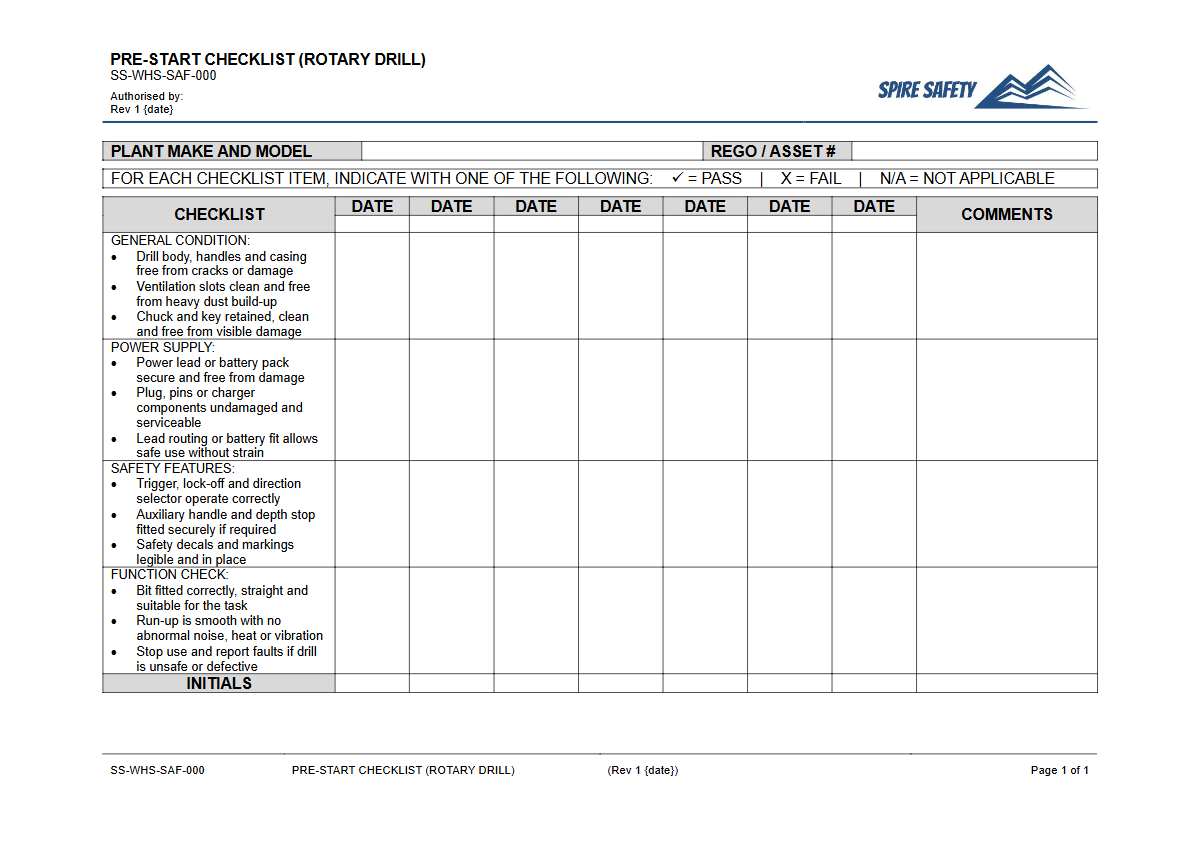
Purpose of the Free Pre-Start Checklist (Rotary Drill) Template
A rotary drill is a common but powerful tool found on construction sites, in workshops, and across many trades. Despite their ubiquity, they pose significant risks if not properly maintained and inspected.
This Free Pre-Start Checklist (Rotary Drill) Template provides a structured framework for operators to conduct consistent and thorough pre-operational checks. Using a formal checklist helps identify potential faults, damage, or wear and tear before the tool is used, significantly reducing the risk of electric shock, entanglement, or mechanical failure.
Formalising this process helps a Person Conducting a Business or Undertaking (PCBU) meet their primary duty of care to ensure the provision and maintenance of safe plant.
The checklist encourages a proactive approach to safety, shifting the focus from reaction to prevention. It serves as a daily reminder of key safety components and functions, reinforcing safe work habits among operators.
Documenting these checks also creates a valuable record for maintenance scheduling, incident investigations, and demonstrating due diligence. For inspections of larger, related equipment, our Free Pre-Start Checklist (Drill Rig) Template provides a more specialised framework.
Video walkthrough
How to use the Free Pre-Start Checklist (Rotary Drill) Template
This resource is provided in both DOCX and PDF formats for your convenience. The DOCX file is fully editable, allowing you to tailor the checklist to the specific models of rotary drills used in your workplace and your unique operational risks.
We recommend a competent person reviews and customises the template before it is implemented.
To use the template effectively:
- Download: Select the DOCX or PDF version and save it to your system.
- Customise: Open the DOCX file and add your company branding. Adjust the checklist items to match the features of your specific rotary drill models. You may need to add or remove checks related to clutches, variable speed controls, or specific battery-powered features.
- Train: Ensure all operators are trained on how to properly conduct the inspection using the finalised checklist. Explain the importance of each check and what to do if a fault is found.
- Implement: Integrate the checklist into your daily safe work procedures. Store completed checklists in a designated location as part of your safety records.
Please note: This document is a template and not a complete safety solution. While it is aligned with Australian WHS principles, we have provided it as a starting point.
You must customise this template to address the specific hazards and operational context of your workplace to ensure it is fit for purpose. Effective use of such tools is a key component of well-designed WHS management systems.
When to use it
The pre-start checklist for a rotary drill should be completed before the first use of the tool on any given day or shift. It should also be used when an operator is using a drill for the first time or returning to a tool after it has undergone maintenance or repair.
Regular, consistent checks are the most effective way to catch developing issues before they lead to an incident. Unlike stationary equipment covered in our Free Pre-Start Checklist (Drill Press) Template, portable tools like rotary drills are more susceptible to damage from transport and frequent handling, making daily checks essential.
Who should use it
The primary user of this checklist is the tool operator—the person who will be physically using the rotary drill. They have the most immediate responsibility for ensuring the equipment is safe to operate before they begin work.
Supervisors should also be familiar with the checklist to oversee its correct use and to ensure that any reported faults are addressed promptly. Maintenance personnel may also use the checklist as a reference when conducting repairs or scheduled servicing, ensuring all key safety components are inspected.
If you require further assistance in defining roles and responsibilities for plant safety, our WHS consulting services can provide tailored guidance.
What's Covered in the Rotary Drill Pre-Start Checklist?
This template prompts the user to inspect critical components and functions before operation. Key areas covered include:
- Physical Condition: Checking the housing for cracks or damage.
- Power Cord and Plug: Inspecting for fraying, cuts, or exposed wires (for corded models).
- Battery: Ensuring the battery is secure and the contacts are clean (for cordless models).
- Chuck and Key: Verifying the chuck operates smoothly and the key (if applicable) is removed before starting.
- Controls: Testing the trigger, reverse switch, and any speed or mode selectors.
- Guards and Handles: Ensuring any auxiliary handles are secure and guards are in place.
- Housekeeping: Confirming the work area is clear of trip hazards and flammable materials.
This systematic inspection follows principles applicable to a wide range of powered hand tools, including those detailed in resources like our Free Pre-Start Checklist (Floor Saw) Template. For a wider selection of safety documentation, you can explore our complete free WHS resources library.
Common mistakes
Common mistakes to avoid
- Using the checklist as a paper exercise without physically inspecting each item.
- Ignoring frayed power cords or damaged plugs, creating a serious electrical hazard.
- Failing to remove a faulty drill from service and tag it out correctly.
- Using blunt or incorrect drill bits, which can cause the drill to bind or kick back.
Legal references
Legal considerations
The following legal requirements may be relevant to this type of work.
- Work Health and Safety Act (Harmonised) — Provides the primary duties for protecting workers and other people from work health and safety risks.
- Work Health and Safety Regulations (Harmonised) — Sets out requirements supporting the management of workplace hazards and risks.
The following codes may be relevant to this type of work.
- Managing WHS Risks Code of Practice — Provides practical guidance on identifying hazards, assessing risks and applying effective controls.
- Work Health and Safety Consultation, Cooperation and Coordination Code of Practice — Provides practical guidance on consulting workers and coordinating with other duty holders.
- Managing the Work Environment and Facilities Code of Practice — Provides practical guidance on safe work environments, workplace facilities and related controls.
Did you know
A Powerful Invention
The world's first portable, handheld electric drill was invented in 1917 by S. Duncan Black and Alonzo G. Decker. Their design, featuring a pistol grip and trigger switch, became the standard for the industry and remains largely unchanged today.
Hand and Power Tool Injuries
According to Safe Work Australia data, injuries involving non-powered and powered hand tools are a significant cause of serious workers' compensation claims, highlighting the importance of proper inspection and safe use.
FAQ
Frequently asked questions
01What is the difference between a rotary drill and a hammer drill?
02How often should a portable rotary drill be inspected?
03Who is responsible for ensuring pre-start checks are completed?
04Is this checklist suitable for both corded and cordless rotary drills?
Share this resource
Free Pre-Start Checklist (Rotary Drill) Template
Browse Categories
How To Use It
- 1Download and open in Word or PDF.
- 2Replace the placeholders with your business details.
- 3Get it reviewed by a WHS specialist before rollout.
Need it customised?
Our WHS consultants can adapt this template to your site, run a gap analysis, or audit what you already have in place.
Book a Free Consultation WHS consulting servicesor call 1300 156 382