
Free Pre-Start Checklist (Rotary Hoe) Template
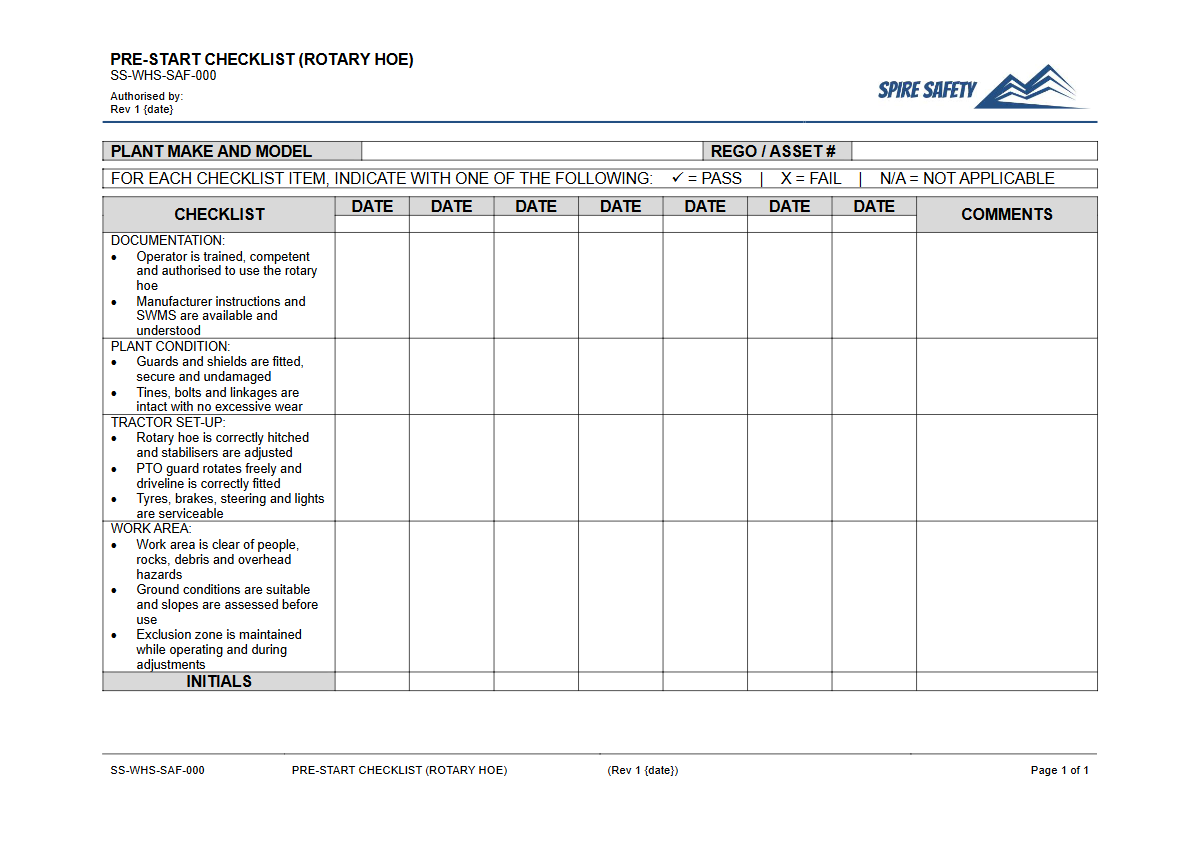
Download our free Pre-Start Checklist (Rotary Hoe) Template to formalise equipment inspections. This DOCX & PDF resource helps manage WHS risks. Get yours now.
Free Pre-Start Checklist (Rotary Hoe) Template
DOCX • 125 KB + PDF
Updated Oct 2026
No signup required
Purpose of the Free Pre-Start Checklist (Rotary Hoe) Template
A rotary hoe simplifies soil cultivation but introduces significant mechanical and operational risks. Our Free Pre-Start Checklist (Rotary Hoe) Template provides a structured method for operators to inspect the equipment for faults, damage, or wear before each use.
Systematically conducting these checks helps identify and control hazards, preventing incidents, equipment failure, and potential injuries. Using this template helps organisations demonstrate due diligence in maintaining safe plant and creates a tangible record of safety practices.
Formalising your pre-start process is a fundamental component of proactive safety management. This checklist serves as a practical tool within broader WHS management systems, ensuring that safety protocols are consistently applied at an operational level.
It encourages a safety-first mindset and empowers workers to take ownership of the condition of their equipment.
Video walkthrough
How to use the Free Pre-Start Checklist (Rotary Hoe) Template
Integrating this pre-start checklist into your daily operations is straightforward. Follow these steps to ensure its effective implementation:
- Download and Customise: Download the template in your preferred format (DOCX for easy editing or PDF). It is crucial to adapt the checklist to your specific circumstances. Note: This document is a starting point. You must customise it to reflect the make, model, and configuration of your rotary hoe, your unique site conditions, and the specific risks identified in your risk assessments. We are not liable for any incidents arising from the use of this template.
- Train Your Team: Ensure all operators are trained on how to conduct a thorough pre-start inspection and correctly complete the checklist. This training should cover what each checkpoint means, how to identify defects, and the procedure for reporting issues. Verifying that operators are competent is essential for any high-risk plant. You can formalise this with a resource like our Verification of Competency (Rotary Hammer) template.
- Implement and Monitor: Make the pre-start check a non-negotiable step before every use. Supervisors should periodically review completed checklists to ensure they are being filled out correctly and that reported faults are being addressed in a timely manner.
When to use a Pre-Start Checklist
A pre-start checklist for a rotary hoe should be completed at several key moments to maximise its effectiveness. The primary occasion is before the first use on any given day or shift.
This establishes a baseline for the equipment's condition and ensures it is safe to start work. The check should also be performed if a new operator takes over mid-shift.
Beyond daily checks, it is good practice to conduct an inspection after the equipment has undergone maintenance or repair to verify it has been returned to a safe operational state. Regular safety discussions can reinforce these habits; our Pre-Start Checks and Plant Maintenance Toolbox Talk can help facilitate these crucial conversations with your team.
Who should use this Pre-Start Checklist
This checklist is designed for use by any person who will operate the rotary hoe. The operator has the most immediate interaction with the equipment and is best placed to notice subtle changes or emerging issues.
They must be deemed competent to both operate the machine and conduct a meaningful pre-start inspection.
Supervisors and managers also have a role. They are responsible for ensuring the checks are being completed and for actioning any maintenance or repairs that are flagged.
Reviewing these checklists can highlight recurring problems that may require more in-depth investigation or changes to maintenance schedules. While this checklist is for a rotary hoe, similar principles apply to other agricultural or landscaping equipment, which may require their own specific documents like a Pre-Start Checklist (Aerator) Template.
Documenting these checks is also a key activity for demonstrating compliance. Records of inspections, maintenance, and repairs should be retained as part of your safety management system. These records can be invaluable during safety reviews or WHS compliance auditing.
Common mistakes
Common mistakes to avoid
- Failing to customise the generic template for the specific rotary hoe model.
- "Pencil-whipping" the checklist without physically inspecting the items.
- Not immediately removing the equipment from service when a serious fault is found.
- Operators not being trained on how to identify defects or what to look for.
Legal references
Legal considerations
The following legal requirements may be relevant to this type of work.
- Work Health and Safety Act (Harmonised) — Provides the primary duties for protecting workers and other people from work health and safety risks.
- Work Health and Safety Regulations (Harmonised) — Sets out requirements supporting the management of workplace hazards and risks.
The following codes may be relevant to this type of work.
- Managing WHS Risks Code of Practice — Provides practical guidance on identifying hazards, assessing risks and applying effective controls.
- Work Health and Safety Consultation, Cooperation and Coordination Code of Practice — Provides practical guidance on consulting workers and coordinating with other duty holders.
- Managing the Work Environment and Facilities Code of Practice — Provides practical guidance on safe work environments, workplace facilities and related controls.
Did you know
Rotary Hoe History
The rotary hoe was invented in Australia in 1912 by Arthur Clifford Howard. He developed a prototype with an L-shaped tine on a powered rotor that could simultaneously plough and harrow, revolutionising small-scale farming.
Entanglement Hazard
The rotating tines of a rotary hoe are a significant entanglement hazard. According to Safe Work Australia, contact with moving parts of machinery is a leading cause of serious injury in the agriculture sector.
FAQ
Frequently asked questions
01What should be included in a rotary hoe pre-start check?
02Why is a pre-start check for a rotary hoe important for WHS?
03How often should rotary hoe pre-start inspections be conducted?
04Can this template be used for other types of soil cultivation equipment?
Share this resource
Free Pre-Start Checklist (Rotary Hoe) Template
Browse Categories
How To Use It
- 1Download and open in Word or PDF.
- 2Replace the placeholders with your business details.
- 3Get it reviewed by a WHS specialist before rollout.
Need it customised?
Our WHS consultants can adapt this template to your site, run a gap analysis, or audit what you already have in place.
Book a Free Consultation WHS consulting servicesor call 1300 156 382