
Free Pre-Start Checklist (Rotator Attachment) Template
Download our free Pre-Start Checklist for rotator attachments. This template helps formalise equipment checks and identify hazards. Get your DOCX & PDF now.
Free Pre-Start Checklist (Rotator Attachment) Template
DOCX • 125 KB + PDF
Updated Oct 2026
No signup required
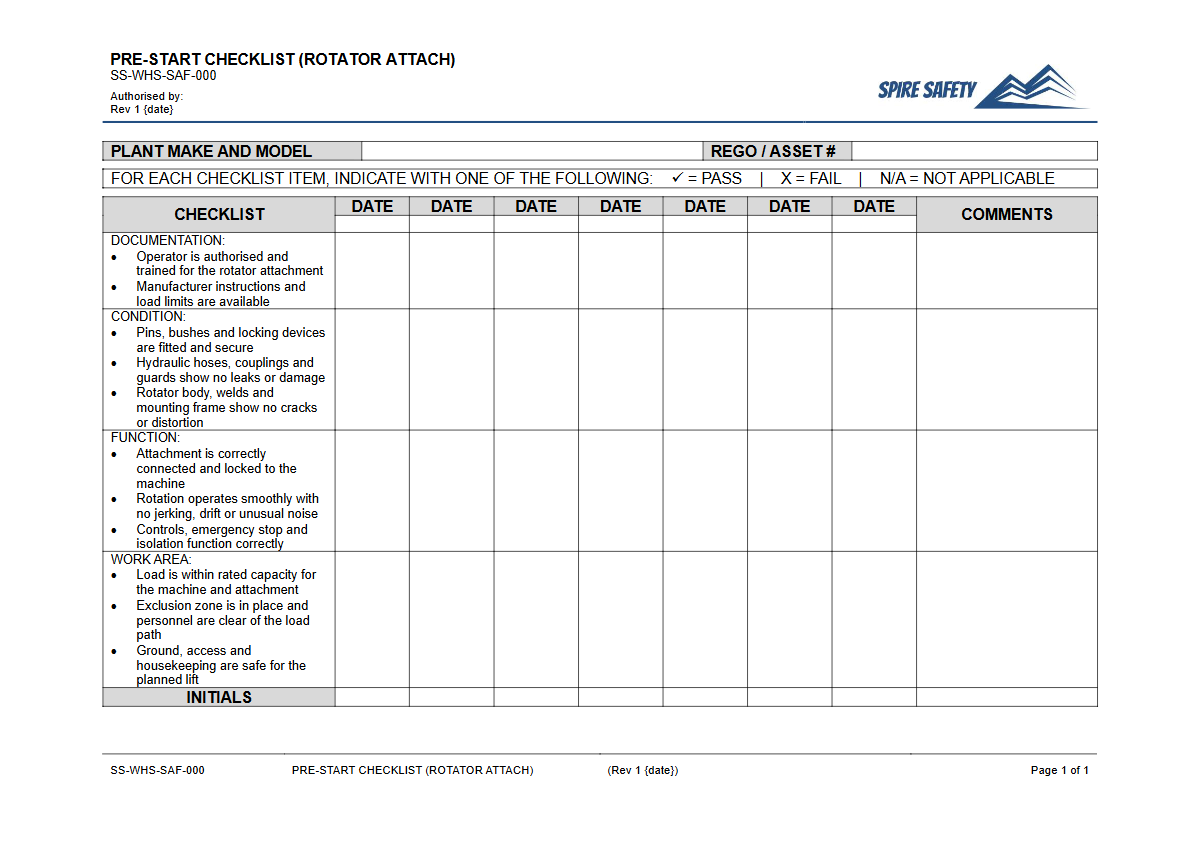
Purpose of the Free Pre-Start Checklist (Rotator Attachment) Template
Operating machinery with attachments like rotators introduces specific risks that must be managed. This free Pre-Start Checklist (Rotator Attachment) Template provides a structured framework for operators to conduct thorough, consistent safety inspections before use.
Its primary purpose is to systematically identify potential defects, damage, or wear and tear that could lead to equipment failure, property damage, or serious injury. By formalising these checks, organisations can ensure that rotator attachments are fit for service, helping to meet their duties under Australian WHS laws.
Using a dedicated checklist ensures that critical inspection points are not overlooked. This includes verifying the integrity of hydraulic hoses and couplings, checking for cracks or deformation in the frame and tynes, ensuring locking mechanisms are fully functional, and confirming that all safety decals and operational markings are legible.
Documenting these checks creates a clear record of due diligence and supports a proactive maintenance culture. Consistent use of this template helps prevent incidents before they occur, protecting both workers and the equipment they operate.
Video walkthrough
How to use the Free Pre-Start Checklist (Rotator Attachment) Template
This resource is designed to be straightforward and adaptable. Simply download the template in your preferred format (DOCX or PDF) to get started.
The DOCX file is fully editable, allowing for extensive customisation to suit your specific operational needs. Operators should be trained to follow the checklist step-by-step, physically inspecting each item listed and noting its condition.
Any identified defects, faults, or concerns must be recorded and reported immediately according to your organisation's procedures. Equipment that fails a pre-start check must be taken out of service, tagged, and isolated until it has been inspected by a competent person and certified as safe to return to use.
Important: This document is a starting point. To ensure its effectiveness, you must customise this template to align with the specific make and model of your rotator attachment, the parent machine it is fitted to (e.g., forklift, telehandler), the tasks it is used for, and the unique risks present in your workplace.
Integrating details from the manufacturer's operating manual is a critical step in this customisation process. For broader discussions on equipment safety, our Pre-Start Checks and Plant Maintenance Toolbox Talk can help reinforce key principles with your team.
When to use this Pre-Start Checklist
A pre-start inspection should be conducted at the beginning of every shift or before the rotator attachment is used for the first time on a given day. It should also be completed if a new operator takes over the equipment during a shift.
This frequency ensures that any damage or defects that may have occurred during previous operation, during transport, or overnight are identified before the equipment is put into service. Conducting checks regularly is a cornerstone of proactive plant safety management.
Who should use this Pre-Start Checklist
The pre-start inspection must be carried out by a person who is trained, licensed (where required for the parent machine), and deemed competent to operate the specific piece of equipment. This operator should be familiar with the rotator attachment's functions, limitations, and potential failure points.
While the operator performs the check, the Person Conducting a Business or Undertaking (PCBU) holds the ultimate responsibility for ensuring that systems are in place for the safe inspection, maintenance, and operation of all plant and equipment.
Integrating Pre-Starts into Your WHS System
Pre-start checklists are not standalone documents; they are a vital component of a comprehensive safety management system. The data collected from these checks should feed into your maintenance schedules, risk assessments, and training programs.
Consistently completed checklists provide valuable information about equipment health, allowing for predictive maintenance and the identification of recurring issues. Integrating these records is a key part of developing robust WHS management systems that effectively control plant-related risks across the organisation.
Review and Record Keeping
Completed checklists serve as a legal record of inspection and must be stored securely. These records are essential for incident investigations and demonstrating compliance during safety audits.
Regular review of these documents can highlight trends, such as frequent hydraulic leaks on a particular unit, indicating a need for more than just a simple repair. Discussing findings from these checks is also a valuable activity for safety meetings, which can be structured using a free Pre-Start Meeting Template. This process ensures that safety knowledge is shared across the team.
External WHS compliance auditing will often involve a review of such records to verify that inspection and maintenance procedures are being followed as required.
By implementing a thorough pre-start process, your organisation can significantly reduce the risk of incidents associated with rotator attachments. For more tools to support your safety programs, explore our complete free WHS resources library.
Common mistakes
Common mistakes to avoid
- Using a generic plant checklist that doesn't cover rotator-specific items like the rotation mechanism or hydraulic swivel.
- Ignoring minor hydraulic leaks or weeping seals, which can be early indicators of impending hose or component failure.
- Failing to document findings accurately or not reporting defects immediately to a supervisor.
- "Pencil-whipping" the checklist — ticking boxes without physically and visually inspecting each component.
Legal references
Legal considerations
The following legal requirements may be relevant to this type of work.
- Work Health and Safety Act (Harmonised) — Provides the primary duties for protecting workers and other people from work health and safety risks.
- Work Health and Safety Regulations (Harmonised) — Sets out requirements supporting the management of workplace hazards and risks.
The following codes may be relevant to this type of work.
- Managing WHS Risks Code of Practice — Provides practical guidance on identifying hazards, assessing risks and applying effective controls.
- Work Health and Safety Consultation, Cooperation and Coordination Code of Practice — Provides practical guidance on consulting workers and coordinating with other duty holders.
- Managing the Work Environment and Facilities Code of Practice — Provides practical guidance on safe work environments, workplace facilities and related controls.
Did you know
Attachment Integrity
A significant number of mobile plant incidents involve the failure of attachments due to incorrect fitting, hydraulic faults, or structural fatigue. Regular pre-start checks are a primary control measure for preventing these failures before they cause harm.
FAQ
Frequently asked questions
01What is a pre-start checklist for a rotator attachment?
02Why is it important to check a rotator attachment before use?
03Who is responsible for completing the rotator attachment pre-start check?
04How often should a rotator attachment pre-start check be performed?
Share this resource
Free Pre-Start Checklist (Rotator Attachment) Template
Browse Categories
How To Use It
- 1Download and open in Word or PDF.
- 2Replace the placeholders with your business details.
- 3Get it reviewed by a WHS specialist before rollout.
Need it customised?
Our WHS consultants can adapt this template to your site, run a gap analysis, or audit what you already have in place.
Book a Free Consultation WHS consulting servicesor call 1300 156 382