
Free Pre-Start Checklist (Rowing Machine) Template
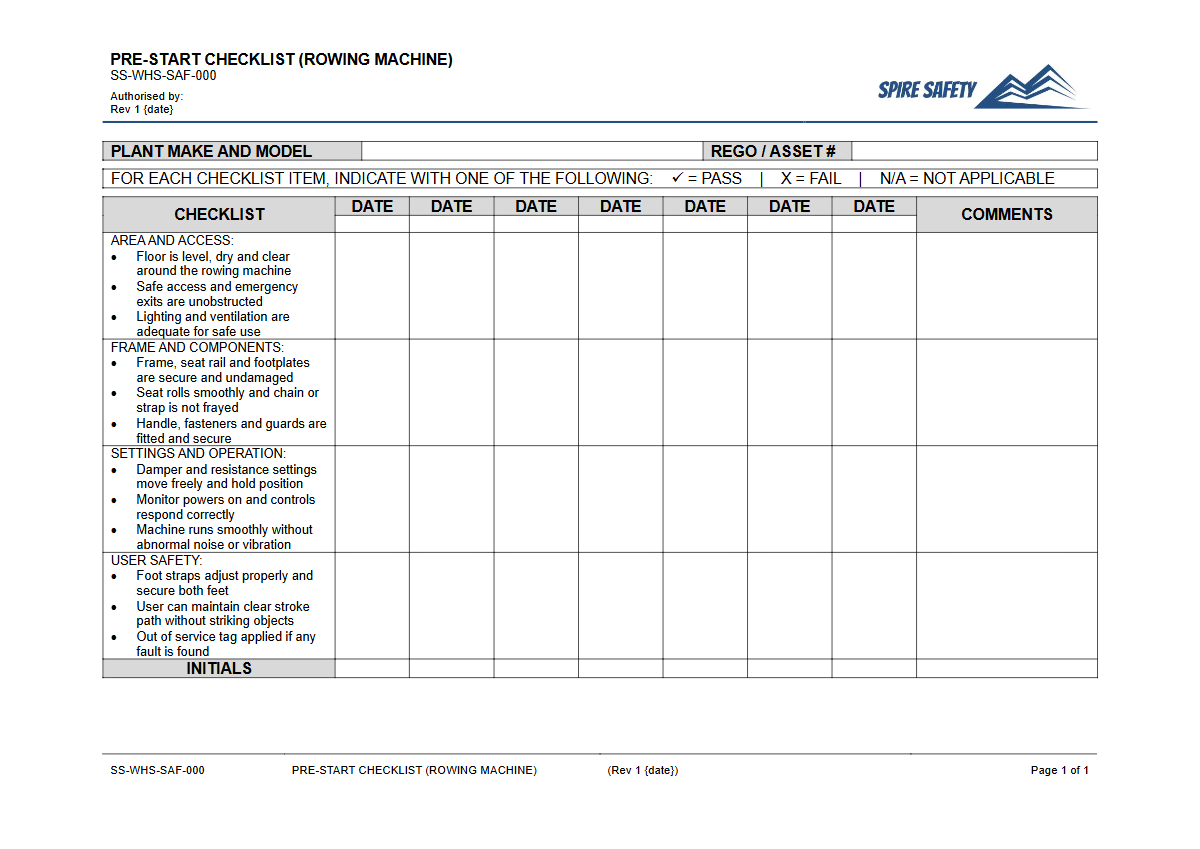
Download our free Pre-Start Checklist for Rowing Machines. This structured template helps identify equipment hazards before use in your gym or facility.
Free Pre-Start Checklist (Rowing Machine) Template
DOCX • 125 KB + PDF
Updated Oct 2026
No signup required
Purpose of the Free Pre-Start Checklist (Rowing Machine) Template
Regularly inspecting exercise equipment is a critical part of maintaining a safe environment in gyms, fitness studios, rehabilitation centres, and corporate wellness facilities. Our Free Pre-Start Checklist (Rowing Machine) Template provides a structured framework to formalise these essential safety checks.
Using this checklist helps you proactively identify potential hazards like frayed pull straps, loose bolts, or malfunctioning digital displays before they can cause an injury. It establishes a consistent inspection routine, ensuring all safety-critical components are assessed methodically.
Under Australian WHS laws, a person conducting a business or undertaking (PCBU) has a primary duty of care to ensure, so far as is reasonably practicable, that plant and structures—including exercise equipment—are safe to use. This template serves as a practical tool to help meet these obligations by creating a documented record of inspections and maintenance needs.
It supports a preventative maintenance culture, reducing equipment downtime and minimising the risk of incidents. You can reinforce these principles with staff by using a Pre-Start Checks and Plant Maintenance Toolbox Talk to standardise training and communication.
Video walkthrough
How to use the Free Pre-Start Checklist (Rowing Machine) Template
This template is designed as a starting point, providing a comprehensive list of common inspection points for a standard rowing machine. To implement it effectively in your workplace, follow these steps:
- Download: Get the template in your preferred format, either DOCX for easy editing or PDF for straightforward printing.
- Customise: Review the checklist and adapt it to the specific make and model of the rowing machines in your facility. You may need to add or remove items based on manufacturer recommendations and your own risk assessment.
- Train: Ensure all relevant personnel, such as gym floor staff, personal trainers, or maintenance teams, are trained on how to conduct the checks properly and what to do if they identify a fault.
- Implement: Integrate the checklist into your daily opening procedures or maintenance schedules. Store completed checklists as part of your safety records.
Important: This is a template, not a finished document. To be effective, you must customise it for your specific equipment, operational context, and workplace risks.
We recommend incorporating it into your broader WHS management systems to ensure it aligns with your overall safety strategy.
When to use the Pre-Start Checklist
A rowing machine pre-start check should be conducted before the equipment is used for the first time each day. In high-traffic commercial gyms or 24/7 facilities, it may be practical to perform checks at the beginning of each staff shift.
The goal is to catch any damage or wear that may have occurred during previous use or overnight.
This routine inspection does not replace the need for scheduled preventative maintenance by qualified technicians as recommended by the equipment manufacturer. Rather, it complements it by providing a daily layer of safety assurance.
Documented checks also provide valuable evidence of due diligence during WHS compliance auditing, demonstrating a proactive approach to risk management.
Who should use the Pre-Start Checklist
This checklist is intended for use by anyone responsible for the day-to-day safety and operation of fitness equipment. This includes a range of roles:
- Gym Managers and Supervisors: To oversee the implementation of safety procedures.
- Personal Trainers and Fitness Instructors: As the primary users and supervisors of the equipment with clients.
- Facility Maintenance Staff: To conduct checks as part of their daily duties and to action any required repairs.
- WHS Officers and Coordinators: To integrate the tool into the organisation's safety framework.
Ensuring equipment is mechanically sound is only one part of preventing injuries. It's also vital to promote correct user technique to avoid musculoskeletal issues. Discussions about proper form and posture share principles with manual handling safety, which can be explored further in resources like our Aged Care Manual Handling Toolbox Talk. For tailored advice on integrating equipment safety into your specific operations, consider engaging professional WHS consulting services.
By systematically checking your rowing machines, you contribute to a safer experience for all users. Explore our free WHS resources library for more tools to support your safety management efforts.
Common mistakes
Common mistakes to avoid
- Overlooking 'minor' issues like a slightly frayed pull strap or a sticky seat roller, which can worsen quickly.
- Failing to document the checks, leaving no record that inspections were completed.
- Using a generic checklist that doesn't match the specific features of the rowing machine model.
- Not training staff on what to do when a fault is found, leading to unsafe equipment remaining in use.
Legal references
Legal considerations
The following legal requirements may be relevant to this type of work.
- Work Health and Safety Act (Harmonised) — Provides the primary duties for protecting workers and other people from work health and safety risks.
- Work Health and Safety Regulations (Harmonised) — Sets out requirements supporting the management of workplace hazards and risks.
The following codes may be relevant to this type of work.
- Managing WHS Risks Code of Practice — Provides practical guidance on identifying hazards, assessing risks and applying effective controls.
- Work Health and Safety Consultation, Cooperation and Coordination Code of Practice — Provides practical guidance on consulting workers and coordinating with other duty holders.
- Managing the Work Environment and Facilities Code of Practice — Provides practical guidance on safe work environments, workplace facilities and related controls.
Did you know
Equipment as 'Plant'
Under Australian WHS regulations, exercise equipment like a rowing machine is legally defined as 'plant'. This means PCBUs have a specific duty to ensure it is inspected, maintained, and safe to use, without risks to health and safety.
Repetitive Motion
While rowing is a low-impact exercise, incorrect form or a malfunctioning machine can contribute to musculoskeletal disorders (MSDs). Regular checks on components like the seat rail and foot straps are vital for ensuring smooth, safe motion.
FAQ
Frequently asked questions
01What should be checked on a rowing machine before use?
02Why are pre-start checks for gym equipment important?
03How often should a rowing machine pre-start check be done?
04Is this template suitable for commercial gyms and studios?
Share this resource
Free Pre-Start Checklist (Rowing Machine) Template
Browse Categories
How To Use It
- 1Download and open in Word or PDF.
- 2Replace the placeholders with your business details.
- 3Get it reviewed by a WHS specialist before rollout.
Need it customised?
Our WHS consultants can adapt this template to your site, run a gap analysis, or audit what you already have in place.
Book a Free Consultation WHS consulting servicesor call 1300 156 382