
Free Pre-Start Checklist (Sausage Filler) Template
Download our free Pre-Start Checklist (Sausage Filler) Template to formalise daily equipment inspections and manage WHS risks. Get the template.
Free Pre-Start Checklist (Sausage Filler) Template
DOCX • 125 KB + PDF
Updated Oct 2026
No signup required
Purpose of the Free Pre-Start Checklist (Sausage Filler) Template
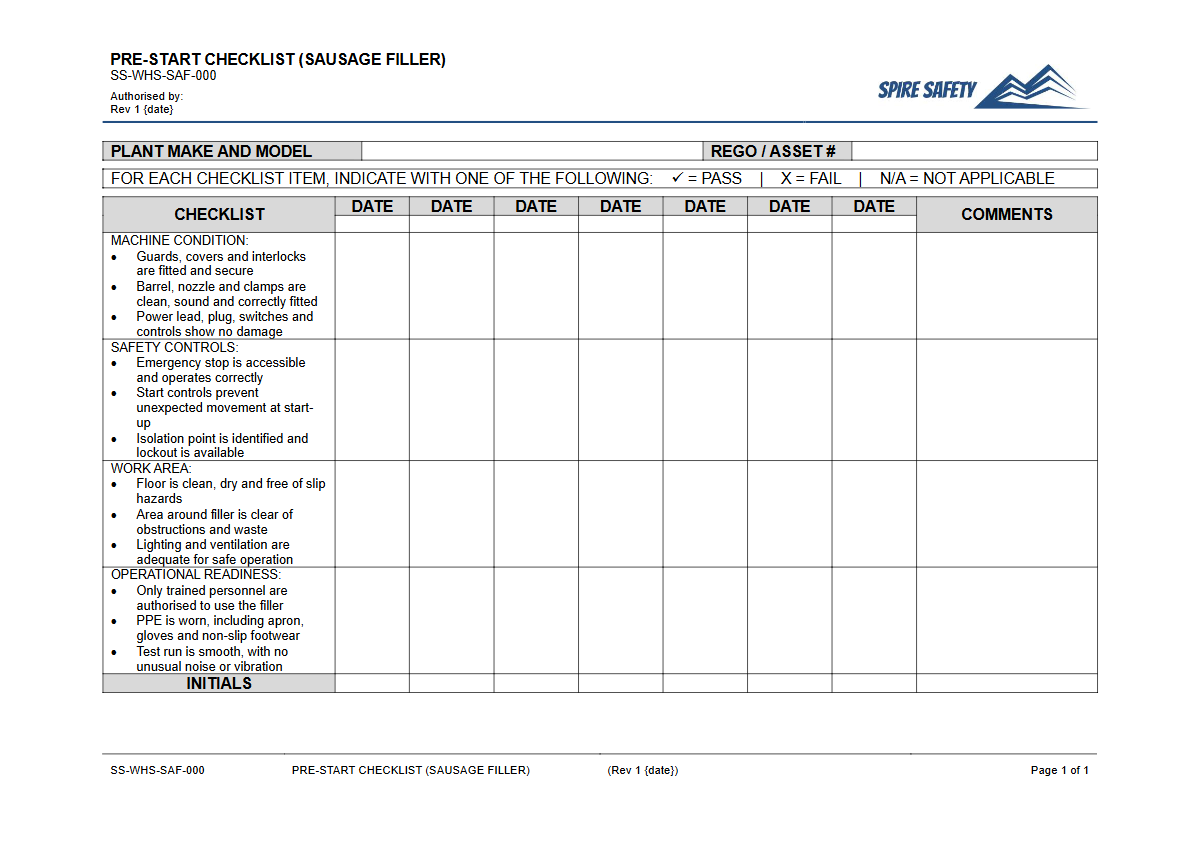
Operating food processing machinery like a sausage filler introduces significant workplace hazards. This Free Pre-Start Checklist (Sausage Filler) Template provides a structured framework for operators to conduct thorough, systematic inspections before using the equipment.
Its primary purpose is to identify and control risks before they can cause harm, such as entanglement in moving parts, electrical faults, or hygiene-related issues. By formalising these checks, you create a documented record of due diligence, promote a proactive safety culture, and ensure the equipment is safe for use at the start of every shift.
A documented pre-start process is a key element in any effective WHS management system, demonstrating a commitment to worker safety and operational integrity.
Video walkthrough
How to use the Free Pre-Start Checklist (Sausage Filler) Template
Follow these steps to integrate this Pre-Start Checklist into your daily operations:
- Download and Customise: Download the template in the format that suits you—DOCX for easy editing or PDF for immediate use. This is a critical step; you must adapt the checklist to your specific workplace.
- Adapt to Your Equipment: Add your company name, the specific location, and the make, model, and asset ID of your sausage filler. Review the checklist items and modify them based on the manufacturer's operating manual and the unique hazards of your environment.
- Integrate and Train: Incorporate the checklist into your standard start-of-shift procedures. Ensure all operators are trained not just on how to fill it out, but on the importance of each check and the hazards they are looking for. Combine this with regular safety discussions, which can be guided by resources like our Free Pre-Start Meeting Template.
- Establish a Fault Procedure: Define a clear process for when an item fails inspection. This must include immediately stopping work, applying a danger or “Do Not Operate” tag to the machine, and reporting the fault to a supervisor or maintenance department.
- File and Review: Store completed checklists as part of your WHS records. Periodically review them to identify recurring faults or trends that may indicate a need for more comprehensive maintenance or equipment replacement.
Important: This template provides a solid foundation, but it is not a complete, out-of-the-box solution. We have no way of knowing your specific sausage filler model, its condition, your site conditions, or your operational procedures.
You MUST customise this document to align with your specific equipment and the unique risks present in your workplace.
When to use it
A Pre-Start Checklist for a sausage filler should be completed at several key times to ensure ongoing safety. The most important time is before the first use of the equipment at the beginning of each work shift.
This confirms its condition hasn't changed overnight and it's safe for operation. Additionally, a check should be performed after the equipment has undergone any repair or maintenance, has been moved to a new location, or if there is any reason to suspect its safety has been compromised. Consistent use of these checks is a practical way to demonstrate ongoing safety management, which is often a focus of a WHS compliance audit.
Who should use it
The primary person responsible for completing the Pre-Start Checklist is the operator of the sausage filler. This individual must be trained and deemed competent to both operate the machinery safely and understand the items they are inspecting.
It is crucial that the person completing the check is competent; you can formalise operator assessments using a document like our Verification of Competency (Pipe Threader) Template as a structural guide for your own processes. Supervisors and managers should also be familiar with the checklist, as they are responsible for reviewing completed forms, ensuring the checks are being performed correctly, and actioning any reported faults or defects in a timely manner. For more safety documents for your business, you can browse our complete free WHS resources library.
Common mistakes
Common mistakes to avoid
- Using the template without customising it for the specific make and model of the sausage filler.
- "Pencil-whipping" the checklist without physically inspecting each item.
- Failing to have a clear procedure for what to do when a fault is found (e.g., no tag-out system).
- Not retaining completed checklists as a record of inspection and due diligence.
Legal references
Legal considerations
The following legal requirements may be relevant to this type of work.
- Work Health and Safety Act (Harmonised) — Provides the primary duties for protecting workers and other people from work health and safety risks.
- Work Health and Safety Regulations (Harmonised) — Sets out requirements supporting the management of workplace hazards and risks.
The following codes may be relevant to this type of work.
- Managing WHS Risks Code of Practice — Provides practical guidance on identifying hazards, assessing risks and applying effective controls.
- Work Health and Safety Consultation, Cooperation and Coordination Code of Practice — Provides practical guidance on consulting workers and coordinating with other duty holders.
- Managing the Work Environment and Facilities Code of Practice — Provides practical guidance on safe work environments, workplace facilities and related controls.
Did you know
Guarding is Critical
Unguarded machinery is a leading cause of serious workplace injuries in Australia. The model WHS Regulations mandate that any part of a machine that can cause injury must be guarded.
Lockout/Tagout Procedures
An effective lockout/tagout (LOTO) procedure is essential for equipment like sausage fillers. This ensures the machine cannot be accidentally started during cleaning or maintenance, preventing severe injuries.
FAQ
Frequently asked questions
01What are the main hazards of a sausage filler?
02How often should a sausage filler pre-start check be done?
03What should I do if I find a fault during the pre-start check?
04Is this template enough for WHS compliance?
Share this resource
Free Pre-Start Checklist (Sausage Filler) Template
Browse Categories
How To Use It
- 1Download and open in Word or PDF.
- 2Replace the placeholders with your business details.
- 3Get it reviewed by a WHS specialist before rollout.
Need it customised?
Our WHS consultants can adapt this template to your site, run a gap analysis, or audit what you already have in place.
Book a Free Consultation WHS consulting servicesor call 1300 156 382