
Free Pre-Start Checklist (Scissor Trolley) Template
Download our Free Pre-Start Checklist (Scissor Trolley) Template in DOCX and PDF. A structured starting point for your workplace safety inspections.
Free Pre-Start Checklist (Scissor Trolley) Template
DOCX • 125 KB + PDF
Updated Oct 2026
No signup required
Purpose of the Free Pre-Start Checklist (Scissor Trolley) Template
Regular equipment inspections are a cornerstone of a safe workplace. This Free Pre-Start Checklist (Scissor Trolley) Template provides a structured framework for operators to conduct consistent, documented safety checks before using a scissor trolley or lift table.
Using this checklist helps identify potential mechanical failures, hydraulic leaks, or structural damage before they lead to an incident. Formalising this process helps a Person Conducting a Business or Undertaking (PCBU) meet their primary duty of care and promotes a proactive safety culture.
Scissor trolleys are valuable tools for reducing manual handling risks, but they introduce their own set of hazards that must be managed. A thorough pre-start check is the first line of defence against equipment-related incidents.
Integrating these daily checks into your operational routine is a critical component of plant safety management. The information gathered can inform maintenance schedules and provide valuable data for risk assessments.
For a broader framework on how to manage these processes, consider reviewing how to establish effective WHS management systems that embed safety into every aspect of your organisation.
Video walkthrough
How to use the Free Pre-Start Checklist (Scissor Trolley) Template
This resource is available as a fully editable DOCX file and a print-ready PDF. To use it, simply download the file and integrate it into your daily operations.
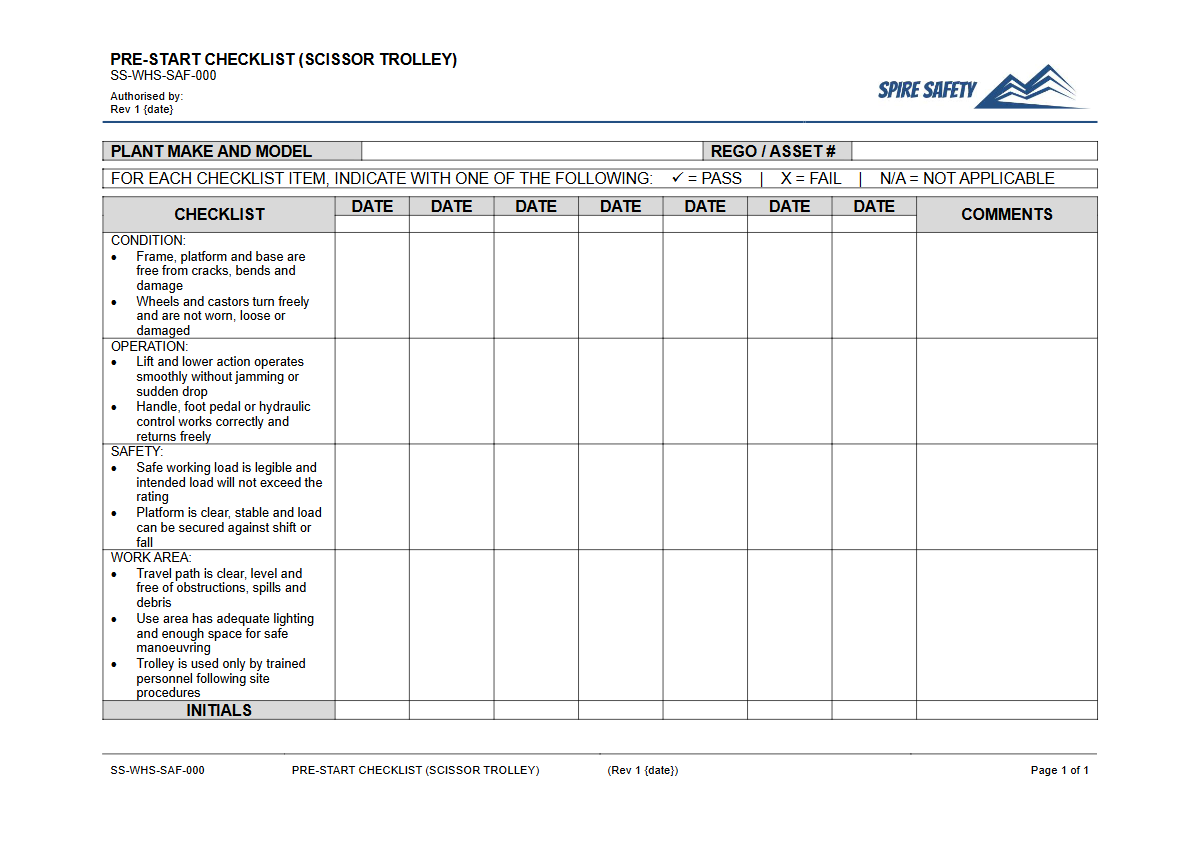
Operators should be trained to complete the checklist at the start of their shift or before the first use of the scissor trolley each day. The form guides the user through inspecting critical components such as wheels, the hydraulic system, lifting mechanism, frame, and safety features.
Completed checklists should be filed as a record of inspection and maintenance activities.
Important: This template is a starting point. Every workplace is different, and so is every piece of equipment.
We strongly advise that you customise this checklist to reflect the specific make, model, and operational context of the scissor trolleys used at your site. You should add, remove, or modify checklist items to align with the manufacturer’s instructions and your own risk assessment. To help train your team on the importance of these checks, you can use our Pre-Start Checks and Plant Maintenance Toolbox Talk Template.
When to use it
A pre-start checklist for a scissor trolley should be completed before its first use on any given day or shift. This ensures the equipment is in safe working order before being subjected to operational loads.
If multiple operators use the same trolley throughout the day, the initial check by the first operator is typically sufficient, unless a handover protocol requires a new check. If an incident or suspected damage occurs during a shift, an ad-hoc inspection using the checklist should be conducted immediately. Documenting these checks creates a verifiable record, which is essential evidence of due diligence during a WHS compliance audit.
Who should use it
The pre-start checklist should be used by any worker who is tasked with operating a scissor trolley. These operators must be deemed competent, meaning they have received adequate information, training, and instruction on the trolley’s safe operation, including its specific features and limitations.
Supervisors or WHS personnel can also use the checklist to conduct periodic spot-checks or safety audits. For tasks with significant manual handling elements, such as those common in health services, our Aged Care Manual Handling Toolbox Talk Template can provide additional training guidance on correct procedures.
While a high-risk work licence is not required for a standard scissor trolley, ensuring operator competency remains a critical WHS responsibility. For related guidance on manual equipment, you may also find our FREE Hand Trolley SOP (Safe Operating Procedure) Template useful in standardising procedures.
By implementing this checklist, your organisation can significantly improve equipment safety and reduce the risk of workplace injuries. You can find many more helpful documents like this in our complete free WHS resources library to support your safety management system.
Common mistakes
Common mistakes to avoid
- Operator 'pencil-whipping' the checklist without physically inspecting the items.
- Using a generic checklist that doesn't match the specific features of the scissor trolley model.
- Failing to immediately tag out and report faulty equipment identified during the check.
- Continuing to use the trolley after identifying a minor issue, assuming it's 'not that bad'.
Legal references
Legal considerations
The following legal requirements may be relevant to this type of work.
- Work Health and Safety Act (Harmonised) — Provides the primary duties for protecting workers and other people from work health and safety risks.
- Work Health and Safety Regulations (Harmonised) — Sets out requirements supporting the management of workplace hazards and risks.
The following codes may be relevant to this type of work.
- Managing WHS Risks Code of Practice — Provides practical guidance on identifying hazards, assessing risks and applying effective controls.
- Work Health and Safety Consultation, Cooperation and Coordination Code of Practice — Provides practical guidance on consulting workers and coordinating with other duty holders.
- Managing the Work Environment and Facilities Code of Practice — Provides practical guidance on safe work environments, workplace facilities and related controls.
Did you know
Manual Handling Statistics
According to Safe Work Australia, manual handling injuries are the most common type of workplace injury in the country. Using mechanical aids like scissor trolleys correctly is a key control measure for reducing these risks.
Pascal's Principle
Hydraulic scissor trolleys work on Pascal's Principle, which states that pressure applied to a confined fluid is transmitted undiminished. This allows a small force applied via a foot pump to generate a large lifting force to raise heavy loads.
FAQ
Frequently asked questions
01Is a scissor trolley the same as a scissor lift?
02How often should a scissor trolley be inspected?
03What happens if a defect is found during a pre-start check?
04Do I need a licence to operate a scissor trolley?
Share this resource
Free Pre-Start Checklist (Scissor Trolley) Template
Browse Categories
How To Use It
- 1Download and open in Word or PDF.
- 2Replace the placeholders with your business details.
- 3Get it reviewed by a WHS specialist before rollout.
Need it customised?
Our WHS consultants can adapt this template to your site, run a gap analysis, or audit what you already have in place.
Book a Free Consultation WHS consulting servicesor call 1300 156 382