
Free Pre-Start Checklist (Screen Plant) Template
Download our free Pre-Start Checklist (Screen Plant) Template to formalise daily equipment checks and manage WHS risks. Get your DOCX and PDF now.
Free Pre-Start Checklist (Screen Plant) Template
DOCX • 125 KB + PDF
Updated Oct 2026
No signup required
Purpose of the Free Pre-Start Checklist (Screen Plant) Template
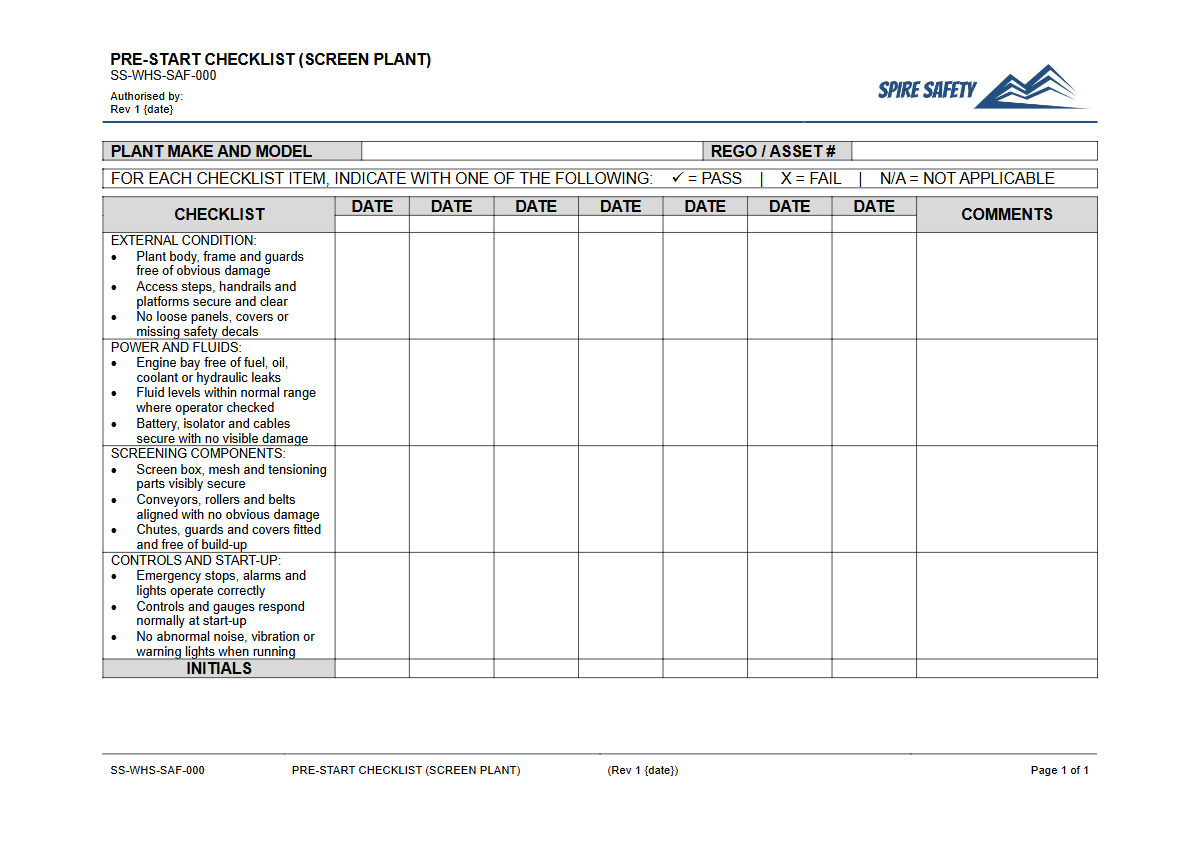
Operating heavy machinery like a screen plant carries inherent risks. This free Pre-Start Checklist (Screen Plant) Template provides a structured framework for operators to conduct thorough, documented safety inspections before starting work.
By systematically checking critical components, operators can identify and report potential faults, defects, or damage that could lead to an incident. Integrating this checklist into your daily procedures helps manage risks associated with moving parts, structural integrity, and hydraulic systems, forming a crucial component of your site's safety protocols. A documented pre-start process provides evidence of due diligence and contributes to the development of effective WHS management systems.
Video walkthrough
How to use the Free Pre-Start Checklist (Screen Plant) Template
This template is provided as a starting point. It is not a complete, out-of-the-box solution for your specific needs.
You must download the DOCX file and customise it to reflect the make, model, and configuration of the screen plant(s) used in your workplace. Add or remove checklist items to address the unique hazards of your equipment and operating environment, whether in a quarry, mine, or recycling facility.
Consult the manufacturer's operating manual and conduct a site-specific risk assessment to ensure all relevant inspection points are covered. For example, the checks required for a large stationary plant will differ from those for a mobile tracked screener. Similar principles apply when adapting other checklists, such as our Pre-Start Checklist for Granulators.
Customisation is essential
To be effective, this document must be customised to your workplace. We are not familiar with your operational context, the specific plant you use, or your internal procedures.
Therefore, you must adapt this template by adding, removing, or modifying sections to align it with your specific WHS risks and legal obligations. This ensures the final document is a practical tool for your operators and not just a generic form.
When to use it
A pre-start check should be completed by the operator at the beginning of every shift or before the screen plant is used for the first time each day. It should be an integral part of the daily startup procedure.
The checklist should also be used after any significant maintenance event, repair, or when the plant has been relocated to ensure it is safe to return to service. Regular completion and review of these checklists can provide valuable data for maintenance planning and are often a key point of review during a WHS compliance audit.
Who should use it
This Pre-Start Checklist should be used by personnel who are trained, competent, and authorised to operate the specific screen plant. The operator performing the check is responsible for physically inspecting each item and accurately recording their findings.
Supervisors or site managers also have a role in reviewing the completed checklists to ensure checks are being performed correctly, identify recurring faults, and action any required maintenance or repairs in a timely manner. If you are unsure about establishing competency frameworks, you can seek advice from a WHS consultant to ensure your processes are robust.
You can find other useful documents for different equipment types, like a free Pre-Start Checklist (Bench Grinder) Template, in our library.
By implementing a consistent pre-start inspection process, your organisation demonstrates a proactive commitment to machinery safety and risk management. For more tools to support your safety framework, explore our complete free WHS resources library.
Common mistakes
Common mistakes to avoid
- Using a generic checklist that hasn't been customised for the specific make and model of the screen plant.
- 'Pencil-whipping' the form without physically inspecting each item on the checklist.
- Failing to immediately tag out unsafe equipment and report identified faults to a supervisor.
- Poor record-keeping, where completed checklists are not filed or reviewed for trends.
Legal references
Legal considerations
The following legal requirements may be relevant to this type of work.
- Work Health and Safety Act (Harmonised) — Provides the primary duties for protecting workers and other people from work health and safety risks.
- Work Health and Safety Regulations (Harmonised) — Sets out requirements supporting the management of workplace hazards and risks.
The following codes may be relevant to this type of work.
- Managing WHS Risks Code of Practice — Provides practical guidance on identifying hazards, assessing risks and applying effective controls.
- Work Health and Safety Consultation, Cooperation and Coordination Code of Practice — Provides practical guidance on consulting workers and coordinating with other duty holders.
- Managing the Work Environment and Facilities Code of Practice — Provides practical guidance on safe work environments, workplace facilities and related controls.
Did you know
Noise Exposure
Screening plants can generate noise levels well over 85 dB(A), the exposure standard over an 8-hour shift. Without proper controls and hearing protection, this can lead to permanent, noise-induced hearing loss for operators.
Dust Hazards
Screening soil, rock, or construction materials can release hazardous dusts like respirable crystalline silica (RCS). Inhaling silica dust can cause serious lung diseases, including silicosis, making dust suppression systems a critical control.
FAQ
Frequently asked questions
01What are the key inspection points for a screen plant pre-start?
02How often should a screen plant pre-start check be performed?
03Who is responsible for signing off on a screen plant pre-start checklist?
04What should an operator do if they find a fault during a pre-start check?
Share this resource
Free Pre-Start Checklist (Screen Plant) Template
Browse Categories
How To Use It
- 1Download and open in Word or PDF.
- 2Replace the placeholders with your business details.
- 3Get it reviewed by a WHS specialist before rollout.
Need it customised?
Our WHS consultants can adapt this template to your site, run a gap analysis, or audit what you already have in place.
Book a Free Consultation WHS consulting servicesor call 1300 156 382