
Free Pre-Start Checklist (Scroll Saw) Template
Download our free Pre-Start Checklist (Scroll Saw) Template. This structured DOCX & PDF helps formalise safety checks for your workshop equipment. Start today.
Free Pre-Start Checklist (Scroll Saw) Template
DOCX • 125 KB + PDF
Updated Oct 2026
No signup required
Purpose of the Free Pre-Start Checklist (Scroll Saw) Template
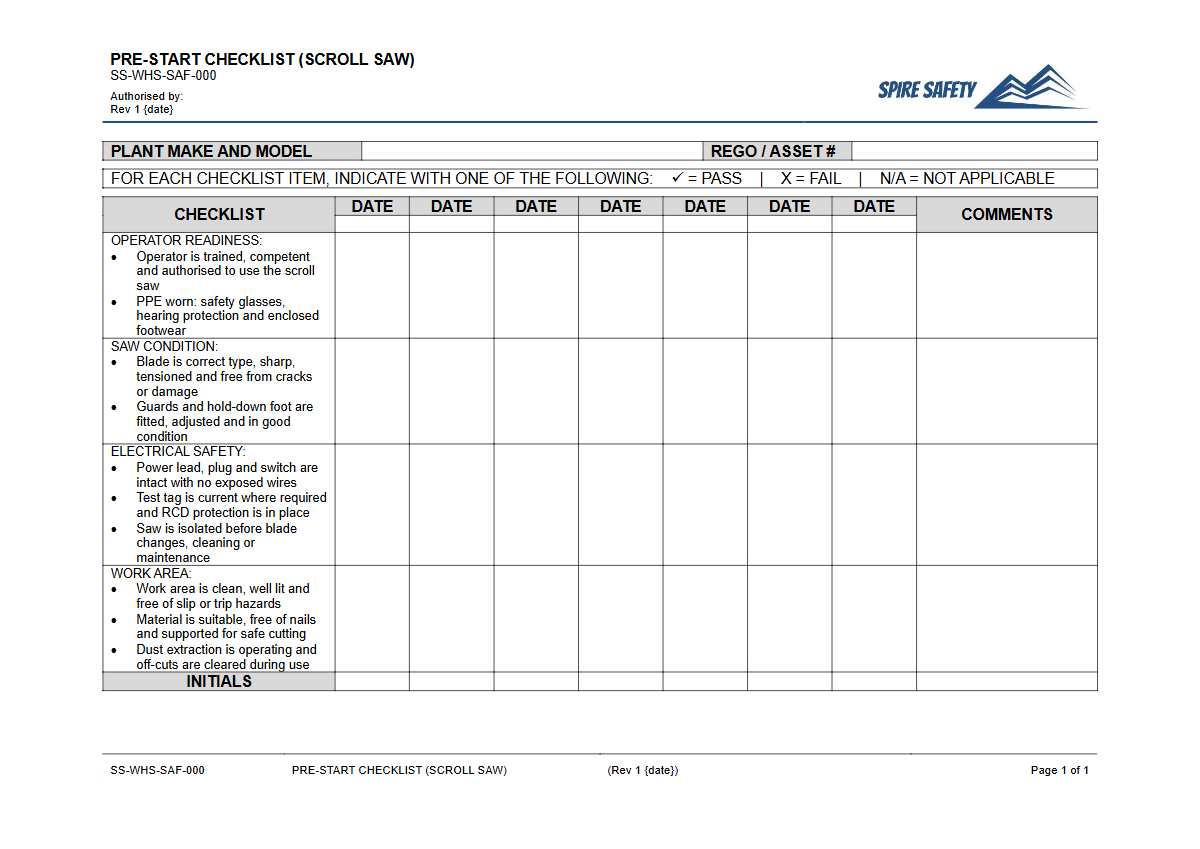
Regularly inspecting equipment is a fundamental aspect of workplace health and safety, especially for powered tools like scroll saws. This Free Pre-Start Checklist (Scroll Saw) Template provides a structured framework for conducting and recording these essential safety inspections before operation.
The primary goal is to identify potential hazards, mechanical faults, or damage that could lead to an incident. By formalising this process, you create a consistent safety habit, reduce the risk of injury to operators, and minimise equipment downtime.
It also serves as a critical record-keeping tool, demonstrating due diligence in managing risks associated with plant and machinery.
Using a standardised checklist ensures that no critical safety component is overlooked. Key checks typically include the condition of the blade and clamps, the functionality of safety guards, the integrity of the power cord, and the general stability of the machine.
Documenting these checks helps in tracking the condition of the equipment over time, identifying recurring issues, and scheduling preventative maintenance. This proactive approach is a core component of an effective safety management system.
To reinforce these principles with your team, consider using our Pre-Start Checks and Plant Maintenance Toolbox Talk to facilitate discussion and training.
Video walkthrough
How to use the Free Pre-Start Checklist (Scroll Saw) Template
This template is designed for ease of use. Simply download the DOCX or PDF file and integrate it into your daily operational procedures.
The DOCX version is fully editable, allowing you to add your company branding and tailor the checklist items to your specific equipment and workplace requirements. Once customised, print copies to be kept with the equipment or use a digital version on a tablet for a paperless workflow.
Operators should be trained to complete the checklist at the beginning of each shift or before using the scroll saw for the first time each day. They should physically inspect each item listed, tick it off, and note any defects or concerns.
If a fault is identified, the equipment should be taken out of service, tagged accordingly, and the issue reported to a supervisor for repair. Completed checklists should be signed, dated, and filed as part of your organisation's safety records.
Integrating this process into your broader WHS management systems ensures it is supported by clear procedures for reporting, repair, and record-keeping.
Important: This document is a template and is not a substitute for a comprehensive risk assessment. It must be customised by a competent person to suit the specific make, model, and configuration of your scroll saw, the tasks it is used for, and the unique conditions of your work environment.
We assume no liability for any incidents that may occur from the use of this template.
When to use it
A scroll saw pre-start checklist should be completed before the equipment is used for the first time on any given day or at the start of each new work shift. This frequency ensures that the saw's condition is verified before any work commences, catching any faults that may have developed overnight or during a previous shift.
It should also be used after any maintenance or repair work has been performed to verify that the equipment is safe to return to service. This routine is a key part of daily safety briefings, which can be formalised using a Pre-Start Meeting Template to ensure all hazards are communicated effectively.
Who should use it
The primary users of this checklist are the scroll saw operators themselves. As the people most familiar with the equipment's day-to-day performance, they are in the best position to notice subtle changes or developing faults.
Supervisors and managers should also be familiar with the checklist to ensure it is being completed correctly and to follow up on any reported defects. Maintenance personnel may also use the checklist as a reference when diagnosing faults or as a final sign-off document after conducting repairs.
Ensuring operators are competent is crucial, and you can formalise this assessment with resources like our Verification of Competency (Pipe Threader) Template for other workshop equipment.
This checklist is relevant for a wide range of industries and settings, including woodworking shops, manufacturing facilities, school design and technology departments, and hobbyist workshops. Implementing pre-start checks is a universal good practice wherever powered plant is used.
For similar equipment in a modern workshop, such as a 3D printer, a specific checklist like our Pre-Start Checklist for 3D Printers should be used. For complex safety challenges or system implementation, seeking expert advice through general WHS consulting can provide tailored solutions for your business.
Common mistakes
Common mistakes to avoid
- Using a generic checklist that hasn't been customised for the specific make and model of the scroll saw.
- Operators completing the checklist as a 'tick-and-flick' exercise without physically inspecting each item.
- Failing to immediately tag and remove faulty equipment from service, creating risk for the next operator.
- Poor record-keeping, such as not filing completed checklists or failing to follow up on corrective actions.
Legal references
Legal considerations
The following legal requirements may be relevant to this type of work.
- Work Health and Safety Act (Harmonised) — Provides the primary duties for protecting workers and other people from work health and safety risks.
- Work Health and Safety Regulations (Harmonised) — Sets out requirements supporting the management of workplace hazards and risks.
The following codes may be relevant to this type of work.
- Managing WHS Risks Code of Practice — Provides practical guidance on identifying hazards, assessing risks and applying effective controls.
- Work Health and Safety Consultation, Cooperation and Coordination Code of Practice — Provides practical guidance on consulting workers and coordinating with other duty holders.
- Managing the Work Environment and Facilities Code of Practice — Provides practical guidance on safe work environments, workplace facilities and related controls.
Did you know
Tension is Key
One of the most critical and unique checks for a scroll saw is blade tension. An improperly tensioned blade—either too loose or too tight—is a primary cause of blade breakage, which can send fragments flying.
Workshop Hazards
According to Safe Work Australia, machinery and fixed plant are consistently one of the leading causes of workplace fatalities and serious injuries, underscoring the importance of rigorous pre-start inspection routines.
FAQ
Frequently asked questions
01Why is a scroll saw pre-start check important?
02What are the key items to inspect on a scroll saw before use?
03How often should I complete a scroll saw pre-start checklist?
04Can I use this template for my band saw or other cutting tools?
Share this resource
Free Pre-Start Checklist (Scroll Saw) Template
Browse Categories
How To Use It
- 1Download and open in Word or PDF.
- 2Replace the placeholders with your business details.
- 3Get it reviewed by a WHS specialist before rollout.
Need it customised?
Our WHS consultants can adapt this template to your site, run a gap analysis, or audit what you already have in place.
Book a Free Consultation WHS consulting servicesor call 1300 156 382