
Free Pre-Start Checklist (Semi Trailer) Template
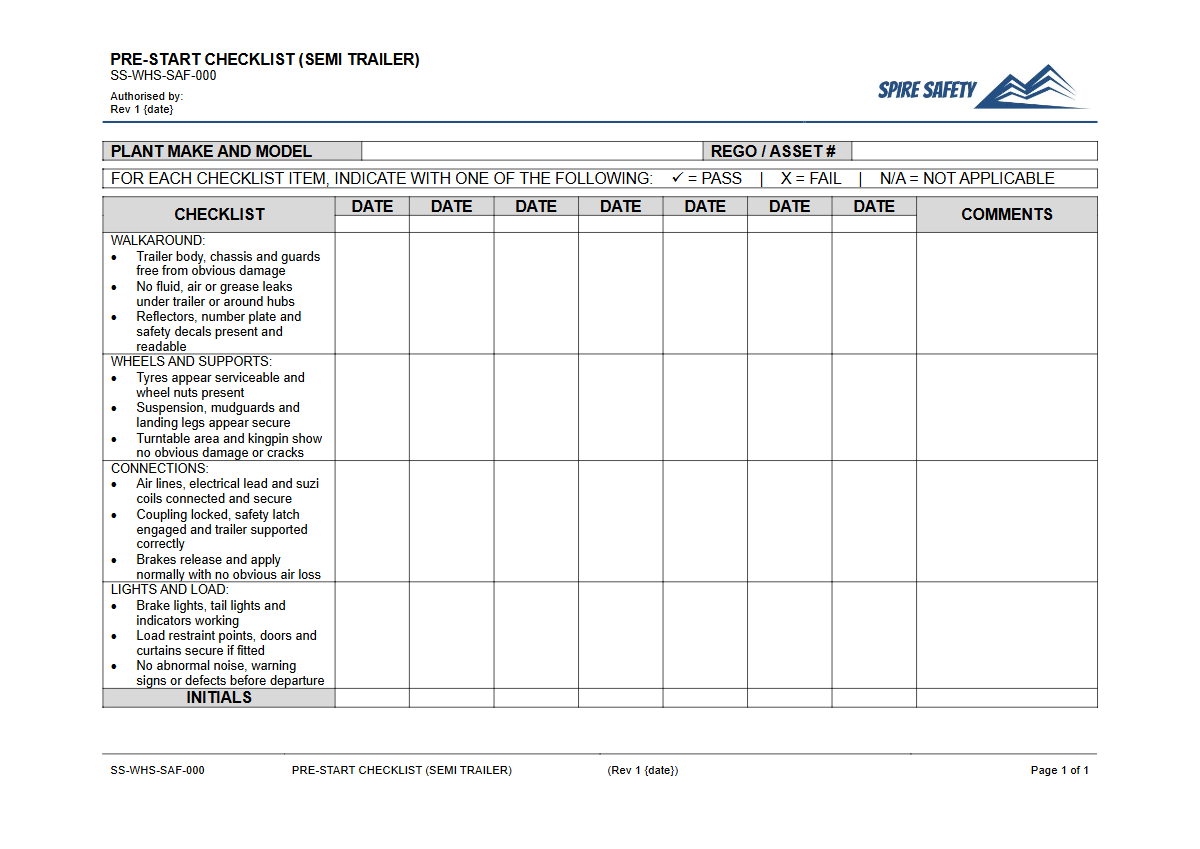
Download our free Pre-Start Checklist (Semi Trailer) Template (DOCX & PDF). This structured checklist helps formalise daily vehicle inspections. Get started.
Free Pre-Start Checklist (Semi Trailer) Template
DOCX • 125 KB + PDF
Updated Oct 2026
No signup required
Purpose of the Free Pre-Start Checklist (Semi Trailer) Template
A semi-trailer pre-start inspection is a crucial daily routine that confirms a heavy vehicle is safe for operation before it leaves the yard. Using a structured checklist ensures that key components are systematically checked for wear, damage, or malfunction.
This Free Pre-Start Checklist (Semi Trailer) Template provides a documented framework to guide drivers through this process, helping to identify potential faults before they can lead to on-road incidents, costly breakdowns, or regulatory breaches.
Implementing a formal checklist moves your organisation beyond ad-hoc visual scans, creating a consistent and recordable safety practice. These records are vital for demonstrating due diligence, tracking vehicle condition over time, and scheduling proactive maintenance. For other heavy vehicles, a similar structured approach is beneficial, as shown in our pre-start checklist for dump trailers.
Ultimately, this process is a fundamental part of risk management. Under Australian WHS law, a Person Conducting a Business or Undertaking (PCBU) has a primary duty of care to provide and maintain safe plant and equipment.
A documented pre-start check is a practical way to help meet this obligation, forming a key part of your overall safety management strategy.
Video walkthrough
How to use the Free Pre-Start Checklist (Semi Trailer) Template
This template is designed to be a straightforward starting point for your organisation. The process involves downloading the DOCX or PDF file, adapting it to your specific vehicles and operational needs, training your drivers on its use, and integrating it into your daily procedures.
Completed checklists should be submitted to a supervisor or fleet manager for review, with any identified faults logged for corrective action.
It is essential to customise this document for your workplace. This template is a guide and must be adapted to suit the specific make, model, and configuration of your semi-trailers, including any specialised equipment like refrigeration units or tail lifts.
We recommend consulting with operators and maintenance personnel to ensure all relevant checks are included and reflect your site-specific risks.
Completed pre-start checklists become important operational records. They provide evidence of your safety procedures and can be invaluable during an incident investigation or audit.
Maintaining these records is a core component of effective WHS management systems, demonstrating a commitment to proactive risk control.
Key Inspection Areas for a Semi-Trailer
- Brakes and Air System: Check air pressure, listen for leaks, inspect brake lines, and test service and parking brakes.
- Coupling: Inspect the fifth wheel (turntable) for damage, security, and proper lubrication. Check that the kingpin is locked securely.
- Tyres and Wheels: Check for correct inflation, adequate tread depth, and any signs of damage like cuts or bulges. Ensure all wheel nuts are tight.
- Lights and Electrical: Test all lights, including headlights, indicators, brake lights, and clearance lights. Check reflectors and wiring.
- Body and Chassis: Look for cracks, damage, or corrosion on the trailer chassis, body, and suspension components. Ensure guards and landing legs are secure.
- Safety Equipment: Verify the presence and serviceability of the fire extinguisher, emergency triangles, and first aid kit.
When to use it
The pre-start checklist should be completed before the semi-trailer is used for the first time each day or at the beginning of each new shift. This ensures that the vehicle's condition is verified before it enters public roadways or a work site.
Additional checks are also recommended whenever there is a change of driver during a shift, after significant maintenance has been performed, or following any event that may have affected the vehicle's roadworthiness. Consistency in this process is something that is often verified during regular WHS compliance auditing.
Who should use it
The primary user of this checklist is the licensed and competent driver or operator of the semi-trailer. They have the hands-on responsibility to conduct the physical inspection and accurately record their findings. Their training should cover not just how to drive the vehicle, but also how to properly inspect it, similar to the operational requirements for other complex machinery like those covered in a pre-start checklist for a forwarder.
Supervisors, fleet managers, and safety officers also use the completed checklists. They are responsible for reviewing the records, ensuring compliance with the procedure, identifying recurring faults, and actioning necessary repairs.
Maintenance personnel rely on the detailed information from these checks to diagnose and rectify defects efficiently.
Management plays a crucial role by establishing the pre-start inspection policy and providing the necessary resources, time, and training for it to be effective. For organisations looking to formalise or improve these frameworks, leveraging specialist WHS consulting services can provide expert guidance and support.
By ensuring every team member understands their role, the pre-start check becomes a powerful tool for maintaining a safe and reliable fleet. You can find more templates and tools like this in our free WHS resources library.
Common mistakes
Common mistakes to avoid
- "Pencil-whipping" the form without physically performing the checks.
- Using a generic car checklist that misses semi-trailer specific items like the turntable, air lines, and suzi coils.
- Failing to report minor defects (e.g., a cracked mirror), which can escalate or lead to fines.
- Not providing drivers with adequate training on what to look for during each check.
Legal references
Legal considerations
The following legal requirements may be relevant to this type of work.
- Work Health and Safety Act (Harmonised) — Provides the primary duties for protecting workers and other people from work health and safety risks.
- Work Health and Safety Regulations (Harmonised) — Sets out requirements supporting the management of workplace hazards and risks.
The following codes may be relevant to this type of work.
- Managing WHS Risks Code of Practice — Provides practical guidance on identifying hazards, assessing risks and applying effective controls.
- Work Health and Safety Consultation, Cooperation and Coordination Code of Practice — Provides practical guidance on consulting workers and coordinating with other duty holders.
- Managing the Work Environment and Facilities Code of Practice — Provides practical guidance on safe work environments, workplace facilities and related controls.
Did you know
Chain of Responsibility
Under Chain of Responsibility (CoR) laws, everyone in the supply chain, not just the driver, can be held responsible for a vehicle's safety. A robust pre-start check system helps every party meet their legal obligations.
Tyre Pressure and Fuel
Maintaining correct tyre pressure, verified during a pre-start, can improve fuel efficiency by up to 3%. For a large fleet, this represents a significant cost saving and reduction in environmental impact.
FAQ
Frequently asked questions
01What is a semi-trailer pre-start checklist?
02Is a daily pre-start check legally required in Australia?
03What happens if a defect is found during a pre-start check?
04How long should we keep completed pre-start checklists?
Share this resource
Free Pre-Start Checklist (Semi Trailer) Template
Browse Categories
How To Use It
- 1Download and open in Word or PDF.
- 2Replace the placeholders with your business details.
- 3Get it reviewed by a WHS specialist before rollout.
Need it customised?
Our WHS consultants can adapt this template to your site, run a gap analysis, or audit what you already have in place.
Book a Free Consultation WHS consulting servicesor call 1300 156 382