
Free Pre-Start Checklist (Service Truck) Template
Download our free Pre-Start Checklist (Service Truck) Template to formalise daily equipment inspections and manage WHS risks. Get your DOCX and PDF now.
Free Pre-Start Checklist (Service Truck) Template
DOCX • 125 KB + PDF
Updated Oct 2026
No signup required
Purpose of the Free Pre-Start Checklist (Service Truck) Template
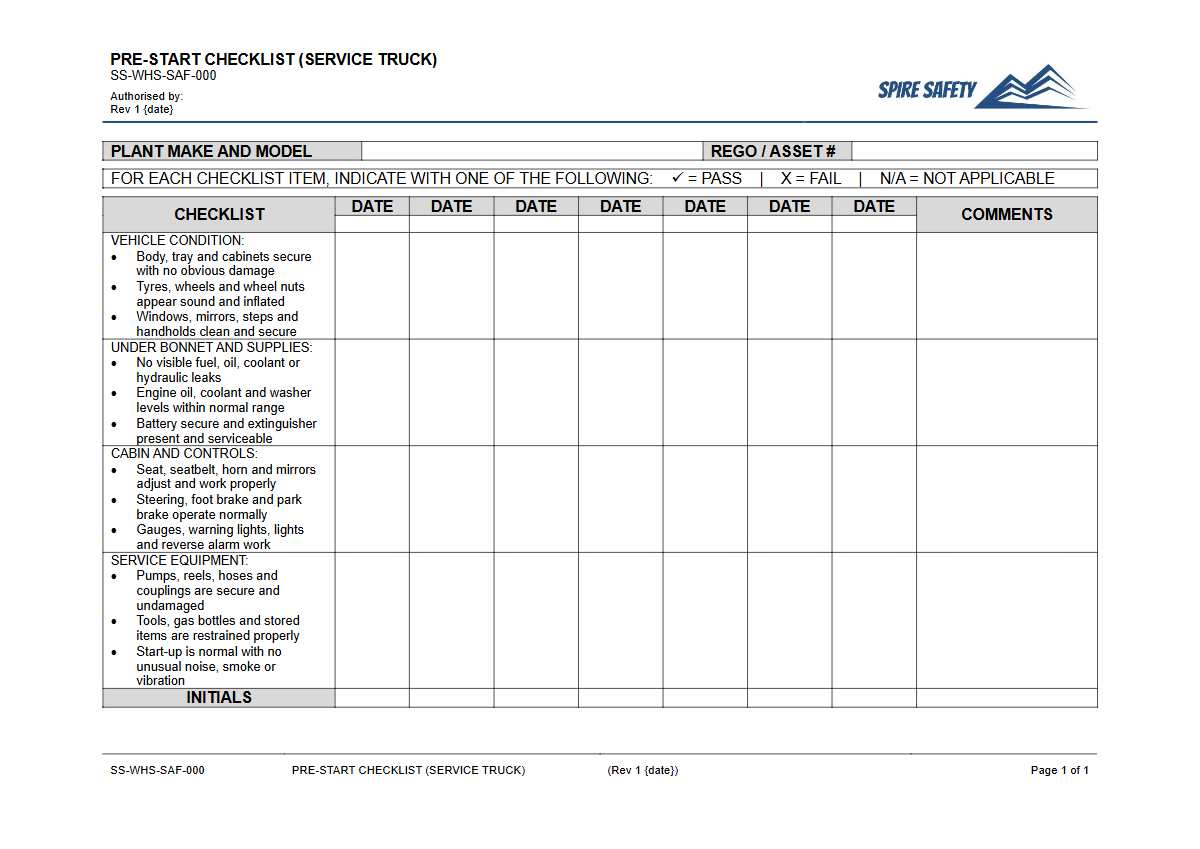
A service truck is a complex piece of mobile plant, often equipped with auxiliary equipment like cranes, welders, and air compressors. Our free Pre-Start Checklist (Service Truck) Template provides a structured framework for operators to conduct thorough daily inspections before use.
The primary purpose is to systematically identify any faults, damage, or wear and tear that could compromise the safety of the operator or others. Using a formal checklist helps prevent incidents caused by equipment failure, demonstrates due diligence in managing WHS risks, and creates a documented record of the vehicle's condition over time.
This checklist template is designed as a comprehensive starting point, aligned with Australian WHS principles for managing plant safety. It prompts checks on the base vehicle, critical safety systems, and common ancillary equipment.
The process encourages a proactive approach to maintenance, helping to identify minor issues before they escalate into major failures or costly repairs. Similar structured checks are vital for all workplace equipment, including items that may be carried on the truck, which might require their own specific inspection like a Pre-Start Checklist for a Bench Grinder.
Video walkthrough
How to use the Free Pre-Start Checklist (Service Truck) Template
This resource is available for download in both DOCX and PDF formats. The DOCX version is fully editable, allowing you to tailor the checklist to the specific make, model, and configuration of the service trucks in your fleet.
IMPORTANT: This template is a starting point. It must be customised to your specific service truck model, its configuration, the attached equipment (e.g., vehicle loading cranes, air compressors), and your operational risks.
We recommend a consultation process with operators and maintenance staff to ensure the checklist is comprehensive and practical for your workplace. Once customised, the checklist should be integrated into your daily operational procedures.
Operators should complete the checklist at the beginning of each shift, carefully inspecting each item and noting its condition. Any identified faults or defects must be immediately reported to a supervisor according to your organisation's fault-reporting procedure.
The faulty vehicle must be taken out of service, isolated, and tagged to prevent inadvertent use until it is inspected and cleared for use by a competent person. These daily checks should form a critical part of your broader WHS management system, providing valuable data on equipment condition.
Key Areas Covered in the Checklist
A thorough service truck pre-start inspection covers more than just the basics of a standard vehicle. Our template prompts checks across several key areas to ensure comprehensive coverage:
- Vehicle Fundamentals: Tyres (pressure and condition), wheels and nuts, brakes (including parking brake), steering, fluid levels (oil, coolant, hydraulic), lights, indicators, and horn.
- Safety Equipment: Presence and condition of the fire extinguisher, first aid kit, spill kit, wheel chocks, and reversing beeper/camera.
- Onboard Systems: Checks for auxiliary equipment such as vehicle loading cranes, welders, air compressors, and hydraulic systems, including checks for leaks, damage, and correct function of controls and safety features.
- Load Security: Inspection of trays, toolboxes, gates, tie-down points, and any load restraint equipment to ensure they are secure and free from damage.
- Cabin & Controls: Function of all cabin controls, seat and seatbelt condition, and cleanliness of windows and mirrors for clear visibility.
The principles of thorough vehicle inspection are universal, whether you're checking a service truck or using a free Pre-Start Checklist for Forwarders in a forestry operation. The key is adapting the checks to the specific machinery and its associated risks.
When to Conduct a Pre-Start Check
Consistency is key to the effectiveness of any pre-start inspection regime. The check should be performed:
- At the beginning of every work shift, before the vehicle is first used.
- When there is a change of operator during a shift.
- Before using a vehicle that has been idle for an extended period or has just returned from off-site servicing.
Completed checklists are key documents reviewed during internal and external WHS compliance audits to verify that safety procedures are being followed and that the organisation is actively managing its plant-related risks.
Who Should Use It
The primary responsibility for completing the pre-start checklist lies with the authorised and competent operator of the service truck. They are in the best position to assess the vehicle's condition before they operate it. However, other roles are also involved in the process:
- Supervisors and Managers: They are responsible for ensuring operators are trained and competent to perform the checks, reviewing completed checklists, and actioning any reported faults in a timely manner.
- Maintenance Personnel: They use the information from reported defects to schedule inspections, diagnosis, and repairs.
This clear allocation of responsibility is a core tenet of WHS management for all mobile plant, applying equally to equipment requiring a Pre-Start Checklist for a Bin Lifter as it does to a large service truck. For more tools to enhance your safety systems, browse our complete free WHS resources library.
Common mistakes
Common mistakes to avoid
- "Pencil-whipping" the form without physically inspecting the items.
- Failing to immediately report identified faults and tag out unsafe equipment.
- Using a generic checklist that hasn't been customised for the specific truck model and its attachments.
- Ignoring minor issues like small fluid leaks, which can indicate a more serious developing fault.
Legal references
Legal considerations
The following legal requirements may be relevant to this type of work.
- Work Health and Safety Act (Harmonised) — Provides the primary duties for protecting workers and other people from work health and safety risks.
- Work Health and Safety Regulations (Harmonised) — Sets out requirements supporting the management of workplace hazards and risks.
The following codes may be relevant to this type of work.
- Managing WHS Risks Code of Practice — Provides practical guidance on identifying hazards, assessing risks and applying effective controls.
- Work Health and Safety Consultation, Cooperation and Coordination Code of Practice — Provides practical guidance on consulting workers and coordinating with other duty holders.
- Managing the Work Environment and Facilities Code of Practice — Provides practical guidance on safe work environments, workplace facilities and related controls.
Did you know
Vehicle Incidents
According to Safe Work Australia, vehicle incidents are a leading cause of workplace fatalities in Australia. Thorough pre-start checks are a critical control measure to mitigate the risks associated with vehicle use.
FAQ
Frequently asked questions
01Why is a service truck pre-start check important?
02What should be included in a service truck pre-start checklist?
03How often should a service truck pre-start be completed?
04Who is responsible for completing the service truck pre-start checklist?
Share this resource
Free Pre-Start Checklist (Service Truck) Template
Browse Categories
How To Use It
- 1Download and open in Word or PDF.
- 2Replace the placeholders with your business details.
- 3Get it reviewed by a WHS specialist before rollout.
Need it customised?
Our WHS consultants can adapt this template to your site, run a gap analysis, or audit what you already have in place.
Book a Free Consultation WHS consulting servicesor call 1300 156 382