
Free Pre-Start Checklist (Sheep Race) Template
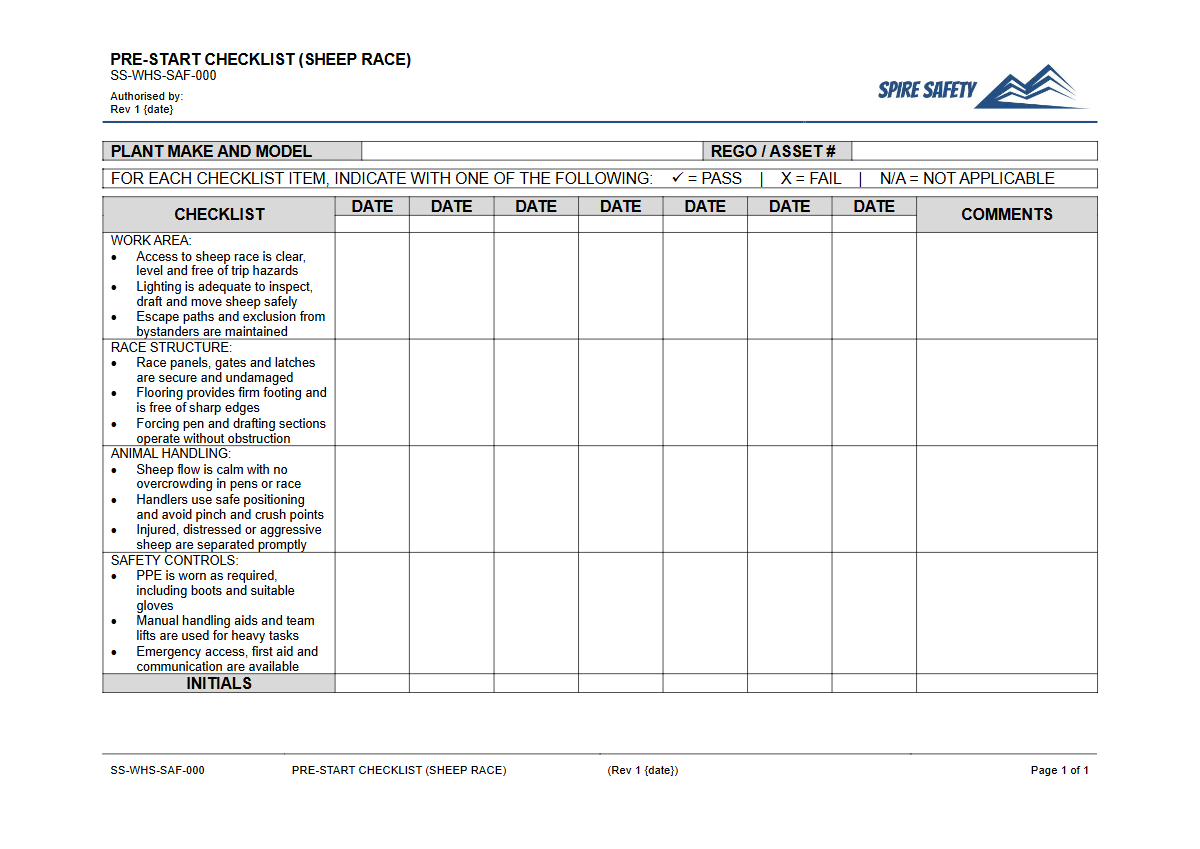
Download our free Pre-Start Checklist (Sheep Race) Template to formalise equipment inspections and manage WHS risks in agricultural settings.
Free Pre-Start Checklist (Sheep Race) Template
DOCX • 125 KB + PDF
Updated Oct 2026
No signup required
Purpose of the Free Pre-Start Checklist (Sheep Race) Template
Regular safety checks are essential for any piece of agricultural plant, and a sheep race is no exception. Our Free Pre-Start Checklist (Sheep Race) Template provides a structured framework for operators to conduct thorough inspections before use.
Using a sheep race involves significant risks, including crushing from gates, entanglement in mechanisms, and unpredictable animal behaviour. A systematic pre-start check helps identify and control these hazards, protecting both workers and livestock from harm and ensuring the equipment operates as intended.
The primary purpose of this Pre-Start Checklist is to formalise the process of inspecting the equipment for damage, wear, and operational faults. Implementing this checklist helps your agricultural business to:
- Identify and report defects before they cause an incident or equipment failure.
- Ensure all safety features, such as locking pins, latches, and anti-backing gates, are functional.
- Create a documented record of due diligence in managing plant-related risks.
- Promote a safety-conscious culture where operators take ownership of equipment condition.
It formalises a key component of your maintenance program, a topic covered in our Pre-Start Checks and Plant Maintenance Toolbox Talk.
Video walkthrough
How to use the Free Pre-Start Checklist (Sheep Race) Template
This template is available in both DOCX for easy customisation and PDF for straightforward printing and use. Download the file and integrate it into your daily operational procedures.
To get the most value from this resource, you must adapt it to your specific circumstances.
IMPORTANT: This template is a starting point. We strongly recommend you customise it to reflect the specific make and model of your sheep race, your unique operational procedures, and the hazards present in your work environment.
A generic checklist may not cover critical components of your particular equipment or location-specific risks like uneven ground.
Review the checklist items, adding or removing checks as needed to create a practical tool that forms part of a comprehensive WHS management system. Once customised, train all operators on how to complete the checklist and the procedure for reporting any identified faults.
When to use it
A pre-start check should be completed by the operator before the sheep race is used for the first time each day or at the beginning of each shift involving its use. This routine ensures that the equipment's condition has not changed unexpectedly and that it remains safe for the day's tasks.
If multiple operators use the equipment throughout the day, a handover process should confirm that checks have been done and any reported issues have been communicated. These checks can be discussed as part of your daily pre-start safety meetings to ensure all team members are aware of equipment status.
Who should use it
The pre-start checklist should be completed by a person who is trained, competent, and authorised to operate the sheep race. This individual must understand the equipment's functions, its potential hazards, and what constitutes a defect or unsafe condition.
They are responsible for not only ticking the boxes but physically and visually inspecting each component. It is not an administrative task; it is a critical safety function.
If an organisation identifies gaps in its processes during this stage, engaging external specialists for WHS consulting can provide expert guidance on risk assessment and procedure development.
Completed checklists should be reviewed by a supervisor or farm manager, who is responsible for ensuring that any reported defects are addressed promptly and that unsafe equipment is taken out of service until it is repaired. Ensuring your internal processes are robust can be verified through periodic WHS compliance audits.
Common mistakes
Common mistakes to avoid
- Failing to customise the generic template to the specific make and model of the sheep race.
- 'Pencil-whipping' the checklist without physically inspecting each item.
- Not training operators on what to look for or the procedure for reporting faults.
- Ignoring reported defects and continuing to use faulty or damaged equipment.
Legal references
Legal considerations
The following legal requirements may be relevant to this type of work.
- Work Health and Safety Act (Harmonised) — Provides the primary duties for protecting workers and other people from work health and safety risks.
- Work Health and Safety Regulations (Harmonised) — Sets out requirements supporting the management of workplace hazards and risks.
The following codes may be relevant to this type of work.
- Managing WHS Risks Code of Practice — Provides practical guidance on identifying hazards, assessing risks and applying effective controls.
- Work Health and Safety Consultation, Cooperation and Coordination Code of Practice — Provides practical guidance on consulting workers and coordinating with other duty holders.
- Managing the Work Environment and Facilities Code of Practice — Provides practical guidance on safe work environments, workplace facilities and related controls.
Did you know
Livestock Handling Risks
Agriculture is one of Australia's most high-risk industries. According to Safe Work Australia, interactions with livestock are a leading cause of serious injuries and fatalities on farms, highlighting the need for safe equipment and procedures.
Race Design Matters
The design of a sheep race, including its width, wall height, and flow, can significantly impact animal welfare. A well-designed race encourages natural animal movement, reducing stress on the livestock and minimising the physical effort and risk for handlers.
FAQ
Frequently asked questions
01What are the key hazards of a sheep race?
02How often should a sheep race pre-start check be done?
03Is this sheep race checklist a legal document?
04Can I use this template for other livestock handling equipment?
Share this resource
Free Pre-Start Checklist (Sheep Race) Template
Browse Categories
How To Use It
- 1Download and open in Word or PDF.
- 2Replace the placeholders with your business details.
- 3Get it reviewed by a WHS specialist before rollout.
Need it customised?
Our WHS consultants can adapt this template to your site, run a gap analysis, or audit what you already have in place.
Book a Free Consultation WHS consulting servicesor call 1300 156 382