
Free Pre-Start Checklist (Shotcrete Pump) Template
Formalise daily safety checks for shotcrete pumps with our free Pre-Start Checklist. This structured template in DOCX & PDF helps you manage WHS risks.
Free Pre-Start Checklist (Shotcrete Pump) Template
DOCX • 125 KB + PDF
Updated Oct 2026
No signup required
Purpose of the Free Pre-Start Checklist (Shotcrete Pump) Template
Operating a shotcrete pump involves significant risks, primarily related to high-pressure systems. A sudden blockage can cause hoses to whip violently or components to fail explosively, posing a severe impact hazard.
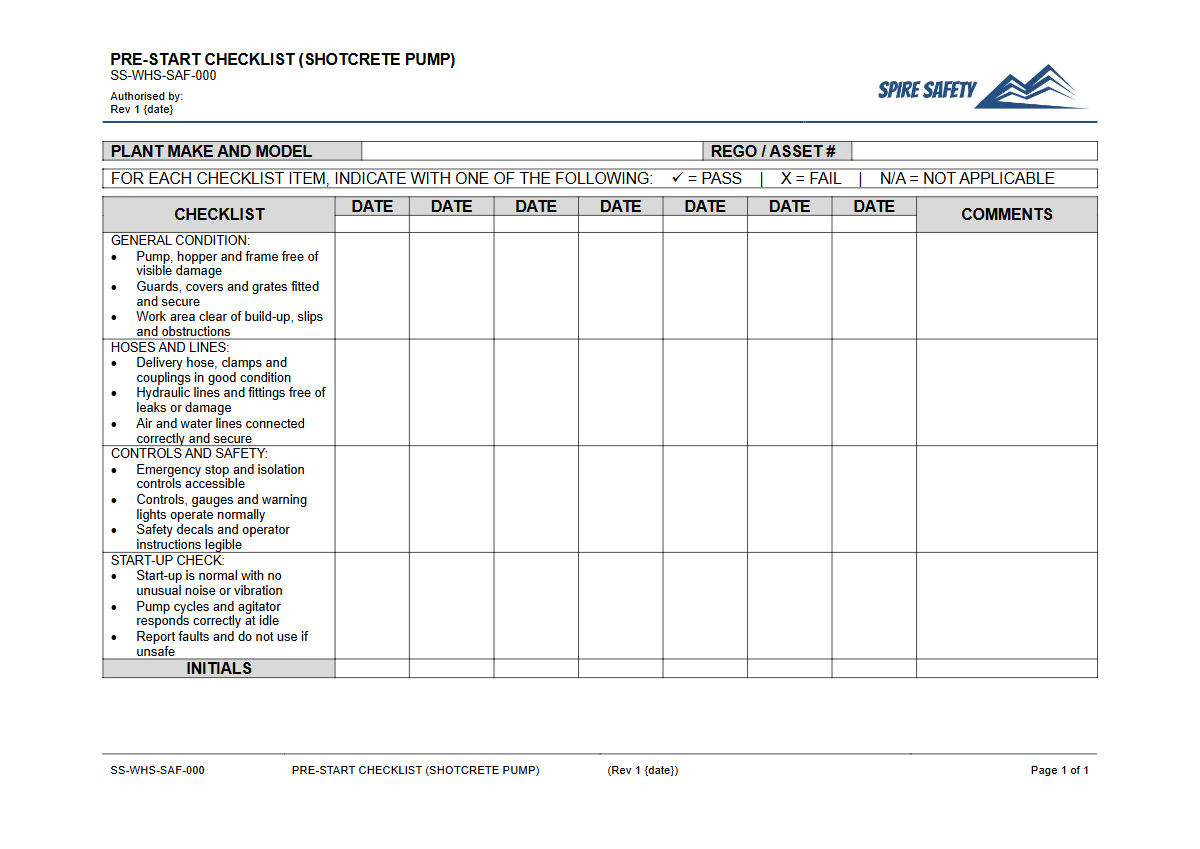
This free Pre-Start Checklist (Shotcrete Pump) Template provides a structured framework for operators to systematically inspect the equipment before each use. Regular, documented checks are a critical first step in identifying worn parts, leaks, damaged safety features, or other hazardous conditions before they lead to an incident.
By formalising this process, your organisation can proactively manage equipment-related risks and demonstrate a commitment to workplace safety. Integrating these daily checks is a practical component of robust WHS management systems, helping to create a safer environment for operators and nearby personnel.
The checklist prompts a thorough review of mechanical, hydraulic, and safety components, ensuring the pump is in a safe condition to start work.
Video walkthrough
How to use the Free Pre-Start Checklist (Shotcrete Pump) Template
This Pre-Start Checklist for a Shotcrete Pump is provided as a user-friendly template in both DOCX and PDF formats. After downloading, you can implement it immediately or, preferably, customise it to better suit your operational context.
The DOCX version is fully editable, allowing you to add, remove, or modify checklist items to align with the specific model of your shotcrete pump and the unique conditions of your worksite.
It is crucial that you adapt this template. We have based it on common industry practice and Australian WHS principles, but it is impossible for a generic document to cover every specific hazard of your plant and work environment.
Always consult the manufacturer's operating manual for your pump and incorporate any specific inspection points they recommend. If you require assistance in developing site-specific safety documentation, consider engaging professional WHS consulting services.
Key Areas Covered in the Checklist
A comprehensive pre-start inspection should cover several critical areas of the equipment:
- General Condition: Check for signs of damage, cracks in the chassis, fluid leaks (hydraulic oil, fuel, coolant), and the condition of tyres and stabilisers.
- Pressure System: This is the most critical area. Inspect all concrete delivery hoses, pipes, and couplings for wear, abrasion, or damage. Ensure all clamps are secure, correctly rated for the pressure, and fitted with safety pins. The principle of checking critical pump components also applies to other fixed systems, like inspecting a site's fire pump system.
- Hopper and Agitator: Ensure the hopper grate is in place and not damaged. Check that the agitator moves freely and that all guards are secure to prevent entanglement.
- Safety and Emergency Equipment: Verify that the emergency stop buttons are functional and accessible. Check that all safety decals are legible, and that guards for moving parts are properly secured.
- Work Area Assessment: The checklist should also prompt an inspection of the immediate work area, confirming that the ground is stable, an adequate exclusion zone is established, and there is safe access and egress.
When to use it
A pre-start checklist for a shotcrete pump should be completed by the operator at the beginning of every shift or before the first use of the day. It should also be completed after any significant break, after the equipment has undergone maintenance or repairs, or before it is used in a new location on site.
This frequency ensures that any issues that may have developed are identified at the earliest opportunity.
Who should use it
The pre-start checklist must be completed by a person who is trained, competent, and authorised to operate the specific shotcrete pump. They must have the knowledge to recognise what 'safe' looks like and understand the consequences of operating faulty equipment.
Supervisors should periodically review completed checklists to verify that inspections are being carried out diligently and to identify recurring mechanical issues that may require more significant maintenance attention.
Record Keeping and Audits
Completed checklists are important safety records. They should be retained as evidence that pre-start inspections are being consistently performed. These documents provide a valuable maintenance history and can be essential during safety investigations or formal WHS compliance auditing. Maintaining these records helps demonstrate due diligence in managing plant-related risks. Explore our entire free WHS resources library for more templates to support your safety management system.
Common mistakes
Common mistakes to avoid
- Neglecting to thoroughly check wear on hoses, pipes, and clamps, leading to failures under pressure.
- Using a generic checklist without customising it for the specific pump model and site conditions.
- Failing to properly secure and depressurise the system before attempting to clear blockages.
- "Pencil-whipping" the checklist by ticking boxes without physically inspecting each item.
Legal references
Legal considerations
The following legal requirements may be relevant to this type of work.
- Work Health and Safety Act (Harmonised) — Provides the primary duties for protecting workers and other people from work health and safety risks.
- Work Health and Safety Regulations (Harmonised) — Sets out requirements supporting the management of workplace hazards and risks.
The following codes may be relevant to this type of work.
- Managing WHS Risks Code of Practice — Provides practical guidance on identifying hazards, assessing risks and applying effective controls.
- Work Health and Safety Consultation, Cooperation and Coordination Code of Practice — Provides practical guidance on consulting workers and coordinating with other duty holders.
- Managing the Work Environment and Facilities Code of Practice — Provides practical guidance on safe work environments, workplace facilities and related controls.
Did you know
High-Pressure Hazard
A blockage in a concrete pump line can generate pressures exceeding 100 bar (1,500 psi). A sudden release can be catastrophic, ejecting materials and components with lethal force.
Wet-Mix vs. Dry-Mix
Shotcrete can be applied using a wet-mix or dry-mix process. Each method has different equipment requirements and associated hazards that should be reflected in your risk assessments.
FAQ
Frequently asked questions
01What is the primary hazard when operating a shotcrete pump?
02How often should a shotcrete pump pre-start inspection be performed?
03Who is responsible for completing the shotcrete pump checklist?
04Can I use this template for any brand of shotcrete pump?
Share this resource
Free Pre-Start Checklist (Shotcrete Pump) Template
Browse Categories
How To Use It
- 1Download and open in Word or PDF.
- 2Replace the placeholders with your business details.
- 3Get it reviewed by a WHS specialist before rollout.
Need it customised?
Our WHS consultants can adapt this template to your site, run a gap analysis, or audit what you already have in place.
Book a Free Consultation WHS consulting servicesor call 1300 156 382