
Free Pre-Start Checklist (Side Loader) Template
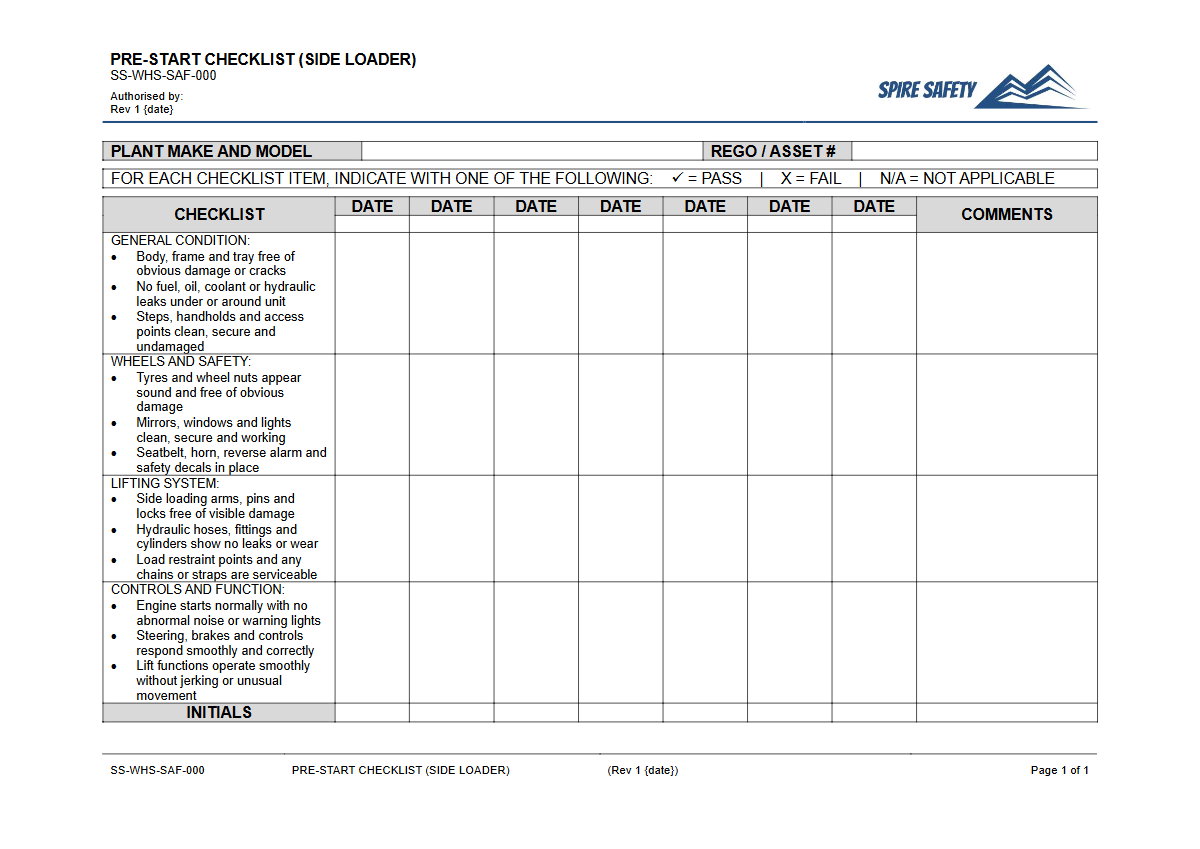
Download our free Pre-Start Checklist (Side Loader) Template. This structured DOCX & PDF resource helps formalise daily equipment checks and manage WHS risks.
Free Pre-Start Checklist (Side Loader) Template
DOCX • 125 KB + PDF
Updated Oct 2026
No signup required
Purpose of the Free Pre-Start Checklist (Side Loader) Template
The primary purpose of this Free Pre-Start Checklist (Side Loader) Template is to provide a structured framework for ensuring side loaders are safe to operate before any work commences. Side loaders, used for handling long and awkward loads, have unique risks associated with their stabilisers, mast, and lifting mechanisms.
Systematically inspecting these components helps identify potential faults, wear, or damage that could lead to incidents, equipment failure, or injuries. By formalising this process, organisations can significantly reduce operational risks and demonstrate due diligence in managing plant safety.
This checklist acts as a practical tool within your broader WHS management systems, reinforcing safe work procedures and operator accountability. Regular, documented checks are a cornerstone of proactive safety management, helping to prevent incidents before they occur.
It provides a consistent method for evaluating the condition of critical safety features, such as hydraulic systems, tyres, warning devices, and load-handling attachments. This approach supports a culture where safety is prioritised and equipment integrity is consistently verified.
Video walkthrough
How to use the Free Pre-Start Checklist (Side Loader) Template
This Free Pre-Start Checklist (Side Loader) Template is provided in both DOCX and PDF formats for maximum flexibility. The DOCX file can be easily edited to align with the specific requirements of your workplace, including adding your company branding, site-specific hazards, or checks relevant to particular side loader makes and models.
The PDF version is ready for immediate printing and use.
To implement the checklist, operators should physically walk around the side loader and methodically inspect each item listed. They should tick off each point to confirm its condition and make detailed notes of any defects, damage, or concerns in the comments section.
The process should not be a 'tick and flick' exercise; it requires careful observation and functional testing where necessary (e.g., testing lights and horns).
Please note: This document is a template and must be customised to suit the specific models of side loaders, attachments, and operating environment at your workplace. We recommend a competent person reviews and approves the final document before implementation.
When to use this Pre-Start Checklist
A side loader pre-start inspection should be conducted at the beginning of every shift or before the equipment is operated for the first time on any given day. If operator shifts change mid-day, the incoming operator should perform their own pre-start check to verify the machine's condition and take responsibility for its use.
Additional checks may also be warranted after a period of inactivity or if there is any reason to suspect the equipment may have been damaged.
Regular inspections are vital for identifying issues that may develop during operation. This consistent routine is standard practice for most mobile plant, whether you are using our Free Pre-Start Checklist (Forwarder) Template for forestry equipment or checklists for warehouse machinery.
The goal is to catch minor issues before they escalate into major safety hazards or costly breakdowns.
Who should use it
This checklist is designed to be completed by trained and competent side loader operators. The person operating the equipment is best placed to assess its immediate condition, as they will be relying on its safe function.
They have the hands-on responsibility to ensure the machinery is fit for purpose before starting their tasks.
Supervisors and managers also have a critical role. They are responsible for ensuring operators are trained to conduct the checks properly, that checklists are completed accurately, and that a clear process is in place for reporting and actioning any identified faults.
This includes procedures for tagging out and removing unsafe equipment from service until repairs can be made. Integrating this process with regular WHS compliance auditing helps verify that procedures are being followed effectively across the organisation.
For other equipment-specific checklists, from workshop tools to waste management machinery like our Free Pre-Start Checklist (Bin Lifter) Template, explore our complete free WHS resources library for more templates to support your safety programs.
Common mistakes
Common mistakes to avoid
- Failing to physically inspect the equipment and simply 'pencil-whipping' the checklist.
- Using a generic template without customising it for the specific side loader model and its attachments.
- Continuing to use the equipment after a minor fault has been identified.
- Poor record-keeping or failing to have a clear process for reporting and rectifying defects.
Legal references
Legal considerations
The following legal requirements may be relevant to this type of work.
- Work Health and Safety Act (Harmonised) — Provides the primary duties for protecting workers and other people from work health and safety risks.
- Work Health and Safety Regulations (Harmonised) — Sets out requirements supporting the management of workplace hazards and risks.
The following codes may be relevant to this type of work.
- Managing WHS Risks Code of Practice — Provides practical guidance on identifying hazards, assessing risks and applying effective controls.
- Work Health and Safety Consultation, Cooperation and Coordination Code of Practice — Provides practical guidance on consulting workers and coordinating with other duty holders.
- Managing the Work Environment and Facilities Code of Practice — Provides practical guidance on safe work environments, workplace facilities and related controls.
Did you know
Unique Design
Side loaders were specifically invented to handle long, bulky loads like timber, steel, or pipes in narrow aisles, a task that is difficult or impossible for conventional counterbalance forklifts.
Operator Risk
A significant number of workplace incidents involving mobile plant like side loaders are not caused by mechanical failure, but by factors like operator error, unstable loads, or travelling on unsuitable ground.
FAQ
Frequently asked questions
01What is the difference between a pre-start check and regular maintenance?
02What should an operator do if a fault is found during a side loader pre-start check?
03Can this checklist template be used for any brand of side loader?
04How long should completed side loader pre-start checklists be kept?
Share this resource
Free Pre-Start Checklist (Side Loader) Template
Browse Categories
How To Use It
- 1Download and open in Word or PDF.
- 2Replace the placeholders with your business details.
- 3Get it reviewed by a WHS specialist before rollout.
Need it customised?
Our WHS consultants can adapt this template to your site, run a gap analysis, or audit what you already have in place.
Book a Free Consultation WHS consulting servicesor call 1300 156 382