
Free Pre-Start Checklist (Slasher) Template
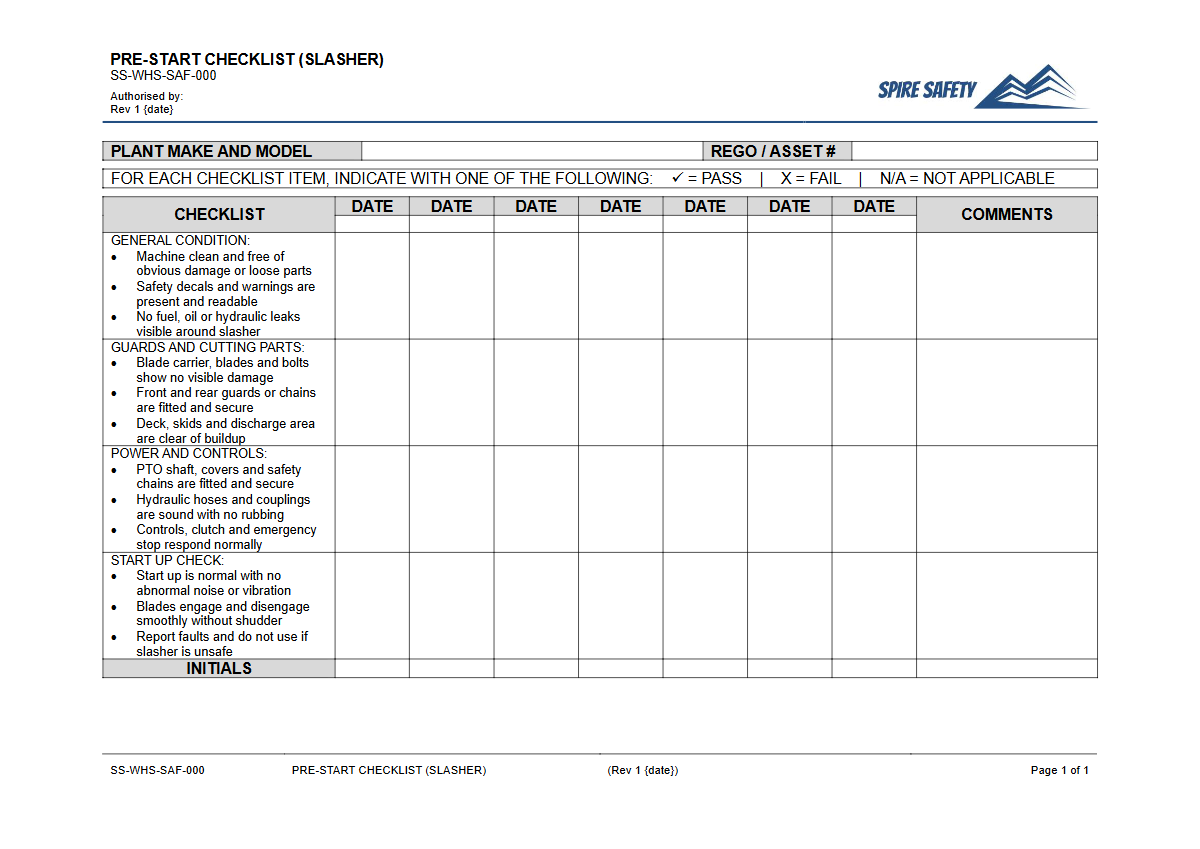
Download our Free Pre-Start Checklist (Slasher) Template to formalise equipment inspections and manage WHS risks. Get your DOCX and PDF now.
Free Pre-Start Checklist (Slasher) Template
DOCX • 125 KB + PDF
Updated Oct 2026
No signup required
Purpose of the Free Pre-Start Checklist (Slasher) Template
Operating a slasher, whether tractor-mounted or self-propelled, involves significant risks, including entanglement in the power take-off (PTO) shaft, being struck by ejected objects, and mechanical failure. This Free Pre-Start Checklist (Slasher) Template provides a structured framework for operators to systematically inspect equipment before each use.
Its primary purpose is to identify and control potential hazards before they can cause an incident, injury, or damage. By formalising this process, organisations can create a consistent safety standard, reduce operational risks, and demonstrate due diligence in maintaining safe plant and equipment. For similar ride-on equipment, consider our Free Pre-Start Checklist (Lawn Tractor) Template.
Key Inspection Areas Covered
A thorough slasher pre-start inspection should focus on several critical areas to ensure operational safety. Our template guides the user through checking:
- Guards and Shields: Verifying that all guards, especially for the PTO shaft, belts, and discharge chute, are securely in place and undamaged.
- Blades and Cutting Deck: Inspecting blades for sharpness, cracks, or damage, and ensuring the cutting deck is free from debris and structural faults.
- Hydraulics and Hoses: Checking for any leaks, cracks, or wear in hydraulic lines and connections that could lead to failure.
- Mechanical Components: Ensuring all pins, bolts, and fasteners are tight and that the gearbox has adequate oil levels.
- Tractor Connection (if applicable): Confirming the three-point linkage is secure and the PTO shaft is correctly engaged and guarded.
Video walkthrough
How to Use the Free Pre-Start Checklist (Slasher) Template
Using this template effectively involves more than just a quick download. First, download the document in your preferred format (DOCX for easy editing or PDF for straightforward printing).
Next, adapt the checklist to the specific make and model of the slashers used in your workplace, as well as the unique environmental conditions of your site. It is critical that you customise this document to reflect your specific operational risks; we cannot guarantee it covers every hazard in your unique context.
Once customised, integrate the checklist into your daily operational procedures, making it a non-negotiable step before any slasher is used. This process forms a vital component of your broader WHS management systems, creating a reliable record of safety compliance.
When to Use It
A pre-start checklist for a slasher should be completed before every use. This means at the beginning of each day or at the start of any new shift where the equipment will be operated.
The high levels of vibration, torque, and potential for impact with foreign objects mean that the condition of a slasher can change rapidly. A bolt that was tight yesterday could be loose today, or a blade could have sustained damage during the last job.
Daily checks are the most effective way to catch these developing issues before they escalate into a major failure or safety incident. For operations involving different types of heavy machinery, it's beneficial to have specific checks for each, such as the Pre-Start Checklist (Forwarder) Template for forestry machinery.
Who Should Use It
The primary user of the pre-start checklist is the equipment operator. They have the most direct interaction with the machinery and are the first line of defence against mechanical failure. The operator is responsible for physically conducting the checks and signing off that the slasher is safe to use. However, responsibility also extends to supervisors and managers, who must ensure that operators are trained on the procedure, that checks are being completed correctly, and that any reported faults are addressed promptly. These completed checklists serve as important safety records, which can be reviewed during a WHS compliance audit to verify that safety procedures are being followed. Maintenance personnel may also use the checklist to understand recurring issues or to verify repairs have been completed successfully. This principle of routine checks applies to workshop tools as well, as seen in resources like the Pre-Start Checklist (Bench Grinder) Template. Find more tools to support your safety processes by browsing our complete free WHS resources library.
Common mistakes
Common mistakes to avoid
- Operating the slasher with damaged or missing PTO guards, chain guards, or rubber flaps.
- Failing to walk the area to be slashed beforehand to identify and remove potential projectiles like rocks, wire, or rubbish.
- Skipping the pre-start check to save a few minutes, assuming the machine is in the same condition as the last use.
- Ignoring minor hydraulic fluid weeps or unusual noises, which are often early indicators of a pending major failure.
Legal references
Legal considerations
The following legal requirements may be relevant to this type of work.
- Work Health and Safety Act (Harmonised) — Provides the primary duties for protecting workers and other people from work health and safety risks.
- Work Health and Safety Regulations (Harmonised) — Sets out requirements supporting the management of workplace hazards and risks.
The following codes may be relevant to this type of work.
- Managing WHS Risks Code of Practice — Provides practical guidance on identifying hazards, assessing risks and applying effective controls.
- Work Health and Safety Consultation, Cooperation and Coordination Code of Practice — Provides practical guidance on consulting workers and coordinating with other duty holders.
- Managing the Work Environment and Facilities Code of Practice — Provides practical guidance on safe work environments, workplace facilities and related controls.
Did you know
Projectile Hazard
The tip of a slasher blade can travel at speeds over 300 km/h. At this velocity, a dislodged rock, piece of metal, or blade fragment can become a lethal projectile.
PTO Dangers
A standard Power Take-Off (PTO) shaft rotates at 540 or 1000 RPM. At 540 RPM, the shaft rotates 9 times per second, making it impossible to let go if clothing becomes entangled.
FAQ
Frequently asked questions
01What are the biggest risks when operating a slasher?
02Is a pre-start check legally required for a slasher in Australia?
03How often should slasher blades be inspected?
04What should an operator do if a fault is found during a pre-start check?
Share this resource
Free Pre-Start Checklist (Slasher) Template
Browse Categories
How To Use It
- 1Download and open in Word or PDF.
- 2Replace the placeholders with your business details.
- 3Get it reviewed by a WHS specialist before rollout.
Need it customised?
Our WHS consultants can adapt this template to your site, run a gap analysis, or audit what you already have in place.
Book a Free Consultation WHS consulting servicesor call 1300 156 382