
Free Pre-Start Checklist (Slush Machine) Template
Download our free Pre-Start Checklist (Slush Machine) Template.
Free Pre-Start Checklist (Slush Machine) Template
DOCX • 125 KB + PDF
Updated Oct 2026
No signup required
Purpose of the Free Pre-Start Checklist (Slush Machine) Template
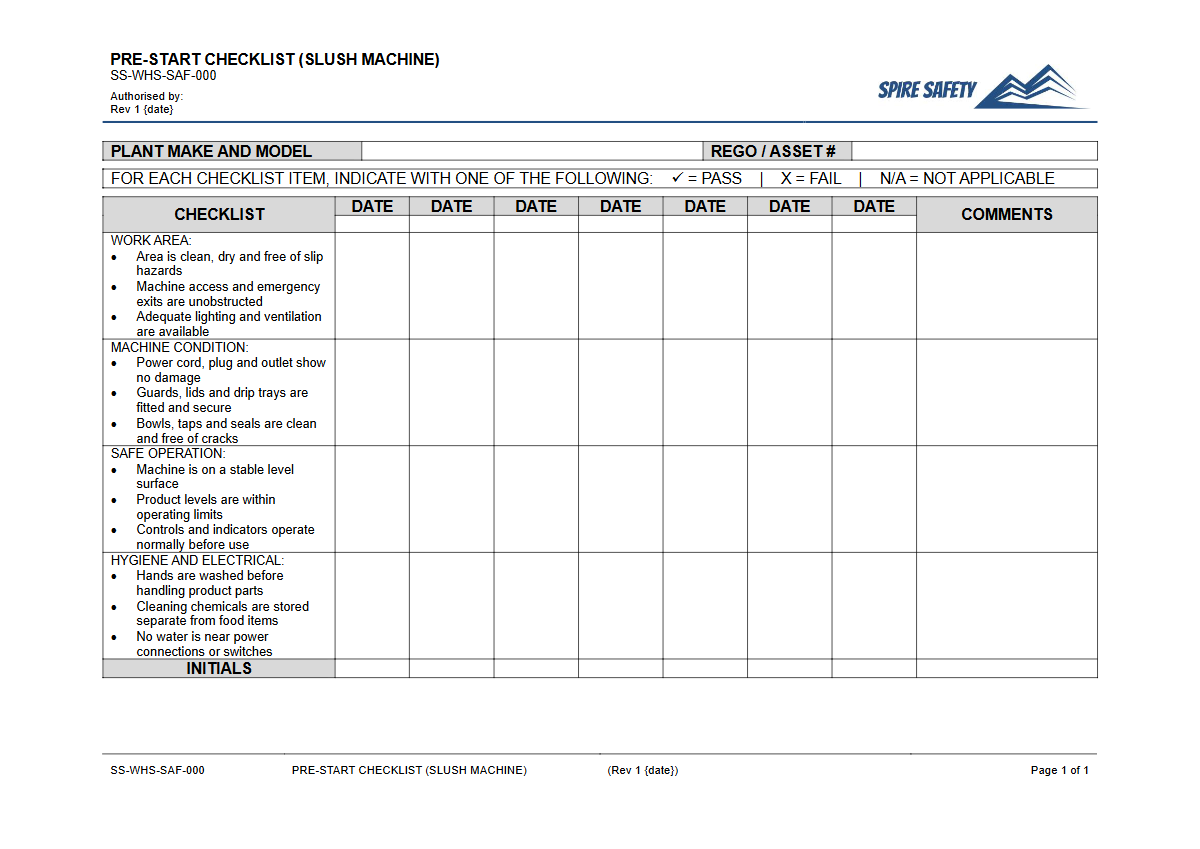
This Free Pre-Start Checklist (Slush Machine) Template provides a structured starting point for organisations to formalise daily safety and operational inspections of commercial slush machines. Regular pre-start checks are a fundamental component of proactive workplace safety, helping to identify potential hazards before they cause injury or equipment failure.
By documenting these checks, you can systematically manage risks associated with electrical faults, moving parts, hygiene, and structural integrity. Consistent use of this checklist helps demonstrate a commitment to maintaining safe plant and equipment, a key duty for any Person Conducting a Business or Undertaking (PCBU) under Australian WHS laws.
Integrating such procedures is a critical part of a functional safety framework. This template serves as a practical tool within your broader WHS management systems, ensuring that equipment maintenance is not overlooked.
It encourages operators to be actively involved in the safety process, fostering a positive safety culture where potential issues are reported and rectified promptly. This not only protects workers and customers but also helps extend the operational life of the equipment by catching minor faults before they become major problems.
Video walkthrough
How to use the Free Pre-Start Checklist (Slush Machine) Template
This checklist is provided as a downloadable DOCX and PDF file, ready for immediate use. The DOCX version is fully editable, allowing for extensive customisation to suit your specific workplace, machine models, and operational environment.
The PDF is ideal for quick printing and distribution.
To implement it effectively:
- Review and Customise: Identify the specific makes and models of slush machines at your site. Add, remove, or modify checklist items to reflect their unique features, potential hazards, and the manufacturer's recommendations. For example, some models may have specific interlock guards or cleaning cycles that need to be checked. You may find it helpful to look at other equipment checklists, like our free Pre-Start Checklist (Agitator) Template, to see how different mechanical actions are assessed.
- Train Staff: Ensure all operators are trained not only on how to use the slush machine safely but also on the importance and correct procedure for completing the pre-start check. This training should cover how to identify faults and the steps to take if a defect is found.
- Integrate and Monitor: Incorporate the completed checklist into your daily opening procedures. Supervisors should periodically review the completed forms to ensure checks are being done diligently and to identify any recurring equipment issues that may require more significant maintenance or replacement.
Important: This is a template only. We have developed it as a starting point, but it must be customised to your specific machinery, site, and operational risks.
You are responsible for ensuring it is suitable for your workplace and meets your legal obligations.
When to use it
A pre-start checklist for a slush machine should be completed before the first use each day or at the beginning of each shift where the equipment is operated. This ensures the machine is in a safe condition before it is filled with product and switched on.
Completing the check before operation is crucial because it allows for faults to be identified while the machine is de-energised and in a state where inspection is safest. It also prevents wasting product by discovering a fault only after the machine has been filled.
These checks are a foundational element of equipment safety, which can be reinforced through regular workplace training. For a broader discussion on this topic, a session based on a Pre-Start Checks and Plant Maintenance Toolbox Talk can be highly effective in communicating the 'why' behind the process.
The checklist should also be used after any major cleaning, servicing, or relocation of the machine to verify it remains in safe working order.
Who should use it
This Pre-Start Checklist should be used by any worker tasked with operating a slush machine. This typically includes food and beverage attendants, café staff, and retail employees.
The person operating the equipment is best placed to identify any changes, unusual noises, or damage from the previous shift. Empowering operators to conduct these checks makes them directly responsible for their own safety and the safety of those around them.
Supervisors and managers also have a role. They are responsible for ensuring the checks are being completed correctly and consistently.
They must also take action on any reported defects, such as isolating the equipment and arranging for repairs. The documented checklists provide a clear record for verification, which is essential for demonstrating procedural compliance during safety assessments or WHS compliance auditing. This process ensures accountability at all levels of the organisation.
While this template is useful for many small machines, you can explore our free WHS resources library for other plant-specific documents.
Common mistakes
Common mistakes to avoid
- Ignoring minor leaks or drips from seals, which can indicate a larger failure is imminent.
- Skipping the inspection of the electrical cord and plug for damage, fraying, or bent pins.
- Failing to check for cleanliness inside the bowl and around dispensing taps, leading to food safety risks.
- Completing the checklist as a 'tick and flick' exercise without physically inspecting each item.
Legal references
Legal considerations
The following legal requirements may be relevant to this type of work.
- Work Health and Safety Act (Harmonised) — Provides the primary duties for protecting workers and other people from work health and safety risks.
- Work Health and Safety Regulations (Harmonised) — Sets out requirements supporting the management of workplace hazards and risks.
The following codes may be relevant to this type of work.
- Managing WHS Risks Code of Practice — Provides practical guidance on identifying hazards, assessing risks and applying effective controls.
- Work Health and Safety Consultation, Cooperation and Coordination Code of Practice — Provides practical guidance on consulting workers and coordinating with other duty holders.
- Managing the Work Environment and Facilities Code of Practice — Provides practical guidance on safe work environments, workplace facilities and related controls.
Did you know
Continuous Motion
The constant turning or agitation inside a slush machine is not just for mixing; it's crucial for preventing the formation of large ice crystals, which ensures a smooth, consistent texture in the final product.
Electrical Risk
Due to the combination of electricity, liquids, and metal components, electrical safety is the most significant risk associated with slush machines. A faulty cord or internal short-circuit can easily lead to electric shock.
FAQ
Frequently asked questions
01What specific hazards should a slush machine pre-start check cover?
02How often should slush machine pre-start inspections be conducted?
03Is a digital pre-start checklist better than a paper one?
04What happens if a fault is found during a slush machine pre-start check?
Share this resource
Free Pre-Start Checklist (Slush Machine) Template
Browse Categories
How To Use It
- 1Download and open in Word or PDF.
- 2Replace the placeholders with your business details.
- 3Get it reviewed by a WHS specialist before rollout.
Need it customised?
Our WHS consultants can adapt this template to your site, run a gap analysis, or audit what you already have in place.
Book a Free Consultation WHS consulting servicesor call 1300 156 382