
Free Pre-Start Checklist (Soil Roller) Template
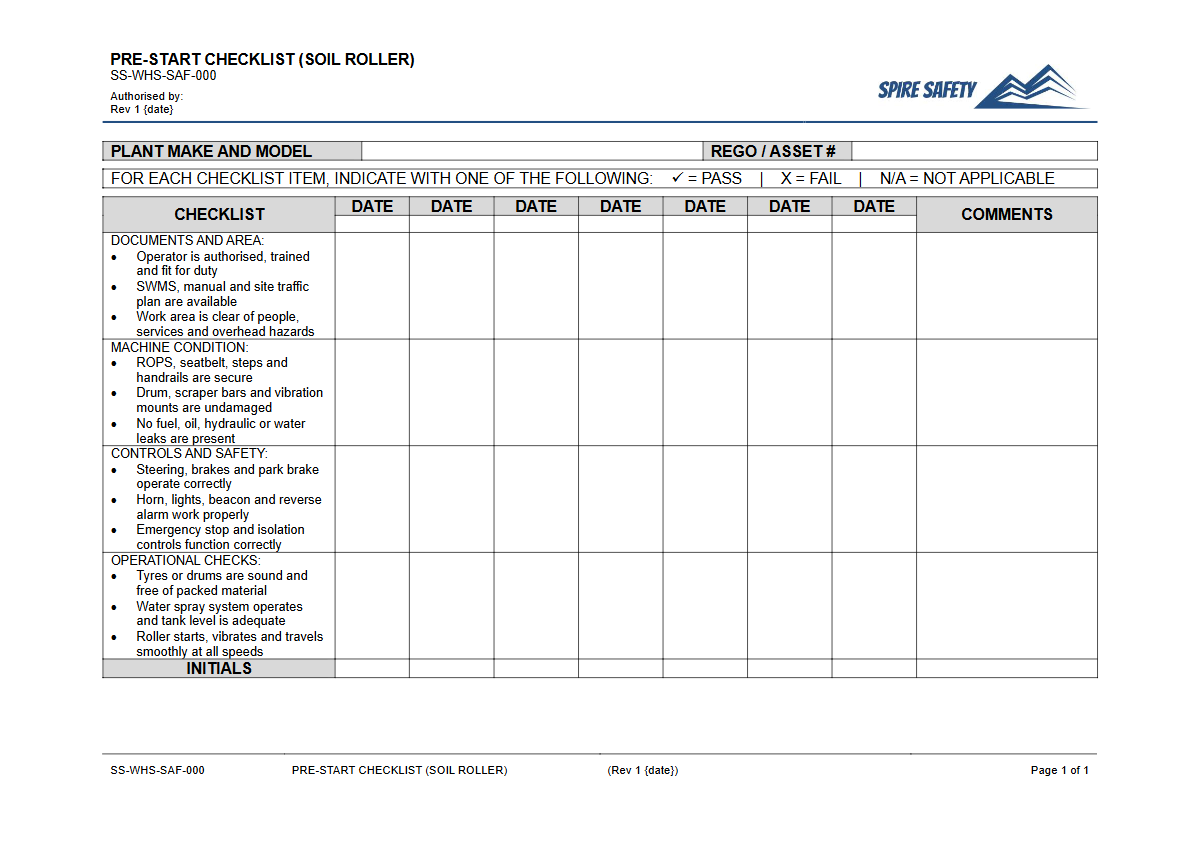
Download our free Pre-Start Checklist (Soil Roller) Template to formalise daily equipment checks. This structured DOCX & PDF helps identify hazards.
Free Pre-Start Checklist (Soil Roller) Template
DOCX • 125 KB + PDF
Updated Oct 2026
No signup required
Purpose of the Free Pre-Start Checklist (Soil Roller) Template
Operating a soil roller involves significant risks, from rollovers to contact with people or structures. A systematic pre-start inspection is a fundamental control measure to ensure the equipment is safe to operate before each use.
This free Pre-Start Checklist (Soil Roller) Template provides a structured starting point for developing a site-specific inspection process, helping your organisation formalise daily safety checks and meet its WHS duties. Using this template helps to identify and document potential defects, mechanical issues, or damage that could lead to an incident or breakdown.
A comprehensive pre-start inspection is a key component of any effective plant safety program. Regular checks help maintain the roller in a safe condition, reduce costly downtime, and provide documented evidence of your safety procedures.
For a complete procedural overview, this checklist works well alongside a Roller Safe Operating Procedure (SOP), which outlines the step-by-step process for operating the machinery safely.
Video walkthrough
How to use the Free Pre-Start Checklist (Soil Roller) Template
This document is provided in both DOCX and PDF formats for your convenience. To get started, download the template and integrate it into your safety management system.
The DOCX version is fully editable, allowing you to tailor the checklist to the specific make, model, and configuration of the soil rollers used in your workplace. This customisation is essential for effectiveness.
Important: This is a template, not a finished document. You must customise it to reflect the specific hazards, controls, and equipment at your workplace.
We advise that you consult with operators, maintenance staff, and safety professionals during this process to ensure all relevant inspection points are included. This collaborative approach helps build a robust WHS management system that is practical and effective.
Once customised, the checklist should be used by a competent person before the start of every shift. The completed checklists should be retained as part of your WHS records.
For higher-risk activities involving rollers, you may also need a specific Padfoot Roller Operation SWMS to manage risks comprehensively.
When to use it
A pre-start check on a soil roller must be conducted before the plant is used for the first time at the start of each shift or workday. It is a pre-operational task designed to catch any faults or issues that may have developed overnight, during transport, or since its last use.
If the roller is used by multiple operators across different shifts on the same day, a handover inspection should also be considered to ensure continuous safety oversight.
Regular safety communications can reinforce the importance of these checks. Using a Pre-Start Checks and Plant Maintenance toolbox talk is an excellent way to train workers on why and how these inspections are critical for their safety and the safety of others on site.
Who should use it
The pre-start inspection must be carried out by a person who is competent to operate the soil roller. Competency means the person has the necessary training, experience, and knowledge to identify potential hazards and defects with the equipment.
This typically includes the plant operator assigned to use the roller for that shift.
Supervisors and managers also have a role in ensuring these checks are completed consistently and correctly. They are responsible for verifying that operators are trained in the pre-start process and for actioning any reported defects or safety concerns in a timely manner.
Periodically reviewing completed checklists can also be part of routine WHS compliance audits to verify that safety procedures are being followed.
You can find many other helpful documents, such as a Safe Work Method Statement for multi-tyre roller operation, by browsing our free WHS resources library for more templates to support your safety goals.
Common mistakes
Common mistakes to avoid
- Operator 'pencil-whipping' the form without physically inspecting the roller.
- Failing to immediately tag out and report equipment with identified defects.
- Using a generic checklist that doesn't match the specific make and model of the soil roller.
- Not providing adequate training to operators on how to perform a thorough and effective inspection.
Legal references
Legal considerations
The following legal requirements may be relevant to this type of work.
- Work Health and Safety Act (Harmonised) — Provides the primary duties for protecting workers and other people from work health and safety risks.
- Work Health and Safety Regulations (Harmonised) — Sets out requirements supporting the management of workplace hazards and risks.
The following codes may be relevant to this type of work.
- Managing WHS Risks Code of Practice — Provides practical guidance on identifying hazards, assessing risks and applying effective controls.
- Work Health and Safety Consultation, Cooperation and Coordination Code of Practice — Provides practical guidance on consulting workers and coordinating with other duty holders.
- Managing the Work Environment and Facilities Code of Practice — Provides practical guidance on safe work environments, workplace facilities and related controls.
Did you know
Mobile Plant Risks
According to Safe Work Australia, incidents involving vehicles are a leading cause of workplace fatalities, with a significant portion related to mobile plant like rollers.
Vibration Exposure
Operators of rollers can be exposed to high levels of whole-body vibration (WBV), a serious long-term hazard. A well-maintained machine with a functional, properly adjusted seat is crucial for mitigating this risk.
FAQ
Frequently asked questions
01What should be included in a soil roller pre-start check?
02Why are daily pre-start checks for soil rollers important?
03Who is responsible for ensuring pre-start checks are done?
04How does this template help with WHS record-keeping?
Share this resource
Free Pre-Start Checklist (Soil Roller) Template
Browse Categories
How To Use It
- 1Download and open in Word or PDF.
- 2Replace the placeholders with your business details.
- 3Get it reviewed by a WHS specialist before rollout.
Need it customised?
Our WHS consultants can adapt this template to your site, run a gap analysis, or audit what you already have in place.
Book a Free Consultation WHS consulting servicesor call 1300 156 382