
Free Pre-Start Checklist (Sous Vide) Template
Download our Free Pre-Start Checklist (Sous Vide) Template. This DOCX & PDF resource helps formalise safety checks for sous vide equipment. Get started now.
Free Pre-Start Checklist (Sous Vide) Template
DOCX • 125 KB + PDF
Updated Oct 2026
No signup required
Purpose of the Free Pre-Start Checklist (Sous Vide) Template
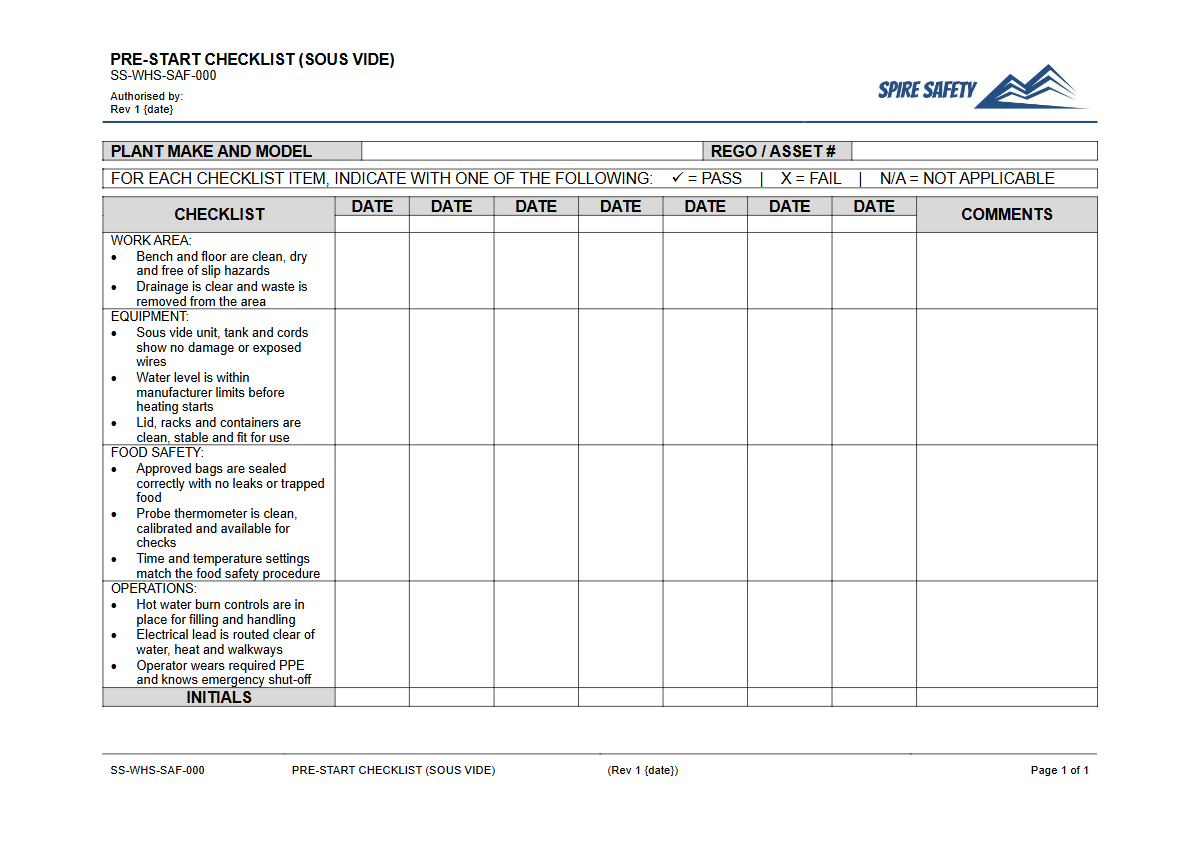
Sous vide cooking offers precise temperature control, but the equipment, like any other kitchen appliance, presents workplace hazards. This Free Pre-Start Checklist (Sous Vide) Template provides a structured framework for operators to verify the safety and operational readiness of sous vide water baths and immersion circulators before use.
Regular checks are crucial for managing risks such as electrical hazards from water ingress, burns from hot water, and food safety failures due to inaccurate temperature control. Implementing a consistent pre-start process helps create a safer kitchen environment and demonstrates a commitment to proactive risk management.
It forms a key part of a robust and integrated safety framework, which can be enhanced by well-documented WHS management systems that formalise your organisation's approach to health and safety.
Video walkthrough
How to Use the Free Pre-Start Checklist (Sous Vide) Template
This resource is available in both DOCX and PDF formats for your convenience. Download the template and integrate it into your daily kitchen procedures.
The DOCX file is fully editable, allowing you to modify checks to suit the specific models of sous vide equipment used in your workplace. Key items to inspect include the power cord and plug for damage, the integrity of the unit's housing, the function of controls and displays, and the cleanliness of the water bath.
You can also add checks specific to your kitchen's workflow or environment.
Note: This template provides a solid starting point based on general safety principles. To ensure it is effective, we recommend you customise it to fit the specific makes and models of equipment in your workplace, your operational procedures, and your unique risk profile. While this checklist covers sous vide machines, other specialised equipment requires its own dedicated checks, such as our Free Pre-Start Checklist for 3D Printers.
When to Use It
A pre-start check for sous vide equipment should be conducted at the beginning of each day or shift before the machine's first use. This ensures any faults or issues that may have developed overnight or during cleaning are identified before the equipment is put into operation for food preparation.
For kitchens with multiple shifts, it is good practice for the incoming operator to perform their own check. Regular safety discussions about equipment use can be reinforced using a Pre-Start Checks and Plant Maintenance Toolbox Talk to keep safety front-of-mind for all staff.
Who Should Use It
Any worker tasked with operating the sous vide equipment should perform the pre-start check. This includes chefs, cooks, kitchen hands, and apprentices.
The person using the machine is best placed to identify subtle changes or potential issues. It is the responsibility of the Person Conducting a Business or Undertaking (PCBU) to ensure that all workers are adequately trained not only in the operation of the equipment but also in the process of conducting and documenting these safety checks.
Regular reviews of completed checklists help supervisors monitor equipment condition and compliance with safety procedures. If concerns arise about the consistency of your safety processes, a WHS compliance auditing service can provide an independent assessment of your workplace practices.
Integrating with Other Kitchen Equipment Checks
A systematic approach to safety involves formalising checks for all relevant plant and equipment. While this document focuses on sous vide, similar principles apply to other machinery.
For instance, commercial kitchens using large-scale mixing equipment would benefit from a dedicated checklist like our Free Pre-Start Checklist (Agitator) Template. Standardising these checks across your kitchen helps build a strong safety culture and simplifies training and record-keeping. You can find these and many other templates in our free WHS resources library to build out your complete safety system.
Common mistakes
Common mistakes to avoid
- Failing to check the calibration and accuracy of the temperature display, risking food safety.
- Ignoring minor damage to power cords or plugs, which poses a significant electrical shock risk.
- Using a generic checklist without customising it for the specific make and model of the sous vide unit.
- Completing the checklist but failing to take faulty equipment out of service for repair or replacement.
Legal references
Legal considerations
The following legal requirements may be relevant to this type of work.
- Work Health and Safety Act (Harmonised) — Provides the primary duties for protecting workers and other people from work health and safety risks.
- Work Health and Safety Regulations (Harmonised) — Sets out requirements supporting the management of workplace hazards and risks.
The following codes may be relevant to this type of work.
- Managing WHS Risks Code of Practice — Provides practical guidance on identifying hazards, assessing risks and applying effective controls.
- Work Health and Safety Consultation, Cooperation and Coordination Code of Practice — Provides practical guidance on consulting workers and coordinating with other duty holders.
- Managing the Work Environment and Facilities Code of Practice — Provides practical guidance on safe work environments, workplace facilities and related controls.
Did you know
Precision Cooking
The term 'sous vide' is French for 'under vacuum'. While it refers to the vacuum-sealing process often used, the core technique is about precise temperature-controlled cooking in a water bath, a method first described in 1799.
The Danger Zone
The food safety 'danger zone' where bacteria multiply rapidly is between 5°C and 60°C. A key function of a sous vide pre-start check is to ensure the machine can accurately hold temperatures outside this range.
FAQ
Frequently asked questions
01Why is a pre-start checklist necessary for a sous vide machine?
02Is this pre-start checklist suitable for a commercial kitchen?
03How often should sous vide pre-start checks be performed?
04What is the difference between a pre-start checklist and a SWMS?
Share this resource
Free Pre-Start Checklist (Sous Vide) Template
Browse Categories
How To Use It
- 1Download and open in Word or PDF.
- 2Replace the placeholders with your business details.
- 3Get it reviewed by a WHS specialist before rollout.
Need it customised?
Our WHS consultants can adapt this template to your site, run a gap analysis, or audit what you already have in place.
Book a Free Consultation WHS consulting servicesor call 1300 156 382