
Free Pre-Start Checklist (Spider Crane) Template
Download our free Pre-Start Checklist (Spider Crane) Template.
Free Pre-Start Checklist (Spider Crane) Template
DOCX • 125 KB + PDF
Updated Oct 2026
No signup required
Purpose of the Free Pre-Start Checklist (Spider Crane) Template
Operating a spider crane involves significant risks, from tipping and structural failure to contact with overhead powerlines. A systematic inspection before each use is a critical control measure to ensure the equipment is safe and ready for operation.
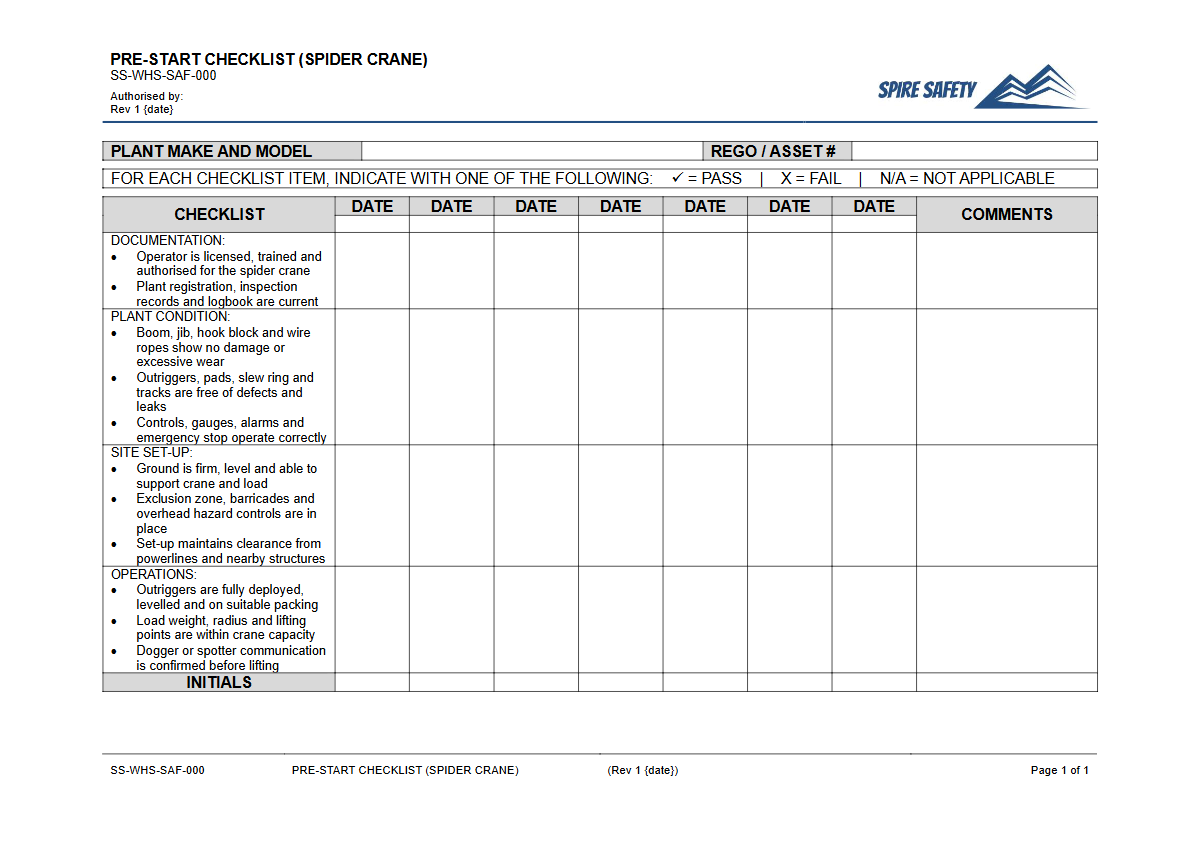
This Free Pre-Start Checklist (Spider Crane) Template provides a structured framework for operators to conduct thorough visual and functional checks, identifying potential faults or damage before they can lead to an incident. Using this checklist helps formalise your safety procedures, promote diligent operator behaviour, and create a verifiable record of equipment safety checks.
Spider cranes are often used in confined spaces or on uneven terrain where stability is paramount. The checklist prompts a review of essential safety components like outriggers, hydraulic systems, control functions, and load-bearing parts.
Regular use of this tool helps maintain the equipment in safe working order, reduces the likelihood of costly breakdowns, and demonstrates a commitment to workplace health and safety. It forms a key part of any robust safety system, contributing to the overall management of high-risk plant in the workplace.
For broader safety discussions, you can also use our Crane and Lifting Operations Safety Toolbox Talk Template to reinforce key messages with your team.
Video walkthrough
How to use the Free Pre-Start Checklist (Spider Crane) Template
This document is a user-friendly template designed for practical application on site. After downloading the DOCX or PDF file, you should adapt it to the specific models of spider cranes used in your organisation and the unique conditions of your work environments.
This includes adding your company branding, specific operational checks recommended by the manufacturer, and any site-specific hazards that need to be considered. Once customised, the checklist should be integrated into your daily operational workflow.
Operators should be trained on how to complete the checklist thoroughly, understanding that it is not a 'tick-and-flick' exercise. Each item requires a genuine physical or visual inspection.
The process should involve walking around the crane, testing functions, and checking fluid levels. Any identified faults or defects must be immediately reported, and the crane should be tagged out of service until it is repaired by a competent person.
These records should then be filed as part of your equipment maintenance history. Properly managing this documentation is a core component of effective WHS management systems.
Important: This is a template document that provides a starting point. It is essential that you customise it to reflect the specific hazards, crane models, and operational context of your workplace.
We are not responsible for your WHS compliance; that responsibility lies with the PCBU.
When to use it
A pre-start checklist for a spider crane must be completed before the start of every shift or before the crane is used for the first time on a given day. It should also be completed if a new operator takes over the crane during a shift.
Conducting these checks at the beginning of the day ensures the equipment was not damaged overnight or left in an unsafe state by a previous user.
Additionally, a pre-start check is crucial after the crane has been transported to a new location. The process of loading, transporting, and unloading can potentially cause damage or dislodge components.
Performing a check upon arrival at a new site ensures the crane is safe to set up and operate. For a general overview of this process, our Pre-Start Checks and Plant Maintenance Toolbox Talk Template can be a helpful resource for team briefings.
Who should use it
The pre-start checklist should be completed by the person operating the spider crane for that shift. This must be a competent individual who holds the relevant High Risk Work Licence (where required) and has received specific training on the make and model of the crane they are using.
The operator has the most direct responsibility for ensuring the equipment is safe to use before commencing work.
Supervisors and managers also have a role in ensuring the pre-start check system is being followed correctly. They should periodically review completed checklists, verify that operators are conducting checks diligently, and ensure that any reported defects are being addressed in a timely manner.
The process of confirming operator skill is also vital; you can see an example of this in our Verification of Competency (Overhead Bridge Crane) Template, which can be adapted for different types of plant. A Safe Work Method Statement is also required for high-risk crane operations, and our SWMS for Vehicle Loading Crane Operation template provides a useful starting point for documenting these procedures.
By integrating this checklist into your daily routine, you empower operators to take ownership of safety and create a more proactive risk management culture within your organisation. To discover more templates and guides, browse our complete free WHS resources library.
Common mistakes
Common mistakes to avoid
- Failing to properly assess ground conditions before setting up the outriggers.
- 'Pencil-whipping' the checklist without performing the actual physical checks.
- Neglecting to check hydraulic fluid levels and look for leaks in hoses and fittings.
- Continuing to operate the crane after a minor fault is found, rather than tagging it out for repair.
Legal references
Legal considerations
The following legal requirements may be relevant to this type of work.
- Work Health and Safety Act (Harmonised) — Provides the primary duties for protecting workers and other people from work health and safety risks.
- Work Health and Safety Regulations (Harmonised) — Sets out requirements supporting the management of workplace hazards and risks.
The following codes may be relevant to this type of work.
- Managing WHS Risks Code of Practice — Provides practical guidance on identifying hazards, assessing risks and applying effective controls.
- Work Health and Safety Consultation, Cooperation and Coordination Code of Practice — Provides practical guidance on consulting workers and coordinating with other duty holders.
- Managing the Work Environment and Facilities Code of Practice — Provides practical guidance on safe work environments, workplace facilities and related controls.
Did you know
Outrigger Stability
The 'spider' legs, or outriggers, are the most critical safety feature of a spider crane. They allow the crane to stabilise on uneven ground and achieve its maximum lifting capacity, which would be impossible on its compact chassis alone.
Japanese Innovation
Spider cranes were invented in Japan to navigate the country's dense urban construction sites and challenging terrains. Their design was inspired by the need for a compact, versatile crane that could access areas inaccessible to traditional mobile cranes.
FAQ
Frequently asked questions
01What is the difference between a pre-start check and a periodic inspection?
02How often should I review and update my spider crane checklist?
03Can this checklist be used for other types of cranes?
04Who is responsible for ensuring pre-start checks are completed?
Share this resource
Free Pre-Start Checklist (Spider Crane) Template
Browse Categories
How To Use It
- 1Download and open in Word or PDF.
- 2Replace the placeholders with your business details.
- 3Get it reviewed by a WHS specialist before rollout.
Need it customised?
Our WHS consultants can adapt this template to your site, run a gap analysis, or audit what you already have in place.
Book a Free Consultation WHS consulting servicesor call 1300 156 382