
Free Pre-Start Checklist (Spot Welder) Template
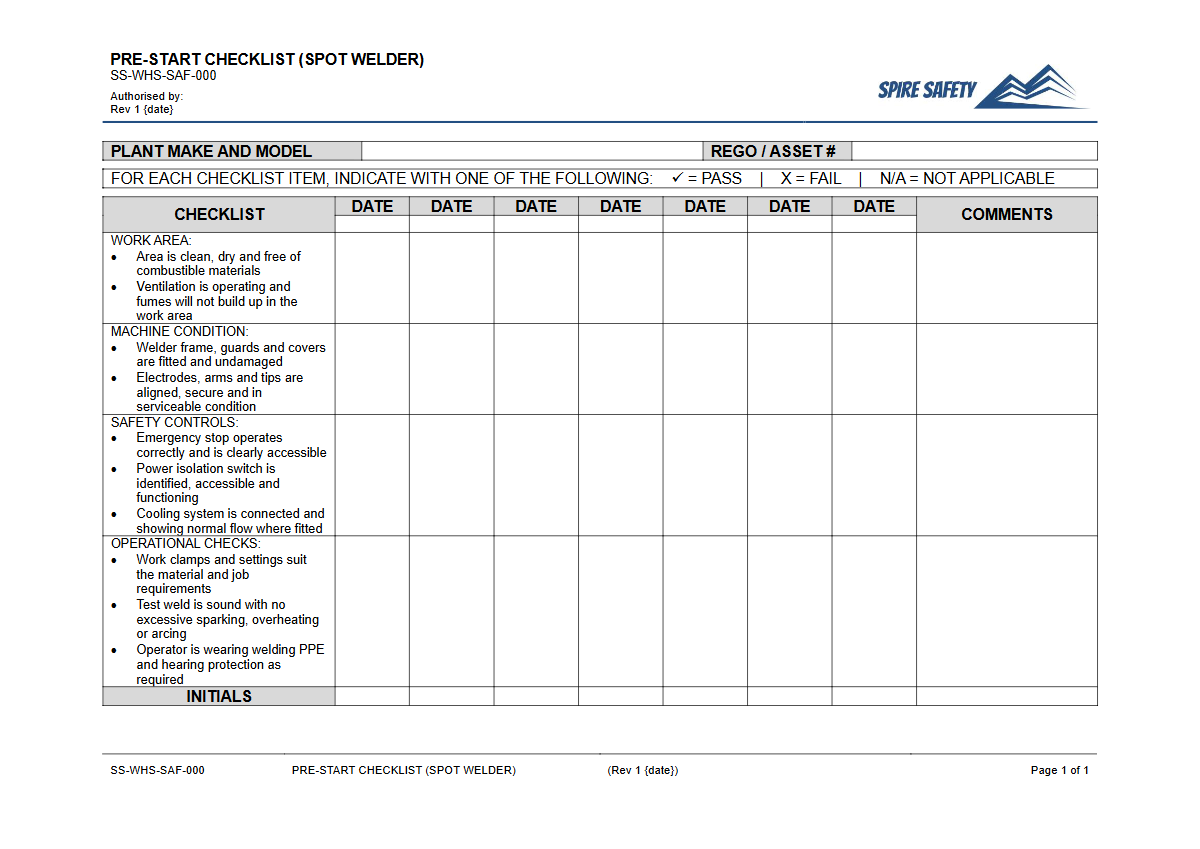
Download our free Pre-Start Checklist (Spot Welder) Template. This structured Word and PDF document helps formalise equipment checks and identify hazards.
Free Pre-Start Checklist (Spot Welder) Template
DOCX • 125 KB + PDF
Updated Oct 2026
No signup required
Purpose of the Free Pre-Start Checklist (Spot Welder) Template
A spot welder joins sheet metal using a powerful electrical current. While efficient, this process introduces significant hazards, including severe electrical shocks, burns, eye injuries from sparks, and crushing risks from moving electrodes.
A systematic pre-start inspection is a critical control measure to manage these risks. This Free Pre-Start Checklist (Spot Welder) Template provides a structured starting point for developing a robust inspection process for your workplace.
Using this checklist helps your organisation meet its duty of care by ensuring equipment is safe to operate before any work begins. It formalises the process of checking key safety components, such as guards, emergency stops, and electrical integrity. Documenting these checks creates a record of due diligence, which is a fundamental part of effective WHS management systems.
Video walkthrough
How to use the Free Pre-Start Checklist (Spot Welder) Template
This template is designed for easy adoption and customisation. Follow these steps to integrate it into your safety procedures:
- Download: Get the template in your preferred format (DOCX or PDF).
- Customise: This is the most critical step. This document is a template and requires your input. We have not been to your site, nor do we know the specific makes and models of your equipment. You must adapt the checklist to reflect the unique features, hazards, and operating environment of your specific spot welders. Add or remove items to ensure the checklist is relevant and practical for your team.
- Train: Ensure all operators and supervisors are trained on how to properly complete the checklist and what actions to take if a fault is found. The checklist should be used in conjunction with other key documents, like a free Mig Welder SOP template, which can be adapted for spot welding processes.
- Implement: Integrate the pre-start check into your daily workflow. Make it a non-negotiable step before any spot welding operations commence.
When to use a Spot Welder Pre-Start Checklist
Consistency is key to the effectiveness of any pre-start inspection. The checklist should be completed:
- Before each shift: The operator starting the shift should conduct a full check to ensure the equipment is safe for use.
- Before the first use of the day: If the equipment is used intermittently, a check should be performed before it is first operated.
- After maintenance or repairs: A check ensures that the equipment has been returned to a safe operational state and that no new hazards have been introduced.
- If any operational issues are suspected: If an operator notices unusual behaviour, a thorough inspection using the checklist can help diagnose the problem.
Reinforcing the importance of daily checks can be achieved through regular safety discussions. You can use a resource like the Pre-Start Checks and Plant Maintenance Toolbox Talk to facilitate these conversations and strengthen your safety culture.
Who should use it
The responsibility for equipment safety is shared. This checklist should be used by:
- Operators: The primary user of the checklist is the person who will be operating the spot welder. They are in the best position to identify any changes or faults with the equipment.
- Supervisors: Team leaders and supervisors should be reviewing completed checklists to ensure they are being filled out correctly and that any identified issues are being addressed promptly. They are responsible for ensuring operators are competent to perform the checks.
- Maintenance Personnel: Fitters and electricians may use the checklist as a reference when conducting repairs or preventative maintenance, ensuring all safety-critical components are inspected.
Confirming that an operator can not only use the machine but also inspect it correctly is a key part of ensuring workplace safety. This process aligns with the principles outlined in our Verification of Competency for TIG welders, which can be adapted for various high-risk roles.
Key Items on a Spot Welder Checklist
A comprehensive spot welder pre-start checklist should cover several critical areas. Your customised version should include checks for:
- Physical Condition: The general state of the machine, including frame, panels, and stability.
- Electrical Systems: All power cables, control boxes, and connections for signs of wear, fraying, or damage.
- Electrode Assembly: The condition and alignment of the electrode arms and tips. Check for wear, damage, or contamination.
- Cooling System: Water hoses, connections, and flow rates. Ensure there are no leaks and that coolant is circulating correctly.
- Guards and Safety Devices: All physical guards, light curtains, and two-hand controls must be in place and functioning.
- Emergency Stop: The E-stop button must be accessible and fully operational.
Periodically verifying that these checks are being performed correctly is a key activity in safety assurance. This can be done as part of internal reviews or through more formal WHS compliance auditing.
Common mistakes
Common mistakes to avoid
- Skipping checks on the water-cooling system, leading to overheating and poor welds.
- Ignoring worn, dirty, or misaligned electrode tips, which compromises weld integrity.
- Failing to inspect electrical cables and connections for damage, creating a serious shock hazard.
- Treating the checklist as a 'tick and flick' exercise without physically verifying each item.
Legal references
Legal considerations
The following legal requirements may be relevant to this type of work.
- Work Health and Safety Act (Harmonised) — Provides the primary duties for protecting workers and other people from work health and safety risks.
- Work Health and Safety Regulations (Harmonised) — Sets out requirements supporting the management of workplace hazards and risks.
The following codes may be relevant to this type of work.
- Managing WHS Risks Code of Practice — Provides practical guidance on identifying hazards, assessing risks and applying effective controls.
- Work Health and Safety Consultation, Cooperation and Coordination Code of Practice — Provides practical guidance on consulting workers and coordinating with other duty holders.
- Managing the Work Environment and Facilities Code of Practice — Provides practical guidance on safe work environments, workplace facilities and related controls.
Did you know
High Current, Low Voltage
Spot welders operate at a low voltage but use extremely high electrical current, often thousands of amperes, to generate the heat needed for welding. This immense current is a significant electrical and fire hazard.
Cooling is Critical
The electrodes on a spot welder are typically water-cooled. A failure in the cooling system can cause the electrode tips to overheat and deform rapidly, leading to poor weld quality and potential equipment damage.
FAQ
Frequently asked questions
01Is a pre-start checklist for a spot welder a legal requirement in Australia?
02How often should a spot welder pre-start check be completed?
03What are the most critical safety checks for a spot welder?
04Can I use this template for other types of welders, like MIG or TIG?
Share this resource
Free Pre-Start Checklist (Spot Welder) Template
Browse Categories
How To Use It
- 1Download and open in Word or PDF.
- 2Replace the placeholders with your business details.
- 3Get it reviewed by a WHS specialist before rollout.
Need it customised?
Our WHS consultants can adapt this template to your site, run a gap analysis, or audit what you already have in place.
Book a Free Consultation WHS consulting servicesor call 1300 156 382