
Free Pre-Start Checklist (Spray Gun) Template
Formalise spray gun safety inspections with our free Pre-Start Checklist Template.
Free Pre-Start Checklist (Spray Gun) Template
DOCX • 125 KB + PDF
Updated Oct 2026
No signup required
Purpose of the Free Pre-Start Checklist (Spray Gun) Template
Using a spray gun involves significant workplace health and safety risks, including high-pressure injection injuries, exposure to hazardous chemicals, and fire or explosion hazards. A structured pre-start inspection is a critical safety control.
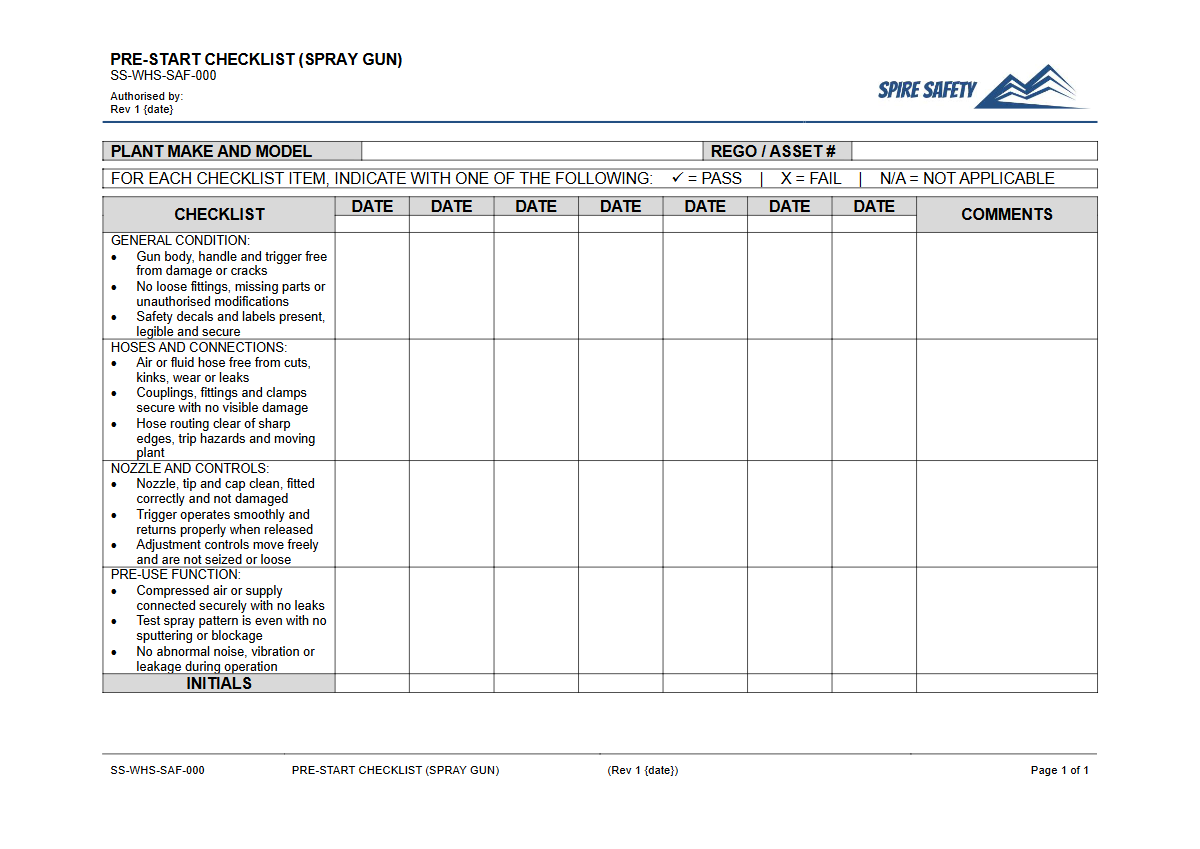
This Free Pre-Start Checklist (Spray Gun) Template provides a formal method for operators to inspect their equipment before each use, helping to identify potential faults or damage that could lead to an incident. By documenting these checks, your organisation can demonstrate proactive risk management and a commitment to worker safety.
This process helps meet PCBU duties under Australian WHS legislation by ensuring plant is safe to use. For tasks involving volatile substances, managing exposure to hazardous fumes and vapours is critical, often requiring equipment like that covered in our Free Pre-Start Checklist for Fume Cabinets.
Video walkthrough
How to use the Free Pre-Start Checklist (Spray Gun) Template
To implement this Pre-Start Checklist, download the template in your preferred format (DOCX or PDF). The checklist guides the user through inspecting key components, including the gun body, trigger and safety catch, hoses and fittings, nozzles, and pressure settings.
It also includes prompts for checking that the correct Personal Protective Equipment (PPE) is available and in good condition. Integrating this process into your daily routine is a practical step towards building stronger WHS management systems, providing tangible evidence of risk control measures.
Customisation is Essential
It is crucial to recognise that this document is a template. We provide it as a starting point, but you must review and customise it to suit the specific models of spray guns, the types of materials being sprayed (paints, coatings, chemicals), and the unique environment of your workplace.
Your customisation ensures the checklist is relevant and effective for your operations.
When to use it
A spray gun pre-start check should be conducted at the beginning of every shift or before the equipment is used for the first time on any given day. It should also be performed after any maintenance, repair, or if the equipment has been idle for an extended period.
Consistency is key; making the pre-start check a non-negotiable part of the setup process helps reinforce safe work habits. While this checklist is for general-purpose spray guns, specialised equipment requires its own specific checks, such as those detailed in our Free Pre-Start Checklist for Bitumen Sprayers.
Who should use it
The primary user of the checklist should be the trained and competent operator assigned to use the spray gun. They are in the best position to notice small changes or developing faults in the equipment they use regularly.
Supervisors or managers should also be involved by periodically reviewing completed checklists. This oversight helps identify recurring equipment issues, potential gaps in training, or trends that might indicate a broader problem.
Completed records can also serve as valuable evidence during a formal WHS compliance audit, demonstrating a systematic approach to equipment safety. For organisations needing assistance to embed these processes, our WHS consulting team can provide expert guidance on training, implementation, and system development.
Explore our complete free WHS resources library for more templates and tools to support your safety management program.
Common mistakes
Common mistakes to avoid
- Ignoring minor leaks from hoses or connections, which can quickly worsen under pressure.
- Using incorrect pressure settings, leading to poor finish quality and increased overspray.
- Failing to check, wear, or properly maintain the correct Personal Protective Equipment (PPE).
- Completing the checklist from memory without physically inspecting each item ('pencil-whipping').
Legal references
Legal considerations
The following legal requirements may be relevant to this type of work.
- Work Health and Safety Act (Harmonised) — Provides the primary duties for protecting workers and other people from work health and safety risks.
- Work Health and Safety Regulations (Harmonised) — Sets out requirements supporting the management of workplace hazards and risks.
The following codes may be relevant to this type of work.
- Managing WHS Risks Code of Practice — Provides practical guidance on identifying hazards, assessing risks and applying effective controls.
- Work Health and Safety Consultation, Cooperation and Coordination Code of Practice — Provides practical guidance on consulting workers and coordinating with other duty holders.
- Managing the Work Environment and Facilities Code of Practice — Provides practical guidance on safe work environments, workplace facilities and related controls.
Did you know
Injection Risk
The fluid stream from a high-pressure spray gun can exit the nozzle at speeds that can easily pierce skin, causing a severe injection injury even from a distance.
Occupational Asthma
Many paints, particularly two-pack polyurethane types, contain isocyanates. Inhaling these substances is a leading cause of occupational asthma in Australia, making correct ventilation and respiratory protection essential.
FAQ
Frequently asked questions
01Why is a pre-start check for a spray gun necessary?
02What are the most critical components to check on a spray gun?
03How often should I perform a spray gun pre-start check?
04What should I do if I find a fault during the pre-start check?
Share this resource
Free Pre-Start Checklist (Spray Gun) Template
Browse Categories
How To Use It
- 1Download and open in Word or PDF.
- 2Replace the placeholders with your business details.
- 3Get it reviewed by a WHS specialist before rollout.
Need it customised?
Our WHS consultants can adapt this template to your site, run a gap analysis, or audit what you already have in place.
Book a Free Consultation WHS consulting servicesor call 1300 156 382