
Free Pre-Start Checklist (Stair Climber) Template
Download our Free Pre-Start Checklist (Stair Climber) Template.
Free Pre-Start Checklist (Stair Climber) Template
DOCX • 125 KB + PDF
Updated Oct 2026
No signup required
Purpose of the Free Pre-Start Checklist (Stair Climber) Template
Powered and manual stair climbers are essential tools for moving heavy and awkward loads up and down stairs, significantly reducing manual handling risks. However, like any piece of plant, they can pose serious safety risks if they are faulty, damaged, or used incorrectly.
Implementing a routine inspection before each use is a fundamental control measure. This is where our Free Pre-Start Checklist (Stair Climber) Template provides a vital framework for your organisation's safety procedures.
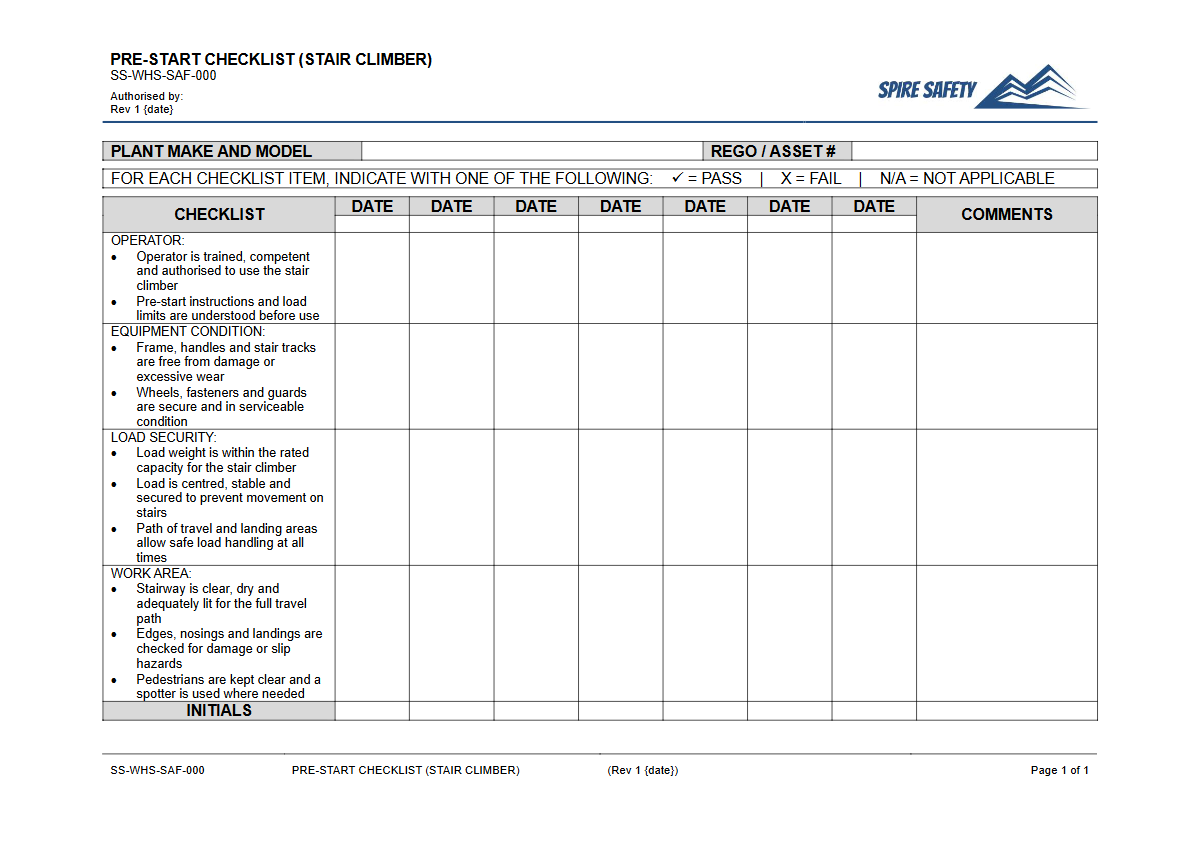
This template serves several key purposes. Primarily, it helps operators systematically identify and report potential defects such as worn straps, damaged wheels, low battery levels, or malfunctioning controls before the equipment is used.
By formalising this process, you create a clear record that the equipment was in a safe condition at the start of the job. A consistent inspection routine, supported by tools like a Pre-Start Checks and Plant Maintenance Toolbox Talk, helps embed a proactive safety culture where workers are empowered to stop and report issues, preventing incidents before they happen.
Video walkthrough
How to use the Free Pre-Start Checklist (Stair Climber) Template
Using this template effectively involves more than just downloading the file. It requires integration into your daily workflow to ensure it becomes a consistent and meaningful practice.
The process begins with downloading the DOCX file and customising it to suit the specific models of stair climbers used in your workplace, as well as the unique environmental and operational risks you face. These documented procedures form a crucial part of your overall WHS management systems, demonstrating a systematic approach to risk management.
Once customised, ensure all relevant operators are trained on how to complete the checklist correctly. This training should cover not just what to check, but also the procedure for reporting faults and tagging out unsafe equipment.
The completed checklists should be stored as part of your safety records, providing valuable data for maintenance scheduling and incident investigations.
Important Customisation Note
This document is a template and not a finished safety document. To be effective, it must be customised to reflect the specific makes and models of stair climbers your business uses, your operational environment, and your internal safety procedures.
We have provided a structured starting point, but you must conduct your own risk assessment and adapt the checklist to address the unique hazards present in your workplace.
Key Inspection Areas
While your customised checklist will be specific, general areas to inspect on a stair climber typically include:
- Frame and Body: Check for cracks, bends, or other structural damage.
- Handles and Controls: Ensure handles are secure and control buttons or levers function correctly.
- Straps and Restraints: Inspect for fraying, cuts, and ensure buckles or tensioners are working properly.
- Wheels and Tracks: Check for wear, damage, and proper inflation (if applicable). Ensure tracks are clean and intact.
- Battery and Power: For powered models, check the battery is fully charged and that all connections are secure and free from corrosion.
- Lifting Mechanism: Test the lifting/climbing function to ensure smooth and proper operation.
When to use it
A pre-start checklist for a stair climber should be completed before every use or, at a minimum, at the beginning of each shift where the equipment is expected to be used. The goal is to catch any faults that may have developed since its last use or during transport.
These checks are a perfect complement to daily team briefings, which can be structured using a free Pre-Start Meeting Template to ensure all safety matters are covered before work begins.
Who should use it
The pre-start checklist should be completed by the person operating the equipment. This must be a worker who is deemed competent, meaning they have received the necessary information, instruction, training, and supervision to use the stair climber safely.
Supervisors should also be familiar with the checklist so they can verify its correct completion and oversee the process. The principles of safe operation extend beyond the machine itself; understanding correct body mechanics is also critical.
Core safety principles, such as those outlined in an Aged Care Manual Handling Toolbox Talk, are fundamental to operating such equipment safely and preventing musculoskeletal injuries.
Regularly verifying that these checks are completed correctly is also a key component of effective safety management, often reviewed during a WHS compliance audit. This verification ensures that safety procedures are not just documented, but actively followed in practice. For more tools to support your safety program, you can browse our complete free WHS resources library, which contains a wide range of templates and guides.
Common mistakes
Common mistakes to avoid
- Using a generic checklist that hasn't been customised for the specific stair climber model.
- Rushing through the checklist without properly inspecting each item ('pencil-whipping').
- Failing to immediately tag out and report faulty or damaged equipment for repair.
- Neglecting to check the battery charge level on powered models before starting a job, leading to failure mid-task.
Legal references
Legal considerations
The following legal requirements may be relevant to this type of work.
- Work Health and Safety Act (Harmonised) — Provides the primary duties for protecting workers and other people from work health and safety risks.
- Work Health and Safety Regulations (Harmonised) — Sets out requirements supporting the management of workplace hazards and risks.
The following codes may be relevant to this type of work.
- Managing WHS Risks Code of Practice — Provides practical guidance on identifying hazards, assessing risks and applying effective controls.
- Work Health and Safety Consultation, Cooperation and Coordination Code of Practice — Provides practical guidance on consulting workers and coordinating with other duty holders.
- Managing the Work Environment and Facilities Code of Practice — Provides practical guidance on safe work environments, workplace facilities and related controls.
Did you know
Manual Handling Risks
Musculoskeletal disorders, often resulting from hazardous manual tasks, account for a significant portion of serious workers' compensation claims in Australia. Tools like stair climbers, when used and maintained correctly, are a key control measure in reducing these injuries.
FAQ
Frequently asked questions
01What is the difference between a pre-start check and regular maintenance?
02How often should our stair climber checklist be reviewed?
03Can a digital form be used for a stair climber pre-start?
04Is specific training required to operate a powered stair climber?
Share this resource
Free Pre-Start Checklist (Stair Climber) Template
Browse Categories
How To Use It
- 1Download and open in Word or PDF.
- 2Replace the placeholders with your business details.
- 3Get it reviewed by a WHS specialist before rollout.
Need it customised?
Our WHS consultants can adapt this template to your site, run a gap analysis, or audit what you already have in place.
Book a Free Consultation WHS consulting servicesor call 1300 156 382