
Free Pre-Start Checklist (Staple Gun) Template
Formalise daily safety inspections for your staple guns with our free Pre-Start Checklist. This structured DOCX & PDF template helps manage WHS risks.
Free Pre-Start Checklist (Staple Gun) Template
DOCX • 125 KB + PDF
Updated Oct 2026
No signup required
Purpose of the Free Pre-Start Checklist (Staple Gun) Template
Even seemingly simple tools like staple guns—whether pneumatic, electric, or manual—can cause serious injuries if they malfunction. Implementing a routine inspection using this Free Pre-Start Checklist (Staple Gun) Template helps formalise a critical safety process.
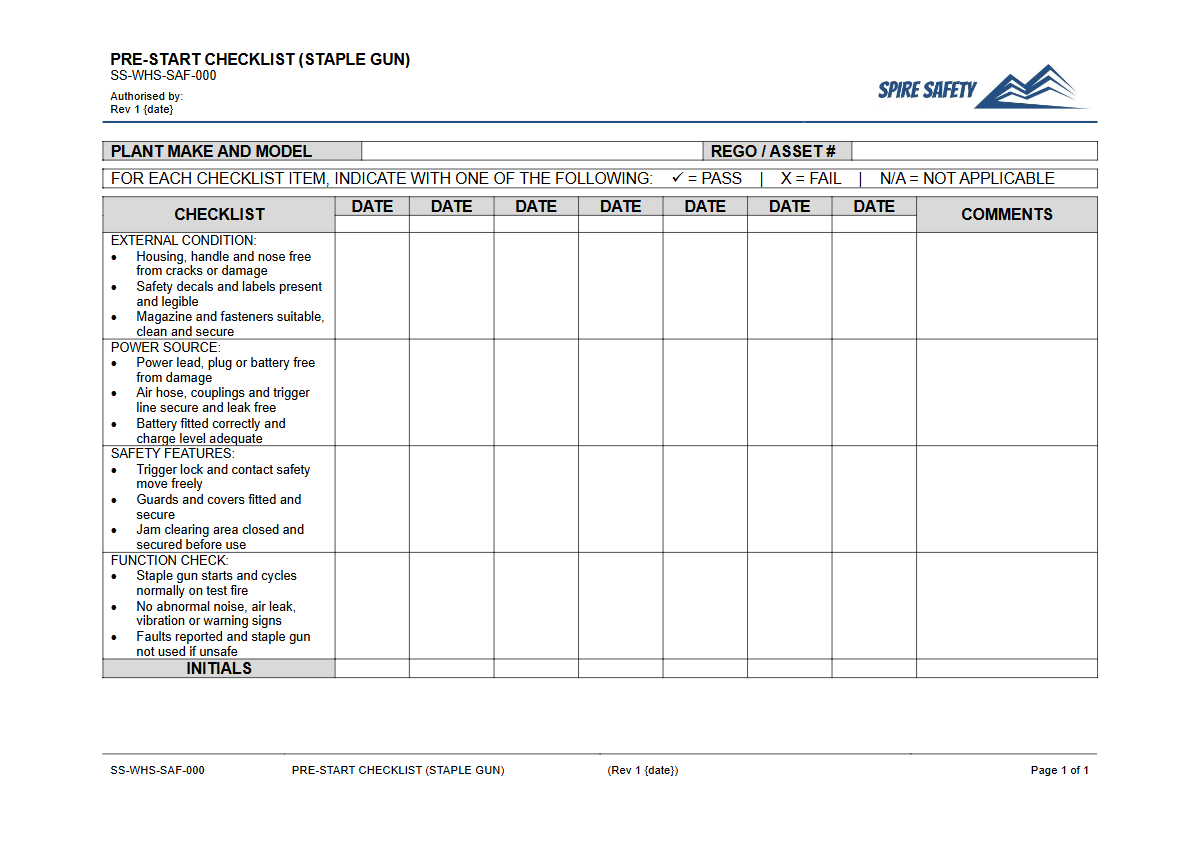
Its primary purpose is to provide a structured method for operators to verify that a staple gun is in safe, working order before use. Using this checklist helps identify potential hazards like faulty safety mechanisms, damaged power cords, or air leaks before they lead to an incident.
Regularly completing these checks creates a documented history of equipment condition, which is a key component of a safe system of work. This record-keeping demonstrates due diligence and supports the proactive management of plant and equipment risks.
Integrating such procedures is a cornerstone of building robust and effective WHS management systems, ensuring safety processes are consistently applied across the organisation.
Video walkthrough
How to use the Free Pre-Start Checklist (Staple Gun) Template
This template is provided as a starting point, available in both DOCX for easy editing and PDF for straightforward printing. To use it effectively, first download the document.
Next, review the checklist items against the specific types of staple guns used in your workplace. You may need to add or remove checks to suit different models (e.g., adding a check for air hose condition for pneumatic guns or battery charge for cordless electric models).
Once customised, integrate the checklist into your daily operational procedures. Train all operators on why the check is important and how to complete it correctly, including the process for reporting any identified faults.
Store completed checklists in a designated location for record-keeping and review.
Please note: This template provides a foundational structure. We recommend you customise it to reflect the specific staple gun models, tasks, and unique risks present in your workplace. For guidance on tailoring safety documentation, consider engaging specialist WHS consulting.
When to use it
A pre-start check should be completed before a staple gun is used for the first time on any given day or at the beginning of each shift. This frequency ensures that any damage or faults that may have occurred overnight, during transport, or from previous use are identified before the tool is operated.
The check itself is designed to be quick, taking only a minute or two, but it is a crucial investment in preventing injuries.
This principle of pre-use inspection is not unique to staple guns; it is a fundamental practice for most powered equipment. For instance, similar diligence is required for workshop machinery, as outlined in our free Pre-Start Checklist (Bench Grinder) Template, reinforcing a consistent safety-first culture.
Who should use it
The primary person responsible for completing the staple gun pre-start checklist is the operator or worker who will be using the tool. They have the most immediate control over its use and are best positioned to notice any operational defects.
Supervisors also have a role in ensuring these checks are being completed consistently and correctly by their team members.
Supervisors should periodically review the completed checklists to identify recurring faults or patterns of wear and tear, which could indicate a need for a revised maintenance schedule or further operator training. These records can also be invaluable during formal WHS compliance audits as evidence of your organisation's risk management processes in action.
Key Inspection Points
While your customised checklist will be more detailed, general inspection points for a staple gun include:
- Casing and Handle: Check for cracks, chips, or other damage that could compromise the tool's integrity or grip.
- Safety Features: Ensure the contact safety tip (nose) moves freely and is not bypassed. This mechanism prevents the gun from firing unless pressed against a surface.
- Trigger Mechanism: Verify the trigger moves smoothly and is not stuck or loose.
- Power Source: For pneumatic guns, inspect the air hose and fittings for leaks or damage. For electric guns, check the cord and plug for fraying or exposed wires. For cordless models, check the battery housing for damage.
- Magazine and Fasteners: Ensure the magazine opens and closes correctly and is loaded with the appropriate size and type of staples for the task.
Applying this level of detailed inspection is crucial for all portable power tools. The same systematic approach can be seen in resources like our free Pre-Start Checklist for Floor Saws, which also focuses on operational controls and mechanical integrity.
Where staple guns are used in environments with other hazards, such as workshops using solvents or adhesives, it's important to consider the entire work area. Proper ventilation might be managed using equipment covered by a free Pre-Start Checklist for Fume Cabinets, showing how different safety procedures can overlap.
This template is just one of many tools designed to help streamline your WHS obligations. You can explore more checklists, policies, and guides in our extensive free WHS resources library to support your safety goals.
Common mistakes
Common mistakes to avoid
- Skipping the check entirely because the tool is perceived as 'simple' and low-risk.
- Using a generic, non-customised checklist that doesn't cover the specific features of the model in use.
- Failing to properly tag out and report faulty equipment, leaving a hazardous tool available for others to use.
- Neglecting to inspect the power source (air hose, electrical cord, battery), which is a common point of failure.
Legal references
Legal considerations
The following legal requirements may be relevant to this type of work.
- Work Health and Safety Act (Harmonised) — Provides the primary duties for protecting workers and other people from work health and safety risks.
- Work Health and Safety Regulations (Harmonised) — Sets out requirements supporting the management of workplace hazards and risks.
The following codes may be relevant to this type of work.
- Managing WHS Risks Code of Practice — Provides practical guidance on identifying hazards, assessing risks and applying effective controls.
- Work Health and Safety Consultation, Cooperation and Coordination Code of Practice — Provides practical guidance on consulting workers and coordinating with other duty holders.
- Managing the Work Environment and Facilities Code of Practice — Provides practical guidance on safe work environments, workplace facilities and related controls.
Did you know
A Common Injury Source
Staple gun injuries are surprisingly common, particularly in construction. Many incidents involve the non-dominant hand when workers place it too close to the firing point, or result from ricochets when staples strike a hard surface or metal.
The Safety Nose
The sequential-trip trigger, or contact safety tip, was a major safety innovation for staple guns and nail guns. It requires the nose of the tool to be depressed against a surface before the trigger can be pulled, preventing accidental firing into the air.
FAQ
Frequently asked questions
01Why is a pre-start check needed for a simple tool like a staple gun?
02What happens if a fault is found during a staple gun pre-start check?
03How often should staple gun pre-start checks be documented and stored?
04Can this staple gun checklist be used for all types of staple guns?
Share this resource
Free Pre-Start Checklist (Staple Gun) Template
Browse Categories
How To Use It
- 1Download and open in Word or PDF.
- 2Replace the placeholders with your business details.
- 3Get it reviewed by a WHS specialist before rollout.
Need it customised?
Our WHS consultants can adapt this template to your site, run a gap analysis, or audit what you already have in place.
Book a Free Consultation WHS consulting servicesor call 1300 156 382