
Free Pre-Start Checklist (Steriliser) Template
Download your free Pre-Start Checklist (Steriliser) Template. This customisable DOCX & PDF helps operators inspect sterilisers for hazards before use.
Free Pre-Start Checklist (Steriliser) Template
DOCX • 125 KB + PDF
Updated Oct 2026
No signup required
Purpose of the Free Pre-Start Checklist (Steriliser) Template
This free Pre-Start Checklist (Steriliser) Template provides a structured framework for operators to conduct essential safety inspections on sterilising equipment, such as autoclaves, before each use. Its primary purpose is to systematically identify potential hazards associated with high pressure, extreme heat, steam, and electrical systems.
Formalising these checks helps a Person Conducting a Business or Undertaking (PCBU) meet their primary duty of care under Australian WHS laws by ensuring plant is safe to operate.
Using a standardised checklist ensures consistency in inspections, reduces the risk of equipment failure, and prevents injuries like severe burns or scalding. It creates a documented record that the equipment was in a safe condition at the start of a shift, forming a critical part of your broader WHS management systems. It also helps reinforce key messages from safety training and toolbox talks.
Video walkthrough
How to use the Free Pre-Start Checklist (Steriliser) Template
The template is provided in both DOCX and PDF formats for ease of use. First, download the document and add your company name, logo, and other relevant site details.
The most critical step is customisation. This checklist is a starting point and must be adapted to the specific make, model, and configuration of the steriliser in your workplace.
This is similar to how our free Pre-Start Checklist for 3D Printers must be tailored to the specific machine's risks.
Important Note: This is a generic template, not a finished, document. We cannot know your specific steriliser model, the substances being processed, or the unique environmental risks of your facility.
You must consult the manufacturer's operating manual, conduct a risk assessment, and modify this checklist to include all relevant inspection points for your equipment. Failure to properly customise the checklist could result in critical safety checks being missed.
When to use a Steriliser Pre-Start Checklist
A pre-start checklist should be completed by the operator before the first use on any given day or shift. For equipment that is used infrequently, the check should be performed before every cycle.
The goal is to catch issues that may have developed since the last use, such as damaged seals, leaking valves, or faulty displays.
This routine check does not replace the need for scheduled preventative maintenance, servicing, or statutory inspections by a competent person as required by regulations for pressure vessels. The completion of these checklists should be monitored by supervisors and can be verified during internal or external WHS compliance audits.
Who should use this checklist
The pre-start checklist should be filled out by the person who will be operating the steriliser. This user must be trained and deemed competent in the safe operation of the specific unit, including understanding its functions, controls, and emergency procedures.
They should be able to recognise the hazards highlighted in the checklist and know the correct procedure to follow if a fault is found—namely, to not operate the equipment and to report the issue immediately through established 'tag out' procedures.
Supervisors and managers are responsible for ensuring operators are trained and that these checks are consistently performed. Integrating this checklist with other safety documents, such as a Pre-Start Checks and Plant Maintenance Toolbox Talk, can help reinforce its importance across the team.
In settings like healthcare, users must also be aware of related risks, such as those associated with loading heavy instrument trays.
What's included in the template?
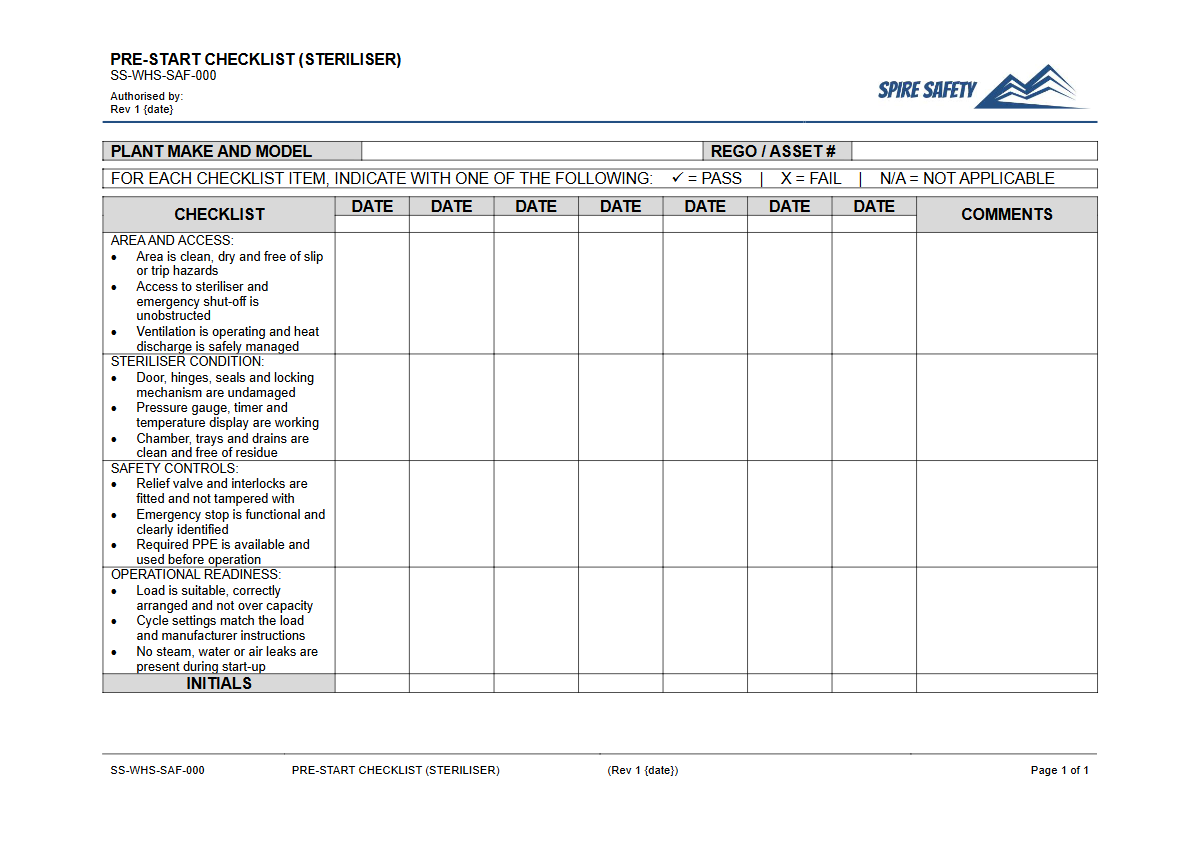
The template provides prompts for essential inspection areas, including:
- General Area: Checks for clear access, slip/trip hazards, and adequate lighting.
- Physical Checks: Inspection of door seals, chamber integrity, locking mechanisms, and external surfaces for damage.
- Controls & Gauges: Verification that pressure gauges, temperature displays, and cycle timers are functional and reading correctly.
- Safety Features: Checks for the condition and accessibility of the emergency stop, pressure relief valves, and any interlock systems.
- Ancillaries: Inspection of water, steam, and electrical connections for leaks or damage.
Feel free to browse our free WHS resources library for other templates that can support your safety management system.
Common mistakes
Common mistakes to avoid
- Failing to physically check door gaskets and seals for cracks or wear.
- Ignoring error codes or unusual readings on gauges, assuming they will 'sort themselves out'.
- 'Pencil-whipping' the form without actually performing the checks.
- Using a generic checklist that hasn't been customised for the specific steriliser model in use.
Legal references
Legal considerations
The following legal requirements may be relevant to this type of work.
- Work Health and Safety Act (Harmonised) — Provides the primary duties for protecting workers and other people from work health and safety risks.
- Work Health and Safety Regulations (Harmonised) — Sets out requirements supporting the management of workplace hazards and risks.
The following codes may be relevant to this type of work.
- Managing WHS Risks Code of Practice — Provides practical guidance on identifying hazards, assessing risks and applying effective controls.
- Work Health and Safety Consultation, Cooperation and Coordination Code of Practice — Provides practical guidance on consulting workers and coordinating with other duty holders.
- Managing the Work Environment and Facilities Code of Practice — Provides practical guidance on safe work environments, workplace facilities and related controls.
Did you know
Pressure Vessel Risk
Autoclaves are pressure vessels that can store immense energy. A catastrophic failure of a large industrial autoclave can have an explosive force equivalent to several kilograms of TNT, highlighting the critical need for regular inspections.
FAQ
Frequently asked questions
01Is a pre-start checklist for a steriliser legally required in Australia?
02What happens if a fault is found during a pre-start inspection?
03How often does a steriliser need a major inspection?
04Can this template be used for any type of autoclave or steriliser?
Share this resource
Free Pre-Start Checklist (Steriliser) Template
Browse Categories
How To Use It
- 1Download and open in Word or PDF.
- 2Replace the placeholders with your business details.
- 3Get it reviewed by a WHS specialist before rollout.
Need it customised?
Our WHS consultants can adapt this template to your site, run a gap analysis, or audit what you already have in place.
Book a Free Consultation WHS consulting servicesor call 1300 156 382