
Free Pre-Start Checklist (Street Sweeper) Template
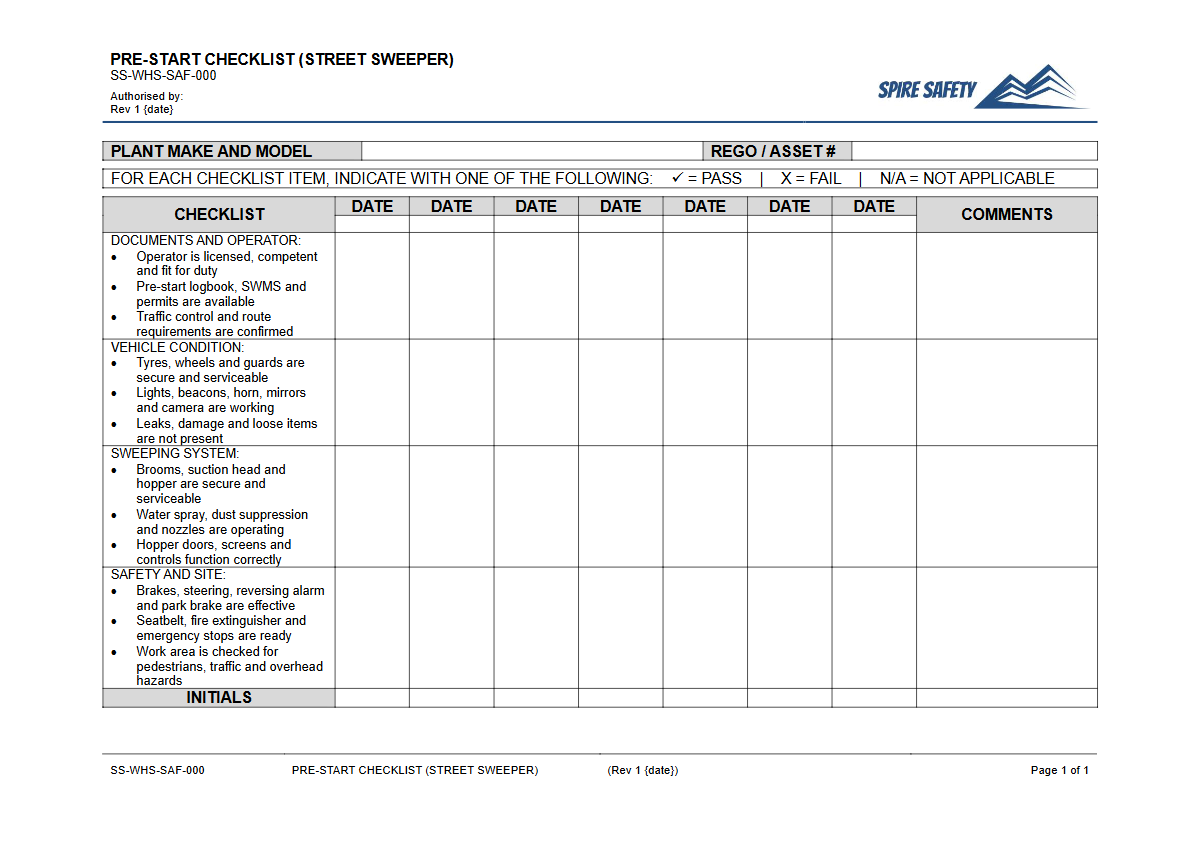
Download our free Pre-Start Checklist (Street Sweeper) Template (DOCX/PDF). A structured starting point to formalise equipment safety inspections. Download now.
Free Pre-Start Checklist (Street Sweeper) Template
DOCX • 125 KB + PDF
Updated Oct 2026
No signup required
Purpose of the Free Pre-Start Checklist (Street Sweeper) Template
Operating a street sweeper, like any piece of mobile plant, involves significant health and safety risks. A systematic pre-start inspection is a fundamental control measure to ensure the equipment is safe to operate before any work begins.
This Free Pre-Start Checklist (Street Sweeper) Template provides a structured format for operators to conduct thorough checks, helping your organisation meet its duty of care. By identifying mechanical faults, fluid leaks, damaged components, or safety system failures early, you can prevent incidents, minimise equipment downtime, and create a documented record of your safety diligence.
Regular pre-start inspections help formalise your approach to plant safety and reinforce safe work practices among operators. They serve as a daily reminder of the importance of mechanical integrity and operational readiness.
You can reinforce these concepts with staff using our Pre-Start Checks and Plant Maintenance toolbox talk to further embed this critical behaviour.
Video walkthrough
How to use the Free Pre-Start Checklist (Street Sweeper) Template
This template is provided as a starting point in both DOCX and PDF formats. The DOCX version is fully editable, allowing you to tailor it to your specific operational needs. Effective implementation involves a few key steps:
- Customise: Modify the checklist to include items specific to the make and model of your street sweepers. Consider adding checks relevant to your unique operating environments, such as visibility aids for night work or specific checks for high-traffic urban areas.
- Train: Ensure all operators are trained on how to use the checklist correctly. This training should cover not just what to check, but why each check is important and the procedure for reporting and rectifying faults.
- Implement: Integrate the checklist into your daily start-up procedure. Establish a clear process for what an operator must do if a fault is found, including 'tagging out' unsafe equipment and reporting the issue to a supervisor or the maintenance team.
- Review: Periodically review completed checklists to identify recurring faults or patterns. This data can inform your maintenance schedule and identify the need for further operator training or process changes.
Important: This is a template document that must be customised to your specific workplace. We are not responsible for your WHS compliance; you must ensure the final document aligns with your specific equipment, operational risks, and legal obligations.
An effective pre-start checklist is just one component of broader WHS management systems that work together to manage risk.
When to use this Pre-Start Checklist
A pre-start checklist should be completed by the operator before the start of every shift or before the first use of the street sweeper on any given day. It is not a weekly or monthly inspection; it is a routine daily check to verify the machine's condition immediately before it is put into service.
If operations are paused and another operator takes over mid-shift, they should also perform a pre-start check to ensure no issues have developed and to take responsibility for the equipment's condition.
This routine check complements, but does not replace, scheduled periodic maintenance and servicing as recommended by the manufacturer. It also works hand-in-hand with verifying operator competency. An operator must not only be competent in using the machine but also in identifying when it is unsafe to use, which is a key outcome of both the pre-start process and a formal Verification of Competency for a ride-on sweeper.
Who should use it
The primary user of the street sweeper pre-start checklist is the operator assigned to the equipment. They have the most direct responsibility for ensuring the machine they are about to use is safe. However, other personnel have roles related to the process:
- Supervisors and Managers: They are responsible for ensuring operators are completing the checklists correctly and for taking appropriate action when faults are reported. They may conduct spot-checks to verify the accuracy of completed forms.
- Maintenance Personnel: They use the information from completed checklists to schedule repairs and conduct preventative maintenance. A clear fault report helps them diagnose and fix problems efficiently.
- WHS Professionals: They are responsible for developing, implementing, and reviewing the overall system. They analyse the data from checklists to identify trends, assess the effectiveness of controls, and ensure the process aligns with the organisation's safety objectives and legal duties. Records from these checks can be valuable evidence during WHS compliance audits.
Integrating the Checklist into Your Safety System
A pre-start checklist is most effective when it is not treated as a standalone administrative task. It should be fully integrated into your organisation's broader safety framework.
The findings from a pre-start can trigger other processes, such as your fault reporting and maintenance request system. If a critical safety system fails the check (e.g., brakes, steering, warning lights), it must trigger a 'tag out' procedure that removes the plant from service immediately.
The information gathered also serves as a valuable input for your risk management activities. For example, if checklists frequently identify worn brushes or blocked water jets, this data can inform the risk assessment for that task and highlight the need for more robust maintenance or different operational procedures.
This process is similar to how a Safe Work Method Statement for concrete truck operation is a living document, informed by ongoing monitoring and review. Your pre-start checklist provides the daily data to keep your risk controls relevant and effective.
By embedding this checklist into your daily operations, you create a powerful tool for proactive risk management. For more templates and tools to build out your safety system, browse our complete free WHS resources library.
Common mistakes
Common mistakes to avoid
- "Pencil-whipping" the checklist without physically inspecting each item.
- Operating the machine despite identifying a "minor" fault that could escalate.
- Failing to formally report defects or remove a faulty machine from service.
- Using a generic checklist that doesn't cover the specific features of the sweeper model.
Legal references
Legal considerations
The following legal requirements may be relevant to this type of work.
- Work Health and Safety Act (Harmonised) — Provides the primary duties for protecting workers and other people from work health and safety risks.
- Work Health and Safety Regulations (Harmonised) — Sets out requirements supporting the management of workplace hazards and risks.
The following codes may be relevant to this type of work.
- Managing WHS Risks Code of Practice — Provides practical guidance on identifying hazards, assessing risks and applying effective controls.
- Work Health and Safety Consultation, Cooperation and Coordination Code of Practice — Provides practical guidance on consulting workers and coordinating with other duty holders.
- Managing the Work Environment and Facilities Code of Practice — Provides practical guidance on safe work environments, workplace facilities and related controls.
Did you know
A Dusty History
The first mechanical street sweeper was invented by C.S. Bishop in England and patented in 1849. His design used a combination of brushes and a conveyor system to collect debris, a basic principle still found in many sweepers today.
Hidden Hazards
Dust generated during sweeping can contain hazardous materials like heavy metals, pesticides, and crystalline silica. This makes checks on dust suppression systems (water sprayers) and operator cabin filtration critical health and safety controls.
FAQ
Frequently asked questions
01What key items should be included in a street sweeper pre-start check?
02How often should a street sweeper pre-start checklist be completed?
03Who is responsible for ensuring pre-start checks are done on a street sweeper?
04Is a digital pre-start checklist better than a paper one?
Share this resource
Free Pre-Start Checklist (Street Sweeper) Template
Browse Categories
How To Use It
- 1Download and open in Word or PDF.
- 2Replace the placeholders with your business details.
- 3Get it reviewed by a WHS specialist before rollout.
Need it customised?
Our WHS consultants can adapt this template to your site, run a gap analysis, or audit what you already have in place.
Book a Free Consultation WHS consulting servicesor call 1300 156 382