
Free Pre-Start Checklist (Suction Pump) Template
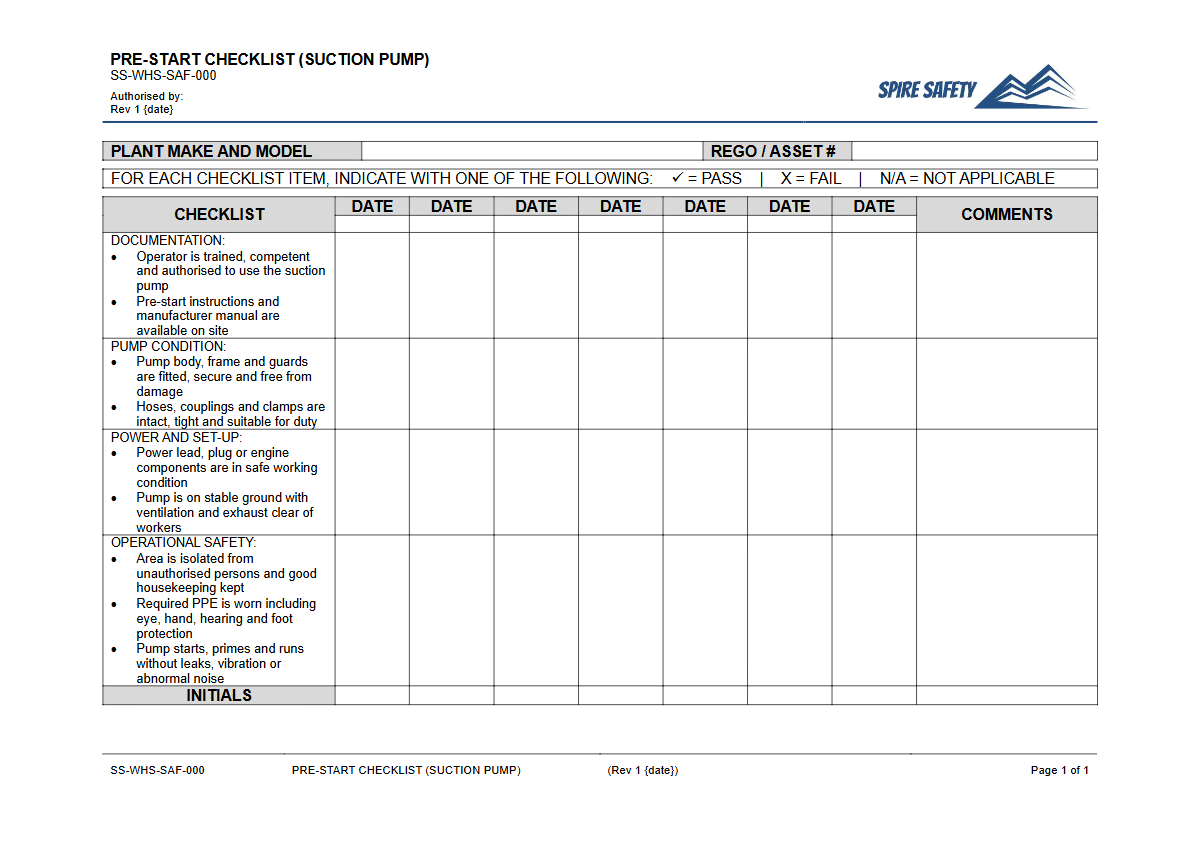
Formalise your equipment safety checks with our free Pre-Start Checklist (Suction Pump) Template. Download the DOCX and PDF to start improving safety.
Free Pre-Start Checklist (Suction Pump) Template
DOCX • 125 KB + PDF
Updated Oct 2026
No signup required
Purpose of the Free Pre-Start Checklist (Suction Pump) Template
This free Pre-Start Checklist (Suction Pump) Template provides a structured starting point for organisations to formalise daily or pre-use inspections of suction pumps. Regularly inspecting equipment before use is a fundamental safety practice that helps identify potential defects, damage, or operational issues before they can lead to an incident.
Using this checklist helps to systematically verify that key components such as hoses, guards, power sources, and emergency stops are in a safe and serviceable condition. It serves as a critical tool in managing risks associated with plant operation, including mechanical failure, fluid leaks, electrical hazards, and operator injury.
Implementing a consistent pre-start check process supports a proactive safety culture and assists in meeting obligations under Australian WHS laws. It creates a documented record of inspections, which can be invaluable for incident investigations, maintenance scheduling, and demonstrating due diligence.
A comprehensive inspection regime is a core component of effective WHS management systems, ensuring that safety is integrated into daily operational routines.
Video walkthrough
How to use the Free Pre-Start Checklist (Suction Pump) Template
This template is available for immediate download in both DOCX (Microsoft Word) and PDF formats. The DOCX file is fully editable, allowing for complete customisation to suit your specific workplace needs.
Important: This is a template, not a finished document. You must customise it to reflect the specific make, model, and configuration of your suction pump, its operating environment, and the specific tasks it is used for.
We have no way of knowing your unique circumstances. Review the checklist items and add or remove checks based on the manufacturer’s instructions and a thorough risk assessment.
The free Water Pump Risk Assessment Template can help you identify specific hazards that need to be addressed in your customised checklist.
To use this resource:
- Download the DOCX file.
- Add your company name, logo, and other relevant details.
- Review, add, and remove checklist items to align with your specific pump model, manufacturer's guidelines, and workplace risk controls.
- Incorporate any site-specific requirements or environmental controls.
- Train operators and relevant personnel on how to use the finalised checklist correctly.
- Implement the checklist as part of your standard pre-operational procedure.
When to use it
The pre-start checklist should be completed by a competent person before the suction pump is used for the first time in a shift or before each new task. This ensures that the equipment's condition is verified immediately prior to operation, catching any issues that may have developed since its last use.
It is also good practice to use the checklist after maintenance or repair activities have been performed to confirm the pump is safe to return to service. Regular safety discussions, such as a Pre-Start Checks and Plant Maintenance Toolbox Talk, can help reinforce the importance of these routine inspections and ensure consistent application across all teams.
Who should use it
This checklist is primarily designed for trained and authorised operators of suction pumps. They are the individuals directly interacting with the equipment and are best positioned to conduct a thorough visual and functional inspection.
Supervisors and managers also have a role in ensuring the pre-start process is completed correctly and consistently. They should periodically review completed checklists to verify compliance, monitor for recurring issues, and ensure any identified faults are addressed promptly and effectively.
These records can also be reviewed during routine WHS compliance audits to verify that safety procedures are being followed. For a comprehensive approach to safety, these checks should be part of a broader procedure documented in a safe work method statement or a free Pump SOP (Safe Operating Procedure) Template.
Ultimately, ensuring workers are competent is just as critical as ensuring machinery is safe. Documenting operator skills through a formal process, such as a Verification of Competency for stationary concrete pumps, is a key part of managing plant safety.
While this link refers to a different pump type, the principle of verifying operator competence is universally applicable. If you can't find the specific document you're looking for, our free WHS resources library has dozens of other templates you may find useful.
Common mistakes
Common mistakes to avoid
- Failing to customise the template for the specific pump model and work environment.
- Operators 'pencil-whipping' the checklist without physically inspecting the items.
- Ignoring or deferring action on minor faults identified during the check, which can escalate into major failures.
- Skipping the pre-start check because the pump appeared to be working correctly during the previous shift.
Legal references
Legal considerations
The following legal requirements may be relevant to this type of work.
- Work Health and Safety Act (Harmonised) — Provides the primary duties for protecting workers and other people from work health and safety risks.
- Work Health and Safety Regulations (Harmonised) — Sets out requirements supporting the management of workplace hazards and risks.
The following codes may be relevant to this type of work.
- Managing WHS Risks Code of Practice — Provides practical guidance on identifying hazards, assessing risks and applying effective controls.
- Work Health and Safety Consultation, Cooperation and Coordination Code of Practice — Provides practical guidance on consulting workers and coordinating with other duty holders.
- Managing the Work Environment and Facilities Code of Practice — Provides practical guidance on safe work environments, workplace facilities and related controls.
Did you know
The Danger of Cavitation
Pump cavitation, the formation of vapour bubbles in the fluid, can cause severe damage to internal components. The collapse of these bubbles creates intense shockwaves that erode impellers and casings, leading to premature failure and costly repairs.
FAQ
Frequently asked questions
01What is the difference between a pre-start checklist and a risk assessment?
02How often should suction pumps be inspected?
03Can I use this pre-start checklist for other types of pumps?
04What records do I need to keep for pre-start checks?
Share this resource
Free Pre-Start Checklist (Suction Pump) Template
Browse Categories
How To Use It
- 1Download and open in Word or PDF.
- 2Replace the placeholders with your business details.
- 3Get it reviewed by a WHS specialist before rollout.
Need it customised?
Our WHS consultants can adapt this template to your site, run a gap analysis, or audit what you already have in place.
Book a Free Consultation WHS consulting servicesor call 1300 156 382