
Free Pre-Start Checklist (Syringe Pump) Template
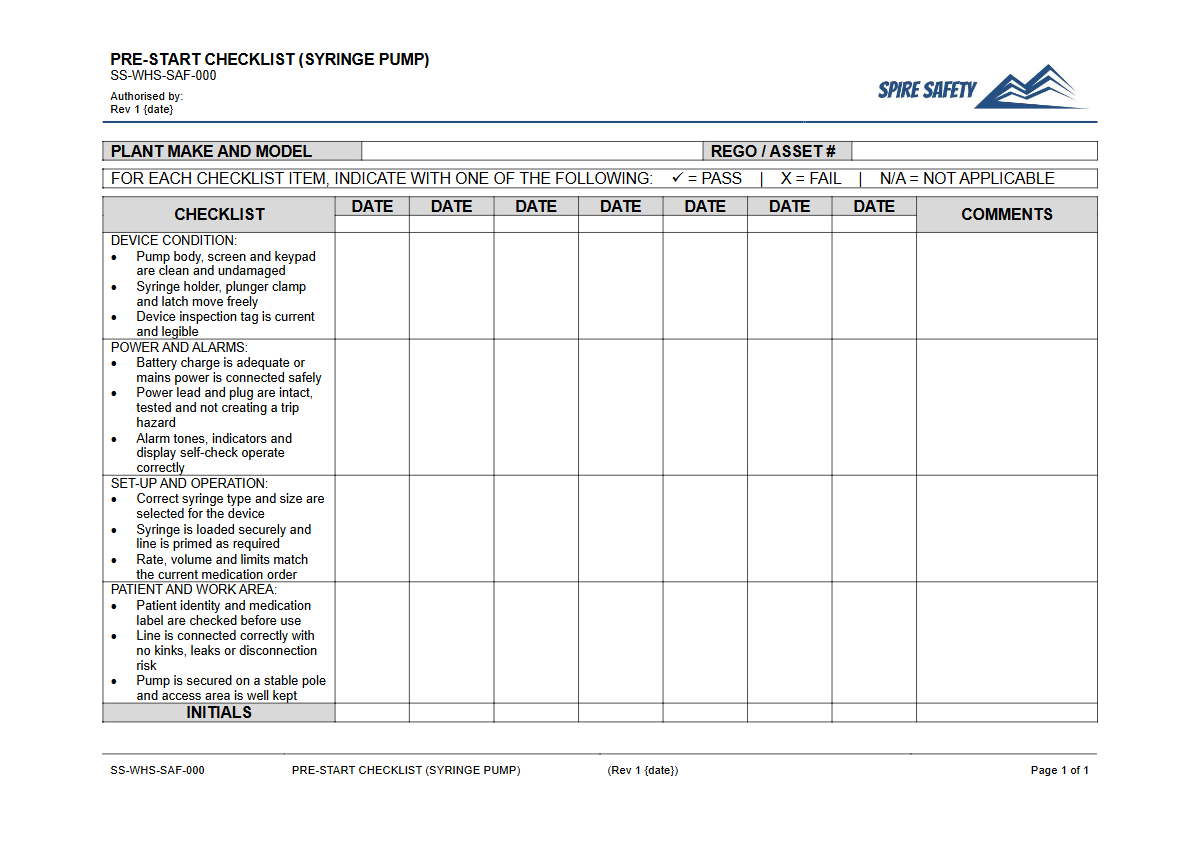
Download our free Pre-Start Checklist (Syringe Pump) Template. This structured DOCX & PDF resource helps formalise safety checks for syringe pumps.
Free Pre-Start Checklist (Syringe Pump) Template
DOCX • 125 KB + PDF
Updated Oct 2026
No signup required
Purpose of the Free Pre-Start Checklist (Syringe Pump) Template
A syringe pump is a piece of precision equipment used to deliver small, accurate, and consistent amounts of fluid. Whether used in a medical, laboratory, or industrial setting, its correct function is critical.
This free Pre-Start Checklist (Syringe Pump) Template provides a structured framework for operators to conduct essential safety and operational checks before use. Integrating these checks helps identify potential faults, damage, or calibration issues that could lead to inaccurate dosing, equipment failure, or exposure to hazardous substances.
Using a daily checklist formalises the inspection process, ensuring no steps are missed and creating a documented record of due diligence. It is a fundamental part of a safe system of work, helping to fulfil the PCBU’s duty of care to provide and maintain safe plant. To further embed this behaviour, you can reinforce the importance of equipment inspections with our Pre-Start Checks and Plant Maintenance Toolbox Talk.
While a pre-start checklist focuses on immediate operational safety, it is also a component of a broader safety strategy. The process of customising and implementing this checklist supports your overall risk management activities. By systematically thinking about what could go wrong with a syringe pump, you are actively identifying hazards, which is the first step in a formal risk assessment process, similar to the one outlined in our Free Water Pump Risk Assessment Template.
Video walkthrough
How to use the Free Pre-Start Checklist (Syringe Pump) Template
This template is designed for ease of use and customisation. After downloading the DOCX or PDF file, you should adapt it to suit the specific context of your workplace. Key steps for implementation include:
- Customise the Checklist: Add your company branding and details. Most importantly, review and modify the checklist items to align with the specific make and model of syringe pumps you use. Consider adding checks relevant to the fluids being pumped (e.g., compatibility), the operating environment, and any specific alarms or features of your equipment.
- Consult with Workers: Involve the operators who use the syringe pumps daily. Their practical experience is invaluable for identifying critical checks and potential failure points.
- Train Your Team: Ensure all relevant personnel are trained on how and when to use the checklist. Explain the importance of each check and the correct procedure to follow if a fault is identified.
- Implement and Review: Integrate the checklist into your daily operational procedures. Periodically review its effectiveness and update it as necessary, especially when new equipment is introduced or incidents occur.
Please note: This document is a template. We provide it as a starting point, and you must customise it to reflect the specific models of syringe pumps used at your workplace, the tasks they perform, and your unique operational environment. A robust checklist is a vital tool within comprehensive WHS management systems.
When to use it
A pre-start checklist for a syringe pump should be completed before its first use on any given day or at the beginning of any shift during which it will be operated. It is a routine check to verify the equipment's condition before it is put into service.
This process does not replace the need for regular, scheduled maintenance and calibration as specified by the manufacturer, but rather complements it by catching potential issues that may arise between service intervals.
Who should use it
This checklist should be used by any person who is trained, authorised, and deemed competent to operate the syringe pump. This may include laboratory technicians, medical staff, research scientists, or industrial operators.
Competency involves not only knowing how to operate the pump but also understanding the associated risks and being able to identify signs of malfunction or damage. The specific procedures for safe operation, including who is authorised to use the equipment, are typically detailed in a Pump SOP (Safe Operating Procedure).
Implementing new safety documents and procedures can sometimes reveal gaps or complexities in your existing safety framework. If you require assistance in developing or refining your processes to align with Australian WHS standards, our WHS consulting services can provide tailored expert guidance.
This can help ensure your safety documentation is practical, effective, and integrated seamlessly into your operations.
Common mistakes
Common mistakes to avoid
- Using a generic checklist without customising it for the specific pump model and substance.
- Failing to check for small leaks or damage to the syringe itself, which can compromise dose accuracy.
- Ignoring error codes or alarms, assuming they are minor or will resolve themselves.
- Skipping the check because the pump was used recently, without considering if conditions have changed.
Legal references
Legal considerations
The following legal requirements may be relevant to this type of work.
- Work Health and Safety Act (Harmonised) — Provides the primary duties for protecting workers and other people from work health and safety risks.
- Work Health and Safety Regulations (Harmonised) — Sets out requirements supporting the management of workplace hazards and risks.
The following codes may be relevant to this type of work.
- Managing WHS Risks Code of Practice — Provides practical guidance on identifying hazards, assessing risks and applying effective controls.
- Work Health and Safety Consultation, Cooperation and Coordination Code of Practice — Provides practical guidance on consulting workers and coordinating with other duty holders.
- Managing the Work Environment and Facilities Code of Practice — Provides practical guidance on safe work environments, workplace facilities and related controls.
Did you know
Precision at Scale
Syringe pumps are capable of delivering fluids at precisely controlled flow rates, some with volumes as small as a few picolitres (one trillionth of a litre) per minute, making them essential in microfluidics and pharmacology.
Not Just Medical
While common in healthcare, industrial-grade syringe pumps are crucial in manufacturing for dispensing adhesives, lubricants, and chemicals with high accuracy, ensuring product quality and consistency.
FAQ
Frequently asked questions
01Is a pre-start checklist for a syringe pump legally required in Australia?
02How often should a syringe pump be calibrated?
03What are the main hazards of using a syringe pump?
04Can this template be used for all types of syringe pumps?
Share this resource
Free Pre-Start Checklist (Syringe Pump) Template
Browse Categories
How To Use It
- 1Download and open in Word or PDF.
- 2Replace the placeholders with your business details.
- 3Get it reviewed by a WHS specialist before rollout.
Need it customised?
Our WHS consultants can adapt this template to your site, run a gap analysis, or audit what you already have in place.
Book a Free Consultation WHS consulting servicesor call 1300 156 382