
Free Pre-Start Checklist (Table Saw) Template
Download our Free Pre-Start Checklist (Table Saw) Template in DOCX and PDF. A structured starting point for formalising equipment safety inspections.
Free Pre-Start Checklist (Table Saw) Template
DOCX • 125 KB + PDF
Updated Oct 2026
No signup required
Purpose of the Free Pre-Start Checklist (Table Saw) Template
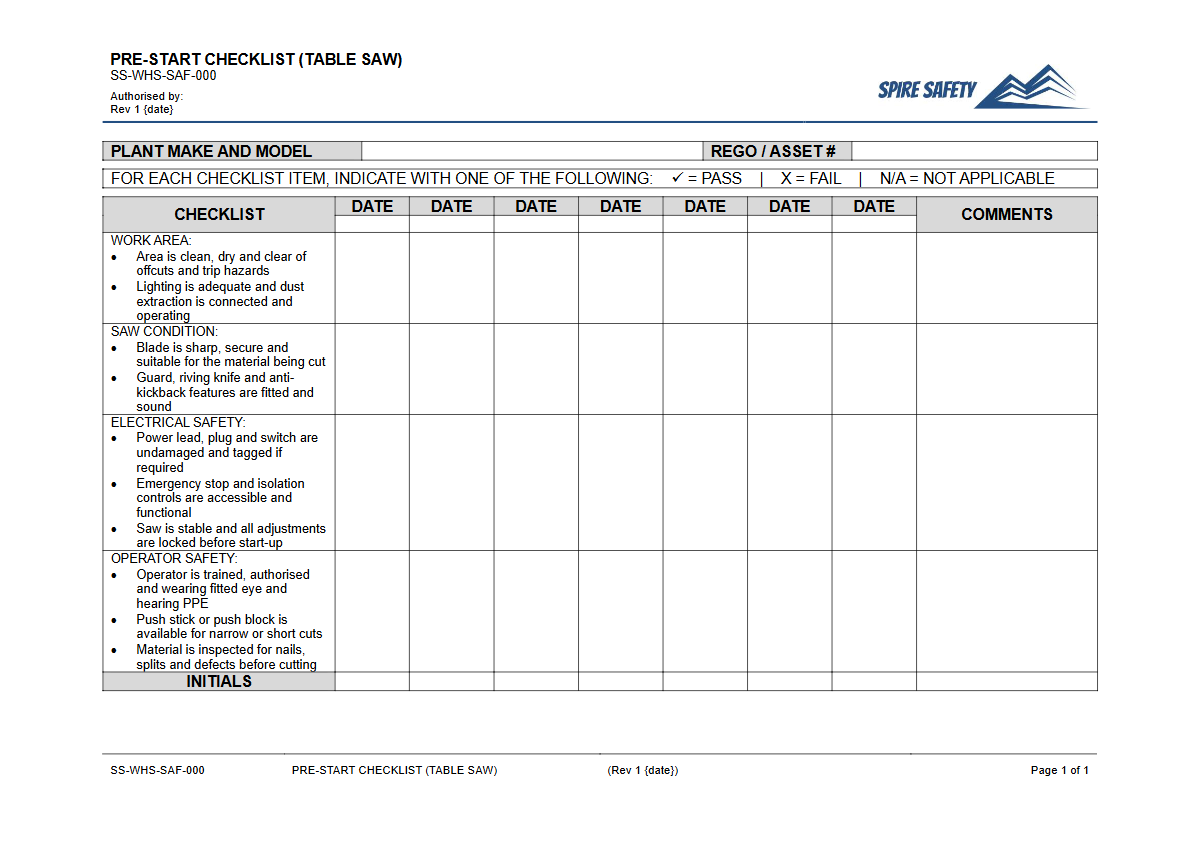
Our free Pre-Start Checklist (Table Saw) Template provides a structured starting point for inspecting table saws before use. Table saws are powerful and essential workshop tools, but they also carry significant risks, including amputation, lacerations, and injuries from kickback.
A systematic pre-start inspection is a critical control measure to identify and address potential mechanical or electrical faults before they can cause harm.
Using this template helps formalise the inspection process, ensuring that operators consistently check key safety components like guards, riving knives, blade condition, and emergency stops. Documenting these checks creates a record of due diligence and promotes a proactive safety culture within your organisation.
This checklist is a foundational step in any workshop's safety protocol and should be integrated with a detailed Table Saw Safe Operating Procedure to guide workers through every stage of use.
Video walkthrough
How to use the Free Pre-Start Checklist (Table Saw) Template
This resource is provided as a fully editable Microsoft Word (DOCX) document and a print-ready PDF. To use it, download the file and adapt it to your specific operational needs.
You can add your company logo, site-specific details, and references to your internal procedures.
Please note: This template is a starting point. We have designed it to be comprehensive, but you must customise it to reflect the specific makes and models of table saws used in your workplace, your unique operational environment, and any state-specific WHS requirements.
Formalising these checks is a key component of robust WHS management systems, helping to create a consistent and auditable safety process.
When to use it
A pre-start checklist for a table saw should be completed before its first use on any given day or shift. This ensures the equipment is in a safe condition before work commences.
If an operator changes during a shift, the incoming operator should also perform a check to verify the saw's condition for themselves.
Additionally, a pre-start check is recommended after the saw has been moved, serviced, or repaired to confirm it is ready to be returned to service. This routine can be reinforced through regular training, such as a Pre-Start Checks and Plant Maintenance Toolbox Talk, to ensure all operators understand its importance.
Who should use it
The primary user of this checklist is the person who will be operating the table saw. They have the most direct responsibility for ensuring the equipment they are about to use is safe.
By completing the checklist, they are consciously reviewing the machine's safety features and overall condition.
Supervisors and workshop managers also have a role. They should periodically review completed checklists to ensure the process is being followed correctly and to identify any recurring maintenance issues that need to be addressed at a higher level.
It is critical that only trained and competent individuals operate a table saw. Competency can be formally assessed using a structured tool like our free Table Saw VOC template to verify skills and knowledge.
What to do if a fault is found
If the pre-start inspection reveals any defects, damage, or missing components, the table saw must not be used. The operator should immediately apply a 'Do Not Operate' or 'Out of Service' tag to the machine's isolation point.
The issue must then be reported to a supervisor or the designated maintenance personnel according to your organisation's fault reporting procedure. Documenting these actions creates a clear audit trail, which is invaluable during internal reviews or a formal WHS compliance auditing process.
While this checklist is specific to table saws, the principles of pre-start inspections apply to a wide range of plant and equipment. The core function of identifying hazards before operation is a universal safety practice.
For instance, a similar methodical approach is taken in our free Pre-Start Checklist for a CNC router, adapted for that machine's unique risks. You can explore our complete free WHS resources library for more templates covering other types of equipment.
Common mistakes
Common mistakes to avoid
- Completing the checklist from memory without physically inspecting the saw ('pencil-whipping').
- Failing to check the riving knife or splitter for correct alignment and height relative to the blade.
- Ignoring 'minor' issues like a slightly frayed power cord or a dull blade, which can lead to major incidents.
- Not properly securing the checklist for review, losing valuable data on equipment condition over time.
Legal references
Legal considerations
The following legal requirements may be relevant to this type of work.
- Work Health and Safety Act (Harmonised) — Provides the primary duties for protecting workers and other people from work health and safety risks.
- Work Health and Safety Regulations (Harmonised) — Sets out requirements supporting the management of workplace hazards and risks.
The following codes may be relevant to this type of work.
- Managing WHS Risks Code of Practice — Provides practical guidance on identifying hazards, assessing risks and applying effective controls.
- Work Health and Safety Consultation, Cooperation and Coordination Code of Practice — Provides practical guidance on consulting workers and coordinating with other duty holders.
- Managing the Work Environment and Facilities Code of Practice — Provides practical guidance on safe work environments, workplace facilities and related controls.
Did you know
Kickback Speed
A table saw's 'kickback'—when the wood is violently thrown back at the operator—can happen faster than human reaction time. The wood can be ejected at over 170 km/h.
A Leading Cause of Injury
In Australia, powered saws are a leading cause of serious workshop injuries, with table saws being a primary contributor to hand and finger amputations.
FAQ
Frequently asked questions
01What is the purpose of a table saw pre-start checklist?
02Who is responsible for completing the table saw pre-start check?
03What should I do if I find a problem during a pre-start inspection?
04How often should a table saw pre-start inspection be performed?
Share this resource
Free Pre-Start Checklist (Table Saw) Template
Browse Categories
How To Use It
- 1Download and open in Word or PDF.
- 2Replace the placeholders with your business details.
- 3Get it reviewed by a WHS specialist before rollout.
Need it customised?
Our WHS consultants can adapt this template to your site, run a gap analysis, or audit what you already have in place.
Book a Free Consultation WHS consulting servicesor call 1300 156 382