
Free Pre-Start Checklist (Tailgate Lift) Template
Download our Free Pre-Start Checklist (Tailgate Lift) Template.
Free Pre-Start Checklist (Tailgate Lift) Template
DOCX • 125 KB + PDF
Updated Oct 2026
No signup required
Purpose of the Free Pre-Start Checklist (Tailgate Lift) Template
Using this free Pre-Start Checklist (Tailgate Lift) Template is a critical step in ensuring the safe operation of vehicle-mounted loading equipment. The primary purpose of a pre-start check is to systematically identify potential hazards, defects, or malfunctions before the equipment is used.
Regular inspections help prevent catastrophic failures, reduce the risk of injury to operators and bystanders, and minimise costly downtime associated with unexpected breakdowns. By formalising this process, your organisation can demonstrate a proactive approach to risk management and foster a positive safety culture.
Integrating such checklists is a cornerstone of robust WHS management systems, providing documented evidence of due diligence.
Video walkthrough
How to use the Free Pre-Start Checklist (Tailgate Lift) Template
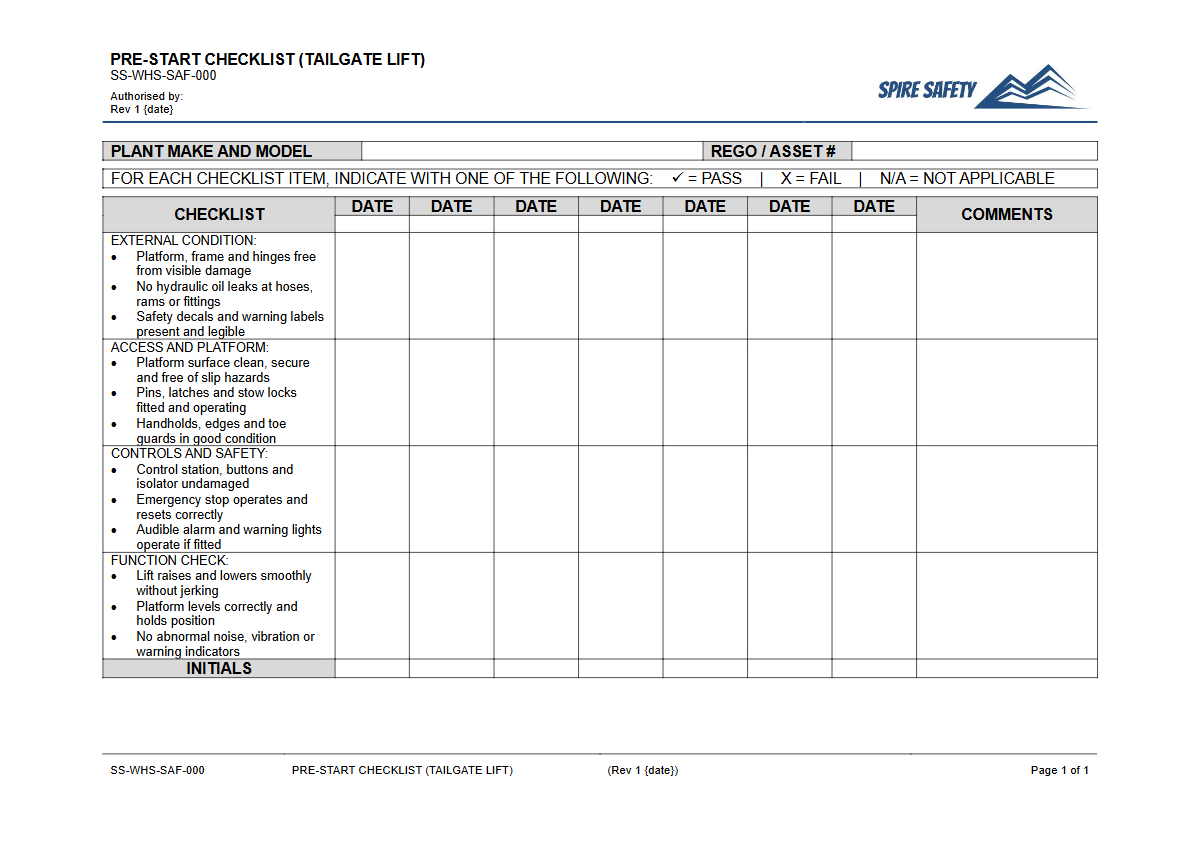
This template provides a structured starting point for developing a checklist tailored to your specific equipment and operational context. It covers key components and safety features commonly found on tailgate lifts, serving as a comprehensive guide aligned with Australian WHS principles.
Steps for Implementation
- Download the DOCX file and open it in a word processor.
- Review each item and customise it to match the make, model, and configuration of your tailgate lifts. Add or remove checks as necessary based on the manufacturer's instructions and a site-specific risk assessment.
- Involve operators and maintenance personnel in the customisation process to ensure the checklist is practical and comprehensive for daily use.
- Once finalised, save and print copies, or integrate the checklist into a digital system for operators to complete before each shift.
Important: This is a generic template that must be customised. We cannot guarantee it covers every specific hazard for your particular equipment or workplace.
A thorough risk assessment should always inform the final checklist content. The principle of customisation is vital for all specialised lifting gear, including those covered by our pre-start checklist for boat lifts.
When to use it
A tailgate lift pre-start checklist should be completed by the operator before the first use on any given shift or workday. If a vehicle is used by multiple operators throughout the day, a new check should ideally be conducted at each handover.
This frequency ensures that any damage or faults that may have occurred during operation or transit are identified promptly before they can escalate. Completed checklists should be filed and periodically reviewed as part of your organisation's safety procedures, a process that can be verified during regular WHS compliance audits to confirm process adherence.
Who should use it
The primary user of this Pre-Start Checklist is the trained and competent operator of the vehicle and its tailgate lift. They are in the best position to assess the equipment's immediate condition before starting work.
Supervisors and fleet managers should also be familiar with the checklist's content to ensure operators are completing it correctly and to establish a clear process for following up on any reported defects. All personnel involved must have received adequate training on the specific model of tailgate lift they are inspecting and operating.
This principle of operator-led checks is universal across different types of machinery, from healthcare equipment detailed in our patient hoist pre-start checklist to heavy-duty logistics vehicles.
Key Inspection Areas
While your customised checklist will be specific to your assets, it should generally cover several critical areas to ensure a thorough inspection.
Structural and Mechanical Checks
- Platform: Check for cracks, bending, warping, or excessive corrosion. Ensure the surface is non-slip and free from debris, oil, or grease.
- Lifting Mechanism: Inspect chains, cables, and arms for wear, damage, or correct tension. Listen for unusual noises like grinding or squealing during operation.
Hydraulic and Electrical Systems
- Hydraulics: Visually inspect for any signs of fluid leaks from hoses, cylinders, or fittings. Check that the hydraulic fluid level is adequate, as per manufacturer guidelines.
- Controls: Test all control buttons and levers (both fixed and remote) to ensure they function correctly and that the platform moves smoothly without juddering. Ensure emergency stop functions work instantly. This process is similar to testing the controls on other automated equipment, such as those in our pre-start checklist for gate motors.
- Power Source: Check battery connections for security and signs of corrosion.
Safety Features
- Safety Rails and Gates: Verify that all guardrails, safety chains, or platform gates are in place and function correctly.
- Warning Devices: Ensure any audible alarms or flashing lights are operational.
- Decals and Markings: Check that all safety warnings, load capacity labels, and operational instructions are legible and intact.
If you need assistance developing comprehensive safety documents tailored to your fleet and operational risks, consider engaging specialist WHS consulting services for expert guidance.
Common mistakes
Common mistakes to avoid
- Overlooking minor hydraulic fluid weeps, which can indicate a future hose failure.
- Failing to test safety features like automatic platform-tilt or cart stops.
- 'Pencil-whipping' the checklist without physically inspecting the components.
- Continuing to use the lift despite known defects, even for 'one last job'.
Legal references
Legal considerations
The following legal requirements may be relevant to this type of work.
- Work Health and Safety Act (Harmonised) — Provides the primary duties for protecting workers and other people from work health and safety risks.
- Work Health and Safety Regulations (Harmonised) — Sets out requirements supporting the management of workplace hazards and risks.
The following codes may be relevant to this type of work.
- Managing WHS Risks Code of Practice — Provides practical guidance on identifying hazards, assessing risks and applying effective controls.
- Work Health and Safety Consultation, Cooperation and Coordination Code of Practice — Provides practical guidance on consulting workers and coordinating with other duty holders.
- Managing the Work Environment and Facilities Code of Practice — Provides practical guidance on safe work environments, workplace facilities and related controls.
Did you know
Loading and Unloading Risks
According to Safe Work Australia, the transport, postal, and warehousing industry has one of the highest rates of serious workers' compensation claims, with vehicle incidents and muscular stress from handling goods being major causes.
FAQ
Frequently asked questions
01How often should a tailgate lift be formally inspected?
02What should an operator do if a fault is found during a pre-start check?
03Is this template a WHS-aligned document?
04Who is responsible for training operators on how to use a tailgate lift?
Share this resource
Free Pre-Start Checklist (Tailgate Lift) Template
Browse Categories
How To Use It
- 1Download and open in Word or PDF.
- 2Replace the placeholders with your business details.
- 3Get it reviewed by a WHS specialist before rollout.
Need it customised?
Our WHS consultants can adapt this template to your site, run a gap analysis, or audit what you already have in place.
Book a Free Consultation WHS consulting servicesor call 1300 156 382