
Free Pre-Start Checklist (Tiller) Template
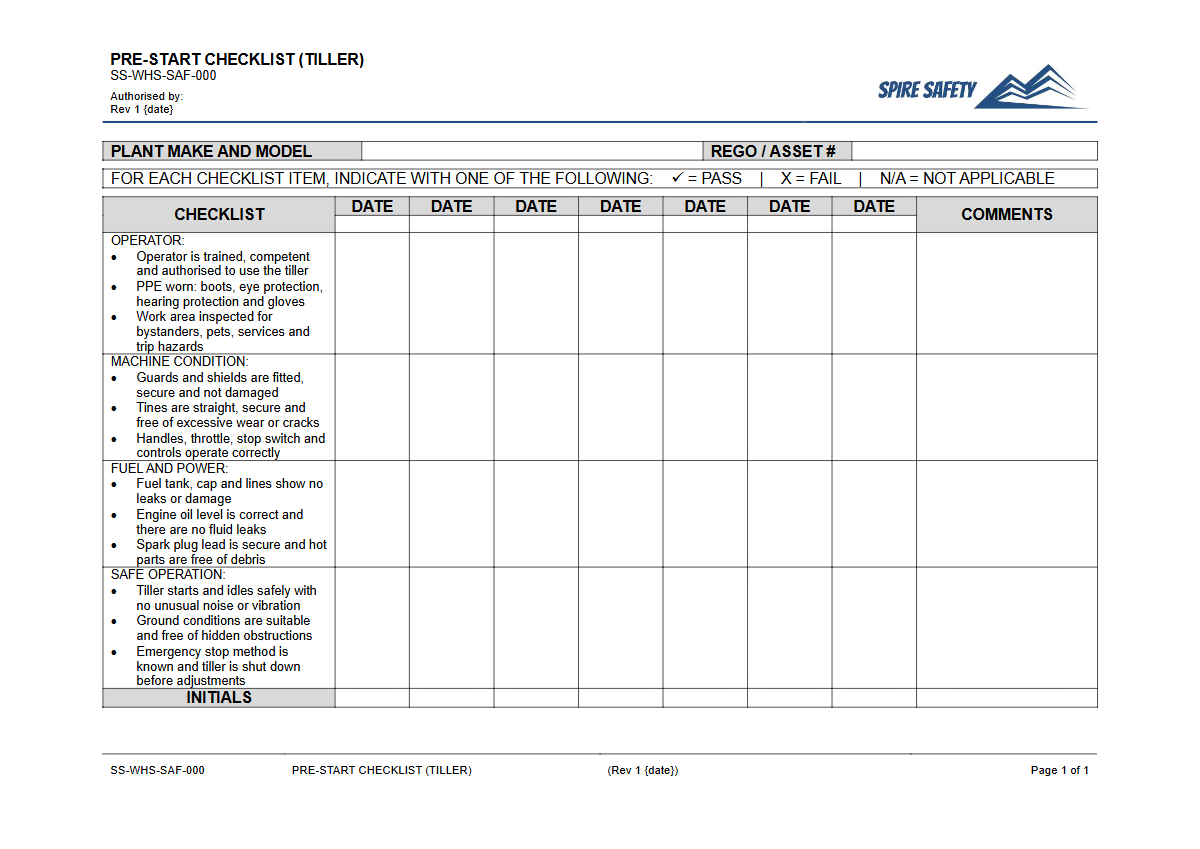
Download our free Pre-Start Checklist (Tiller) Template. This DOCX & PDF resource provides a structured starting point for equipment safety inspections.
Free Pre-Start Checklist (Tiller) Template
DOCX • 125 KB + PDF
Updated Oct 2026
No signup required
Purpose of the Free Pre-Start Checklist (Tiller) Template
Operating a tiller, rototiller, or cultivator involves significant mechanical and ergonomic risks. A pre-start inspection is a fundamental safety practice that helps identify potential faults or hazards before the equipment is used.
This Free Pre-Start Checklist (Tiller) Template provides a structured format to formalise these checks, ensuring operators systematically inspect critical components like tines, guards, controls, and fluid levels. By documenting these inspections, your organisation creates a record of due diligence and promotes a proactive safety culture.
It helps ensure the tiller is in a safe condition, minimising the risk of incidents, injuries, or costly equipment failures.
Integrating routine equipment checks into your daily operations is a key part of plant safety. To help reinforce this behaviour with your teams, you can use resources like our Pre-Start Checks and Plant Maintenance Toolbox Talk Template to facilitate direct safety conversations with workers.
This template is designed as a starting point, aligned with Australian WHS principles. It guides operators through a logical inspection sequence, helping to standardise the process across all teams and worksites.
A consistent approach to pre-starts is a critical component of effective risk management for mobile plant.
Video walkthrough
How to use the Free Pre-Start Checklist (Tiller) Template
This checklist should be completed by a competent operator before the first use of the tiller each day or shift. The operator should walk around the machine, physically inspecting each item listed and ticking off the corresponding box to confirm its condition.
Any identified defects, damage, or concerns must be recorded in the 'Corrective Actions' section of the form. If a fault poses an immediate safety risk, the tiller must be tagged out of service and not used until it has been repaired by a qualified person.
Important: This is a template, not a finished document. To be effective, you must customise it to suit your specific workplace, tiller models, and operational risks.
We recommend consulting with operators, maintenance staff, and safety personnel during the customisation process to ensure all relevant checks are included. An effective checklist forms just one part of broader WHS management systems that document your organisation's approach to safety.
Completed checklists should be retained as part of your safety records. Regularly reviewing these records can help identify recurring equipment faults, highlight the need for further training, or indicate trends that require a review of your maintenance program.
These reviews can be incorporated into your broader safety assurance activities.
When to use it
A pre-start check should be conducted at the beginning of every day or shift before the tiller is operated. It is a pre-operational check, not a maintenance inspection.
It should also be used whenever a new operator takes over the equipment during a shift, or if the machine has been idle for an extended period.
These checks are the first line of defence against equipment-related incidents. They are especially crucial in environments where equipment is shared among multiple users, such as in equipment hire, landscaping, or agricultural businesses.
Using a formal document like our Free Pre-Start Meeting Template can help structure the start of the day and ensure all necessary checks are communicated and completed.
Who should use it
The pre-start checklist should be completed by the person who will be operating the tiller. The operator must be deemed competent, meaning they have received the necessary information, instruction, and training to operate the machine safely and to recognise the hazards associated with its use.
Supervisors or managers are responsible for ensuring these checks are being completed correctly and that any reported defects are addressed promptly.
This process is relevant for any Person Conducting a Business or Undertaking (PCBU) whose workers operate tillers. This includes businesses in agriculture, horticulture, landscaping, construction, and equipment rental services. Regular reviews of safety documentation, including completed checklists, are an important part of ensuring your safety systems remain effective, a process that can be supported by formal WHS compliance auditing.
While this checklist is specific to tillers, the principle of pre-start inspections applies to all types of plant and equipment. For instance, similar checks are required for other landscaping tools, and you can download our Free Pre-Start Checklist (Aerator) Template for that purpose.
You can explore our entire free WHS resources library for other useful templates.
Common mistakes
Common mistakes to avoid
- "Pencil-whipping" the checklist without actually performing the physical inspections.
- Using a generic, non-customised checklist that doesn't cover the specific model of tiller in use.
- Continuing to operate a tiller after identifying a minor fault, assuming it's not a major risk.
- Failing to formally tag out and remove faulty equipment from service, leaving it available for others to use.
Legal references
Legal considerations
The following legal requirements may be relevant to this type of work.
- Work Health and Safety Act (Harmonised) — Provides the primary duties for protecting workers and other people from work health and safety risks.
- Work Health and Safety Regulations (Harmonised) — Sets out requirements supporting the management of workplace hazards and risks.
The following codes may be relevant to this type of work.
- Managing WHS Risks Code of Practice — Provides practical guidance on identifying hazards, assessing risks and applying effective controls.
- Work Health and Safety Consultation, Cooperation and Coordination Code of Practice — Provides practical guidance on consulting workers and coordinating with other duty holders.
- Managing the Work Environment and Facilities Code of Practice — Provides practical guidance on safe work environments, workplace facilities and related controls.
Did you know
Vibration Risk
Prolonged use of tillers can expose operators to Hand-Arm Vibration (HAV), a serious occupational hazard that can cause permanent damage to nerves and blood vessels. Regular breaks and anti-vibration gloves can help manage the risk.
Agricultural Pioneer
The first commercially successful rototiller was patented in 1912 by Australian agriculturalist Arthur Clifford Howard. His machine revolutionised small-scale farming and cultivation worldwide.
FAQ
Frequently asked questions
01What should be included in a tiller pre-start inspection?
02How often should tiller pre-start checks be done?
03Who is responsible for conducting a tiller pre-start check?
04Why is documenting pre-start checks important?
Share this resource
Free Pre-Start Checklist (Tiller) Template
Browse Categories
How To Use It
- 1Download and open in Word or PDF.
- 2Replace the placeholders with your business details.
- 3Get it reviewed by a WHS specialist before rollout.
Need it customised?
Our WHS consultants can adapt this template to your site, run a gap analysis, or audit what you already have in place.
Book a Free Consultation WHS consulting servicesor call 1300 156 382