
Free Pre-Start Checklist (Tow Tractor) Template
Download our Free Pre-Start Checklist (Tow Tractor) Template to formalise daily equipment checks and manage WHS risks.
Free Pre-Start Checklist (Tow Tractor) Template
DOCX • 125 KB + PDF
Updated Oct 2026
No signup required
Purpose of the Free Pre-Start Checklist (Tow Tractor) Template
A tow tractor, or tug, is a powerful piece of equipment essential in many logistics, manufacturing, and airport operations. To ensure it remains safe and reliable, regular inspections are critical.
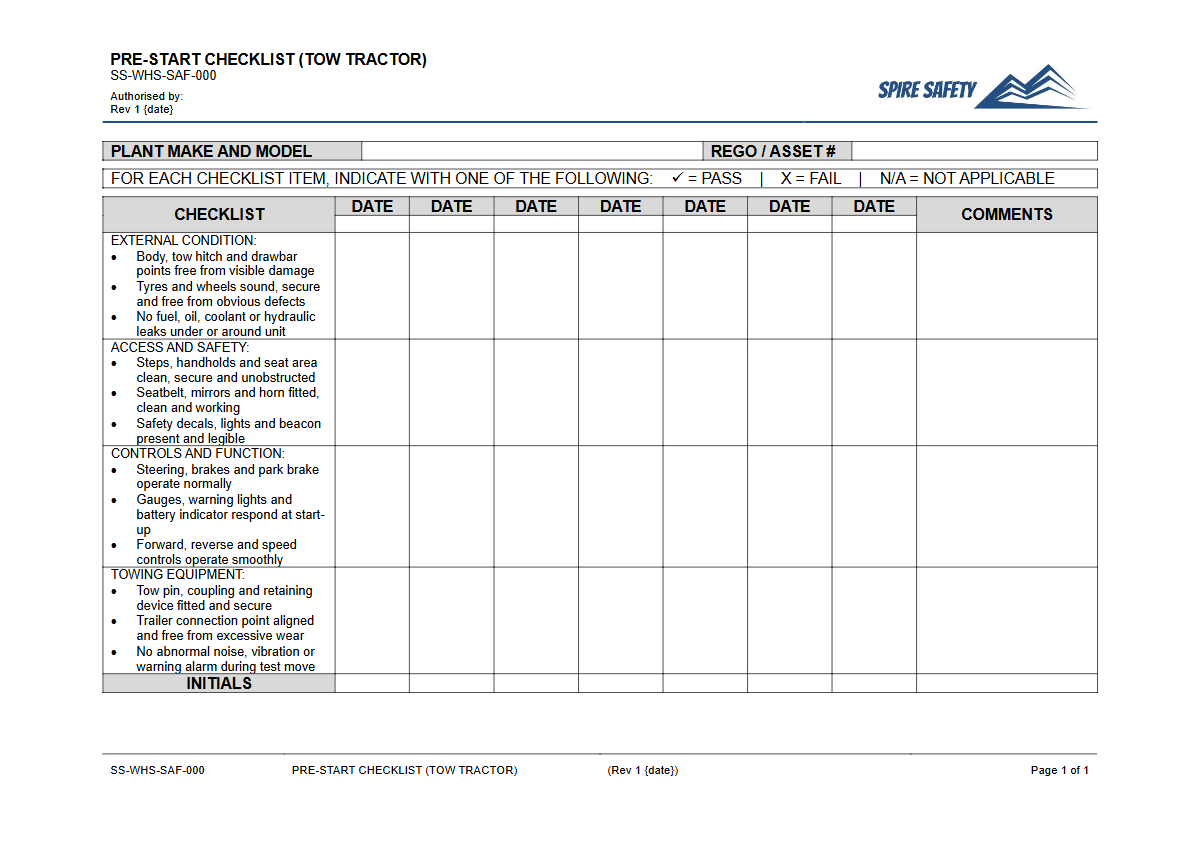
This Free Pre-Start Checklist (Tow Tractor) Template provides a structured framework for operators to conduct thorough pre-operational checks. Using a formal checklist helps systematically identify potential faults or hazards before they lead to an incident, property damage, or injury.
It serves as a practical tool to support your broader safety procedures and demonstrates a proactive approach to risk management.
By integrating this process into daily routines, you create a consistent standard for equipment inspection across your organisation. It prompts operators to look beyond the obvious and check critical components like braking systems, steering, warning devices, and towing mechanisms.
Implementing such checks is a fundamental part of most effective WHS management systems, helping to ensure plant is maintained in a safe condition.
Video walkthrough
How to use the Free Pre-Start Checklist (Tow Tractor) Template
Our pre-start checklist is designed for ease of use and customisation. After downloading the DOCX or PDF file, you should adapt it to your specific operational context.
The process is straightforward: review the items, add or remove checks based on the make and model of your tow tractors, and incorporate any unique risks present in your workplace, such as specific ground surfaces or tight operational areas.
Once customised, integrate the checklist into your standard operating procedures. Ensure all operators are trained on how to properly complete the inspection, what each item means, and the procedure for reporting any faults discovered.
The checklist includes sections for recording the date, operator details, and a sign-off, creating a formal record of the inspection. Similar structured checks are valuable for other equipment, like our pre-start checklist for forwarders used in forestry.
Customisation is Essential
This document provides a solid foundation aligned with Australian WHS principles. However, every workplace and piece of equipment is different.
We strongly advise that you customise this template to accurately reflect the specific tow tractor models you use, your site conditions, and any unique tasks operators perform. A generic checklist may not capture all relevant hazards, so tailoring it is a crucial step in fulfilling your safety duties.
When to use it
A pre-start check should be completed by the operator at the beginning of every shift before the tow tractor is used for the first time. It should also be performed whenever a different operator takes control of the vehicle during a shift.
Additionally, a full pre-start inspection is recommended after the tow tractor has undergone maintenance or repair to verify it is safe to return to service.
These routine checks are a key component of ongoing safety verification. They supplement, but do not replace, scheduled maintenance by qualified technicians or more comprehensive regular WHS compliance audits that assess the overall effectiveness of your safety programs.
Who should use it
The primary user of this checklist is the trained and competent tow tractor operator. They are in the best position to physically inspect the equipment they are about to use and identify any changes or defects from its previous state.
Supervisors and managers also have a role in reviewing completed checklists, ensuring the process is followed correctly, and taking prompt action on any reported faults.
WHS personnel can use the aggregated data from these checklists to identify trends, such as recurring faults with a specific machine, which can inform maintenance schedules and purchasing decisions. For a workshop environment where tow tractors might be serviced, having checks for all equipment, including a bench grinder pre-start checklist, ensures a consistent approach to safety.
Ultimately, a pre-start check is a shared responsibility that contributes to a safer working environment for everyone. If you need assistance developing a comprehensive plant safety program, consider engaging with professional WHS consulting services. You can also explore our extensive free WHS resources library for more templates and guides to support your safety objectives.
Common mistakes
Common mistakes to avoid
- Using a generic checklist without customising it for the specific tow tractor model and workplace.
- Rushing through the checklist ('pencil-whipping') without physically inspecting the components.
- Failing to remove a faulty tow tractor from service immediately after a defect is found.
- Poor record-keeping, where completed checklists are not filed or reviewed by supervisors.
Legal references
Legal considerations
The following legal requirements may be relevant to this type of work.
- Work Health and Safety Act (Harmonised) — Provides the primary duties for protecting workers and other people from work health and safety risks.
- Work Health and Safety Regulations (Harmonised) — Sets out requirements supporting the management of workplace hazards and risks.
The following codes may be relevant to this type of work.
- Managing WHS Risks Code of Practice — Provides practical guidance on identifying hazards, assessing risks and applying effective controls.
- Work Health and Safety Consultation, Cooperation and Coordination Code of Practice — Provides practical guidance on consulting workers and coordinating with other duty holders.
- Managing the Work Environment and Facilities Code of Practice — Provides practical guidance on safe work environments, workplace facilities and related controls.
Did you know
Towing Capacity
Exceeding a tow tractor's rated towing capacity is a leading cause of incidents. An overloaded tug can suffer from reduced braking effectiveness, poor steering control, and instability, especially on inclines or uneven surfaces.
Battery Hazards
For electric tow tractors, the battery packs pose significant risks. These can include chemical burns from acid, fire or explosion from hydrogen gas released during charging, and severe electrical shock from high-voltage systems.
FAQ
Frequently asked questions
01Why is a tow tractor pre-start check important?
02How often should a tow tractor pre-start be completed?
03What happens if a fault is found during the pre-start check?
04Are digital pre-start checklists better than paper ones?
Share this resource
Free Pre-Start Checklist (Tow Tractor) Template
Browse Categories
How To Use It
- 1Download and open in Word or PDF.
- 2Replace the placeholders with your business details.
- 3Get it reviewed by a WHS specialist before rollout.
Need it customised?
Our WHS consultants can adapt this template to your site, run a gap analysis, or audit what you already have in place.
Book a Free Consultation WHS consulting servicesor call 1300 156 382