
Free Pre-Start Checklist (Transfer Pump) Template
Formalise your daily equipment safety checks with our free Pre-Start Checklist (Transfer Pump) Template. Download your customisable DOCX and PDF now.
Free Pre-Start Checklist (Transfer Pump) Template
DOCX • 125 KB + PDF
Updated Oct 2026
No signup required
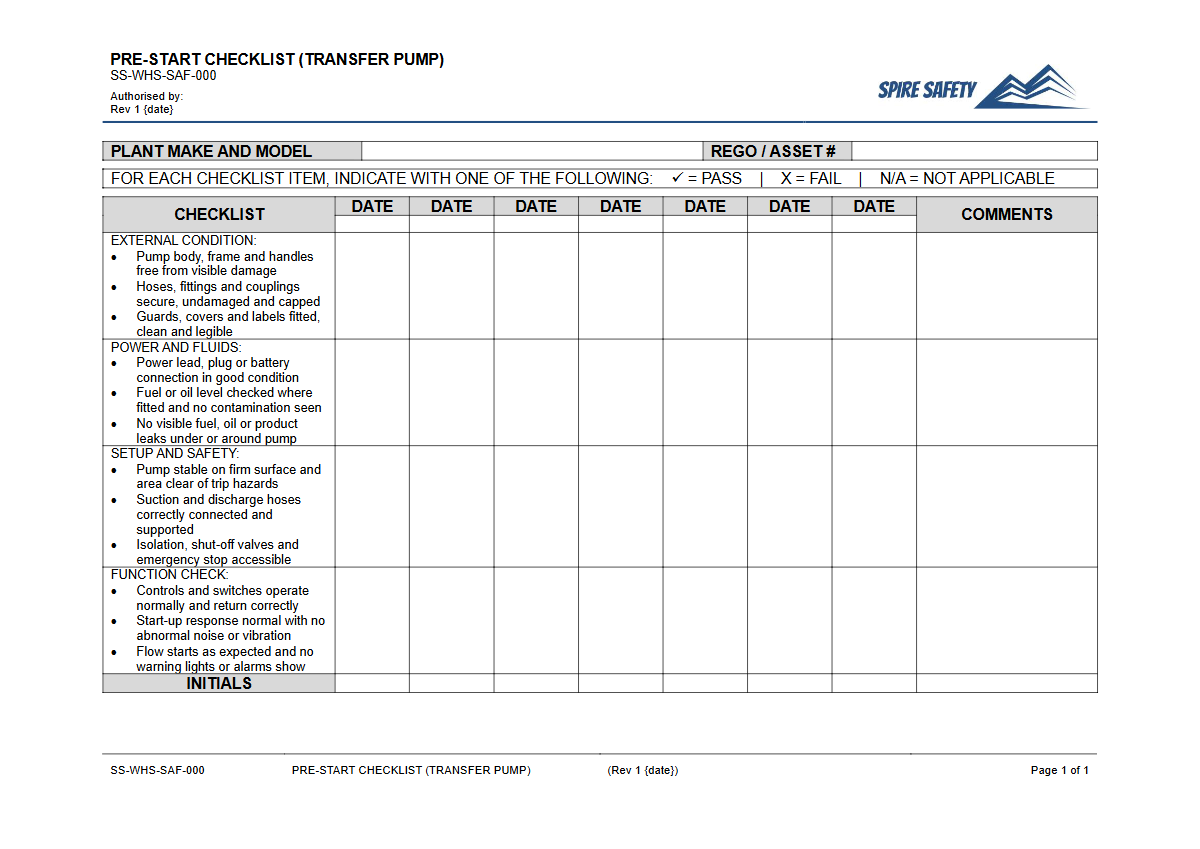
Purpose of the Free Pre-Start Checklist (Transfer Pump) Template
Using a transfer pump involves risks, from fluid leaks and chemical exposure to electrical faults and mechanical failures. This Free Pre-Start Checklist (Transfer Pump) Template provides a structured framework to help your workers identify and control these hazards before they start work.
It’s designed to formalise the daily inspection process, ensuring that pumps are safe to operate and that any potential issues are identified, reported, and rectified promptly.
A consistent pre-start process helps prevent incidents, reduces equipment downtime, and demonstrates your organisation’s commitment to workplace health and safety. These completed checklists form a crucial part of your safety records, which are often reviewed during a WHS compliance auditing process to verify procedural adherence.
Video walkthrough
How to Use the Free Pre-Start Checklist (Transfer Pump) Template
This template is provided as a starting point, aligned with Australian WHS principles. To use it effectively:
- Download the template in your preferred format (DOCX for easy editing or PDF for immediate printing).
- Customise the checklist items to match the specific make and model of your transfer pump(s).
- Add or remove checks based on the pump’s application, the substances being transferred (e.g., fuel, water, corrosive chemicals), and its operating environment.
- Integrate the checklist into your daily operational procedures and provide training to all relevant workers.
Important: This document is a template and must be customised. We have developed it as a guide, but it is your responsibility to ensure it is adapted to the specific equipment, risks, and operational context of your workplace.
A generic checklist that doesn't account for your unique situation may not be sufficient to manage your WHS obligations. Effective integration into your broader WHS management systems is key to its success.
When to Use a Transfer Pump Pre-Start Checklist
A Pre-Start Checklist for a transfer pump should be completed by a competent operator before each work shift or before the first use of the day. This routine ensures that the equipment's condition hasn't changed overnight or between shifts due to damage, tampering, or environmental factors.
For pumps used intermittently, the check should be performed before each use. Similar routines are essential for other critical equipment, as detailed in our Pre-Start Checklist for Fire Pumps.
Who Should Use This Checklist
The primary user of this Pre-Start Checklist is the authorised and competent operator of the transfer pump. They are best placed to physically inspect the equipment they are about to use.
Supervisors also have a role in ensuring the checks are completed correctly and reviewing any reported defects or issues. Maintenance personnel may use the completed checklists to schedule repairs or preventative maintenance tasks, ensuring a closed-loop system for hazard management.
For equipment in specialised environments, such as labs, you might also use a Pre-Start Checklist for Fume Cabinets to manage related risks.
Using this template consistently helps build a stronger safety culture and operational discipline. The principles of pre-start inspections apply to a wide range of pumps; for instance, you might also find our Free Pre-Start Checklist (Cooling Pump) Template useful. For more tools to support your safety programs, explore our complete free WHS resources library.
Common mistakes
Common mistakes to avoid
- Failing to customise the generic template for the specific pump model and its application.
- Operators 'pencil-whipping' the form – ticking boxes without physically performing the checks.
- Not having a clear procedure for reporting and rectifying defects found during the inspection.
- Skipping the pre-start check entirely under time pressure, treating it as optional rather than mandatory.
Legal references
Legal considerations
The following legal requirements may be relevant to this type of work.
- Work Health and Safety Act (Harmonised) — Provides the primary duties for protecting workers and other people from work health and safety risks.
- Work Health and Safety Regulations (Harmonised) — Sets out requirements supporting the management of workplace hazards and risks.
The following codes may be relevant to this type of work.
- Managing WHS Risks Code of Practice — Provides practical guidance on identifying hazards, assessing risks and applying effective controls.
- Work Health and Safety Consultation, Cooperation and Coordination Code of Practice — Provides practical guidance on consulting workers and coordinating with other duty holders.
- Managing the Work Environment and Facilities Code of Practice — Provides practical guidance on safe work environments, workplace facilities and related controls.
Did you know
The Cost of Failure
Industry studies suggest that pump failures are often preventable and that up to 70% of unplanned equipment shutdowns are linked to issues that could have been detected with routine inspections and preventative maintenance.
FAQ
Frequently asked questions
01What is the main purpose of a transfer pump pre-start check?
02Who is responsible for completing the transfer pump checklist?
03How often should a transfer pump pre-start be done?
04What should happen if a defect is found during a pre-start check?
Share this resource
Free Pre-Start Checklist (Transfer Pump) Template
Browse Categories
How To Use It
- 1Download and open in Word or PDF.
- 2Replace the placeholders with your business details.
- 3Get it reviewed by a WHS specialist before rollout.
Need it customised?
Our WHS consultants can adapt this template to your site, run a gap analysis, or audit what you already have in place.
Book a Free Consultation WHS consulting servicesor call 1300 156 382