
Free Pre-Start Checklist (Tray Washer) Template
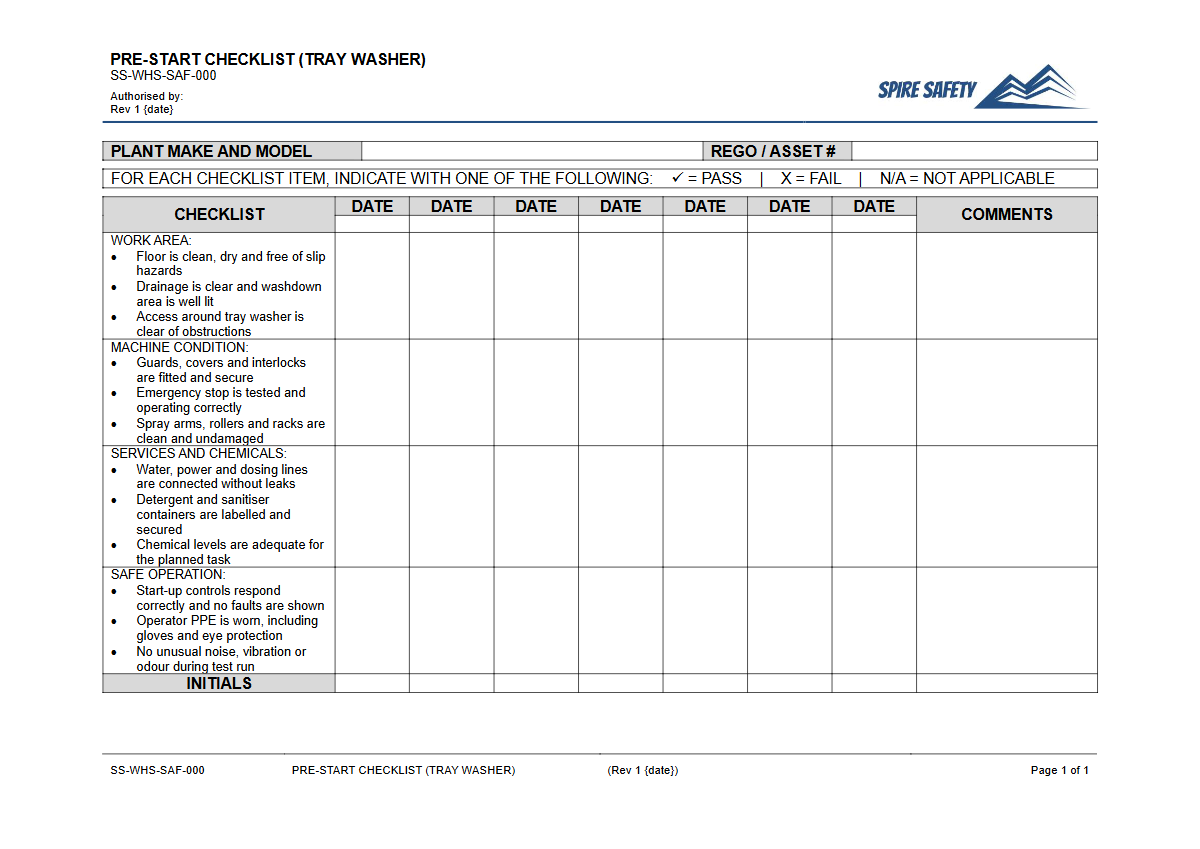
Download our free Pre-Start Checklist for Tray Washers. This template helps formalise daily equipment inspections to identify hazards before use.
Free Pre-Start Checklist (Tray Washer) Template
DOCX • 125 KB + PDF
Updated Oct 2026
No signup required
Purpose of the Free Pre-Start Checklist (Tray Washer) Template
Integrating a formal inspection process is a fundamental aspect of workplace safety, particularly for machinery with thermal, chemical, and mechanical hazards. This free Pre-Start Checklist (Tray Washer) Template provides a structured method for operators to inspect equipment before they begin work.
Its primary purpose is to systematically identify potential faults or hazards, such as leaking seals, blocked wash arms, malfunctioning temperature gauges, or faulty door interlocks. By catching these issues early, organisations can prevent incidents, reduce the risk of injury to workers, and avoid costly equipment downtime.
Using this checklist helps demonstrate a commitment to proactive risk management and can be a key document within your broader WHS management systems. Regular, documented checks create a historical record of the plant's condition, which is invaluable for maintenance scheduling, incident investigations, and demonstrating due diligence. It formalises a critical safety behaviour, moving beyond ad-hoc visual checks to a more rigorous and accountable process.
Video walkthrough
How to use the Free Pre-Start Checklist (Tray Washer) Template
Implementing this checklist effectively involves a few key steps. First, download the template in your preferred format (DOCX or PDF).
The next critical step is customisation. This document provides a solid foundation, but it must be adapted to reflect the specific make, model, and configuration of the tray washer used in your workplace.
Different machines have unique features, controls, and potential failure points that a generic checklist might miss.
Important: Every workplace is unique. We have designed this template as a comprehensive starting point, but you must customise it to address the specific model of tray washer, tasks, and hazards present in your work environment.
Once customised, train all operators on how to complete the checklist correctly, what each item means, and the procedure for reporting faults. A great way to deliver this training is through a targeted safety discussion, and our Pre-Start Checks and Plant Maintenance Toolbox Talk Template can help structure that conversation.
When to use it
A pre-start checklist should be completed before the first use of the tray washer on every shift. For environments where the machine is used intermittently throughout the day by different operators, it may be practical for the first operator of the day to perform the check.
The key is consistency. The check should become a non-negotiable part of the daily operating routine, just like handwashing or setting up the workspace.
This routine ensures a consistent safety standard is met each day before operations commence. For some sites, this process might be discussed during daily planning sessions, which can be documented with a free Pre-Start Meeting Template.
Who should use it
The pre-start checklist must be completed by a worker who is trained and competent in the safe operation of the specific tray washer. This person must understand the machine's functions and be able to recognise the signs of a potential defect or hazard.
While the operator is responsible for performing the check, supervisors also have a responsibility to ensure the checks are being completed correctly and that any reported issues are addressed promptly. A documented procedure, like our FREE Pressure Washer SOP (Safe Operating Procedure) Template, can help formalise the requirements for operator competency on similar cleaning equipment.
Key Inspection Points for a Tray Washer
While your customised checklist will be more detailed, it should generally cover the following areas to ensure a thorough inspection.
General & Structural Checks
- Check for damage to external panels, doors, and the main frame.
- Ensure the machine is level and stable.
- Confirm that all guards and covers are securely in place.
- Inspect the condition of wash and rinse arms, ensuring nozzles are clear of debris.
When loading or unloading the machine, workers must use correct techniques to avoid musculoskeletal injury. These risks are common in industries like food processing and healthcare, and our Aged Care Manual Handling Toolbox Talk Template provides useful guidance on this topic.
Operational & Safety Feature Checks
- Test the emergency stop button to ensure it functions correctly.
- Verify that door safety interlocks stop the cycle immediately when the door is opened.
- Check that control panel lights, gauges (temperature, pressure), and displays are working.
- Confirm that audible or visual alarms are functional.
The effectiveness of these documented checks can be a key focus during a formal safety review. A thorough WHS compliance auditing process will often involve verifying that such plant inspections are not only documented but are also being carried out effectively to control risk.
Fluid & Electrical Checks
- Inspect hoses, pipes, and seals for any signs of water leaks.
- Check levels of detergent and rinse aid, inspecting dosing lines for leaks or damage.
- Examine the electrical cord and plug for any fraying, cracks, or damage.
- Ensure the area around the machine is free from slip hazards caused by water or chemical spills.
By using this template as a starting point, you can develop a robust checklist that enhances operator safety and equipment reliability. For more templates and safety documents, explore our complete free WHS resources library.
Common mistakes
Common mistakes to avoid
- "Pencil-whipping" the checklist without physically performing the checks.
- Failing to immediately report and tag out faulty equipment identified during the inspection.
- Using a generic checklist that doesn't cover the specific model's safety features or hazards.
- Not training operators on the correct procedure for both the inspection and fault reporting.
Legal references
Legal considerations
The following legal requirements may be relevant to this type of work.
- Work Health and Safety Act (Harmonised) — Provides the primary duties for protecting workers and other people from work health and safety risks.
- Work Health and Safety Regulations (Harmonised) — Sets out requirements supporting the management of workplace hazards and risks.
The following codes may be relevant to this type of work.
- Managing WHS Risks Code of Practice — Provides practical guidance on identifying hazards, assessing risks and applying effective controls.
- Work Health and Safety Consultation, Cooperation and Coordination Code of Practice — Provides practical guidance on consulting workers and coordinating with other duty holders.
- Managing the Work Environment and Facilities Code of Practice — Provides practical guidance on safe work environments, workplace facilities and related controls.
Did you know
High Temperatures
Industrial tray washers can reach rinse temperatures of 82–90°C to ensure thermal sanitation, posing a significant scald hazard if safety systems like door interlocks fail.
Chemical Hazards
Detergents and rinse aids used in commercial tray washers are often caustic or acidic. Correct handling procedures and personal protective equipment are essential to prevent chemical burns and respiratory irritation.
FAQ
Frequently asked questions
01What is the purpose of a tray washer pre-start inspection?
02How often should a tray washer pre-start checklist be completed?
03Who is responsible for completing the tray washer checklist?
04Can this template be used for any brand of commercial tray washer?
Share this resource
Free Pre-Start Checklist (Tray Washer) Template
Browse Categories
How To Use It
- 1Download and open in Word or PDF.
- 2Replace the placeholders with your business details.
- 3Get it reviewed by a WHS specialist before rollout.
Need it customised?
Our WHS consultants can adapt this template to your site, run a gap analysis, or audit what you already have in place.
Book a Free Consultation WHS consulting servicesor call 1300 156 382