
Free Pre-Start Checklist (Tree Spade) Template
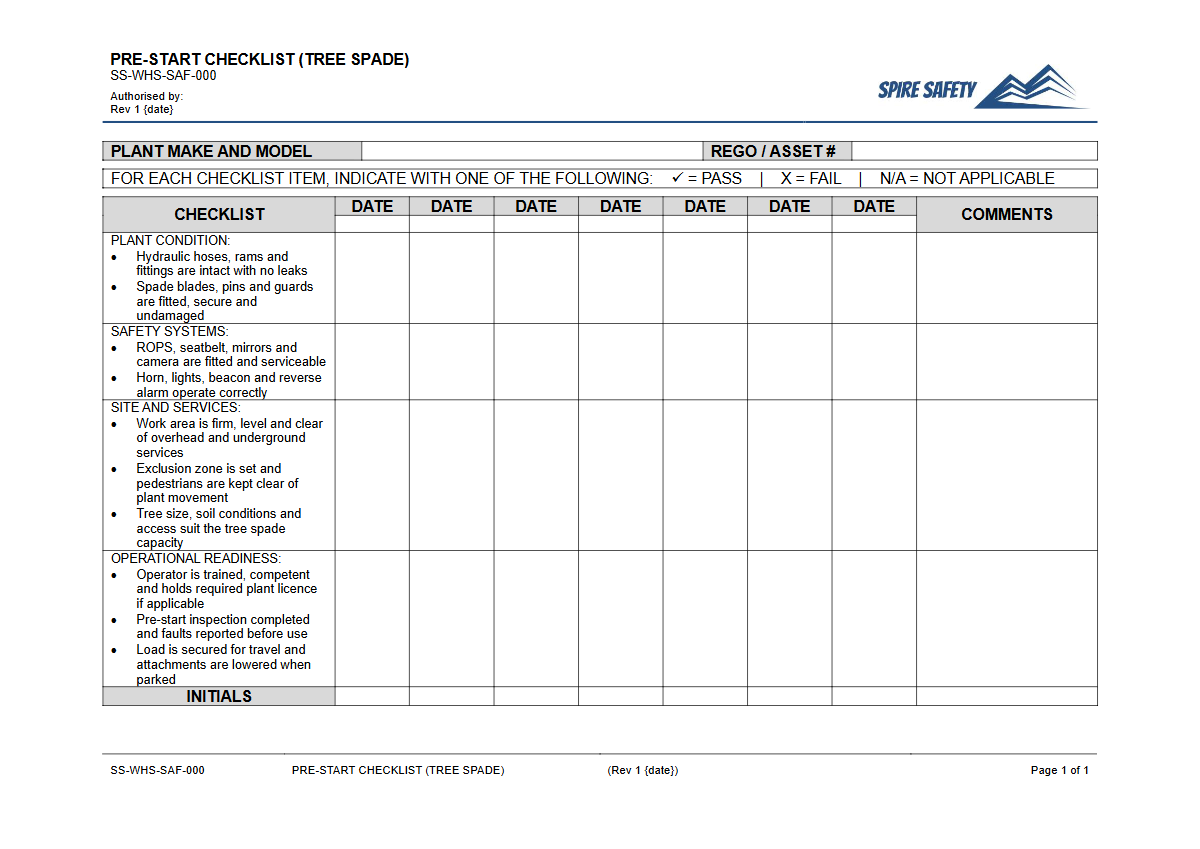
Download our free Pre-Start Checklist for Tree Spades. This DOCX & PDF template helps operators identify and control hazards before use. Get your copy today.
Free Pre-Start Checklist (Tree Spade) Template
DOCX • 125 KB + PDF
Updated Oct 2026
No signup required
Purpose of the Free Pre-Start Checklist (Tree Spade) Template
Operating heavy machinery like a tree spade requires strict safety protocols. Our Free Pre-Start Checklist (Tree Spade) Template provides a structured starting point for operators to conduct thorough safety inspections before use.
By formalising these checks, your organisation can better identify potential hazards, prevent equipment failure, and demonstrate due diligence in managing workplace health and safety risks associated with plant operation.
The primary purpose of this pre-start checklist is to create a consistent and documented process for inspecting the equipment before it is operated. It helps organisations meet their duty of care obligations by systematically checking for mechanical, hydraulic, and electrical faults that could lead to an incident.
Regular use of the checklist promotes a proactive safety culture, reduces costly downtime, and provides a clear record of the machine's condition over time. To further embed these practices, consider discussing findings in a regular Pre-Start Checks and Plant Maintenance Toolbox Talk.
Video walkthrough
How to use the Free Pre-Start Checklist (Tree Spade) Template
To get started, download the DOCX file and adapt it to the specific make and model of the tree spade used in your workplace. This is a crucial step, as different machines have unique features and potential failure points.
Add, remove, or modify checklist items to reflect your operational context and the results of your risk assessments. Once finalised, integrate the checklist into your daily operational procedures and provide training to all relevant operators.
For example, your workplace may use other specialised horticultural equipment that also requires routine inspections, such as a pre-start checklist for an aerator. Consistency across all plant checks is key to building a strong safety system.
Important: This is a template only. We provide it as a starting point, but it is your responsibility to customise the document to suit the specific equipment, tasks, and risks in your workplace.
You must ensure it aligns with the manufacturer’s instructions and any relevant Australian safety standards.
What to Inspect on a Tree Spade
A thorough inspection should cover several key areas of the machine. While your customised checklist will be more detailed, it should always include checks for:
- General Condition: Check for any visible damage, cracks in the frame, loose bolts, or signs of wear and tear.
- Hydraulics: Inspect hoses, cylinders, and fittings for leaks, cracks, or damage. Check hydraulic fluid levels.
- Spades/Blades: Examine the condition of the spades, ensuring they are sharp, secure, and free from damage that could affect performance or safety.
- Operator Controls: Test all functions (e.g., blade extension/retraction, turret rotation, gate operation) to ensure they are responsive and functioning correctly.
- Safety Features: Verify that safety guards, emergency stops, warning decals, and audible alarms are in place and working.
- Mounting & Stability: For truck- or skid-steer-mounted spades, inspect all attachment points, pins, and locking mechanisms to ensure the unit is securely fastened. Check tyre pressure and condition.
The records from these checks are valuable evidence during a formal WHS compliance auditing process, demonstrating that plant safety is being actively managed.
When to use it
The tree spade pre-start check should be completed before the start of every shift or before the equipment is used for the first time each day. It is not a weekly or monthly task but a daily routine essential for safe operation.
The process should be conducted by the operator in a well-lit area before any work begins. These daily checks are a fundamental part of pre-operational planning and can be referenced during daily safety briefings, which can be documented using a Pre-Start Meeting Template.
Who should use it
The primary person responsible for completing the checklist is the competent and trained operator assigned to the tree spade. They have the most direct control and a hands-on understanding of the machine's condition.
Supervisors also have a key role in ensuring the checks are being completed correctly and consistently, reviewing completed forms, and initiating corrective actions for any reported defects. This entire process forms a critical component of your organisation's overall WHS management systems, defining clear responsibilities for safety and maintenance.
Common mistakes
Common mistakes to avoid
- Using a generic checklist that doesn't match the specific tree spade model.
- Rushing through the inspection ('pencil-whipping') without properly checking each item.
- Failing to tag out and report faulty equipment, assuming someone else will notice.
- Ignoring seemingly minor issues like small hydraulic fluid weeps, which can indicate a future failure.
Legal references
Legal considerations
The following legal requirements may be relevant to this type of work.
- Work Health and Safety Act (Harmonised) — Provides the primary duties for protecting workers and other people from work health and safety risks.
- Work Health and Safety Regulations (Harmonised) — Sets out requirements supporting the management of workplace hazards and risks.
The following codes may be relevant to this type of work.
- Managing WHS Risks Code of Practice — Provides practical guidance on identifying hazards, assessing risks and applying effective controls.
- Work Health and Safety Consultation, Cooperation and Coordination Code of Practice — Provides practical guidance on consulting workers and coordinating with other duty holders.
- Managing the Work Environment and Facilities Code of Practice — Provides practical guidance on safe work environments, workplace facilities and related controls.
Did you know
Soil Weight
A large truck-mounted tree spade can move a root ball weighing several tonnes. This massive weight makes equipment stability and hydraulic integrity critical safety factors checked during a pre-start.
Hydraulic Power
The hydraulic systems on tree spades operate under extreme pressure. A pinhole leak in a hydraulic hose can release fluid at a velocity high enough to penetrate skin, causing severe injection injuries.
FAQ
Frequently asked questions
01What is the difference between a pre-start check and regular maintenance?
02What happens if a fault is found during a tree spade pre-start check?
03How long should a tree spade pre-start check take?
04Is a digital pre-start checklist better than a paper one?
Share this resource
Free Pre-Start Checklist (Tree Spade) Template
Browse Categories
How To Use It
- 1Download and open in Word or PDF.
- 2Replace the placeholders with your business details.
- 3Get it reviewed by a WHS specialist before rollout.
Need it customised?
Our WHS consultants can adapt this template to your site, run a gap analysis, or audit what you already have in place.
Book a Free Consultation WHS consulting servicesor call 1300 156 382