
Free Pre-Start Checklist (Truck Loader) Template
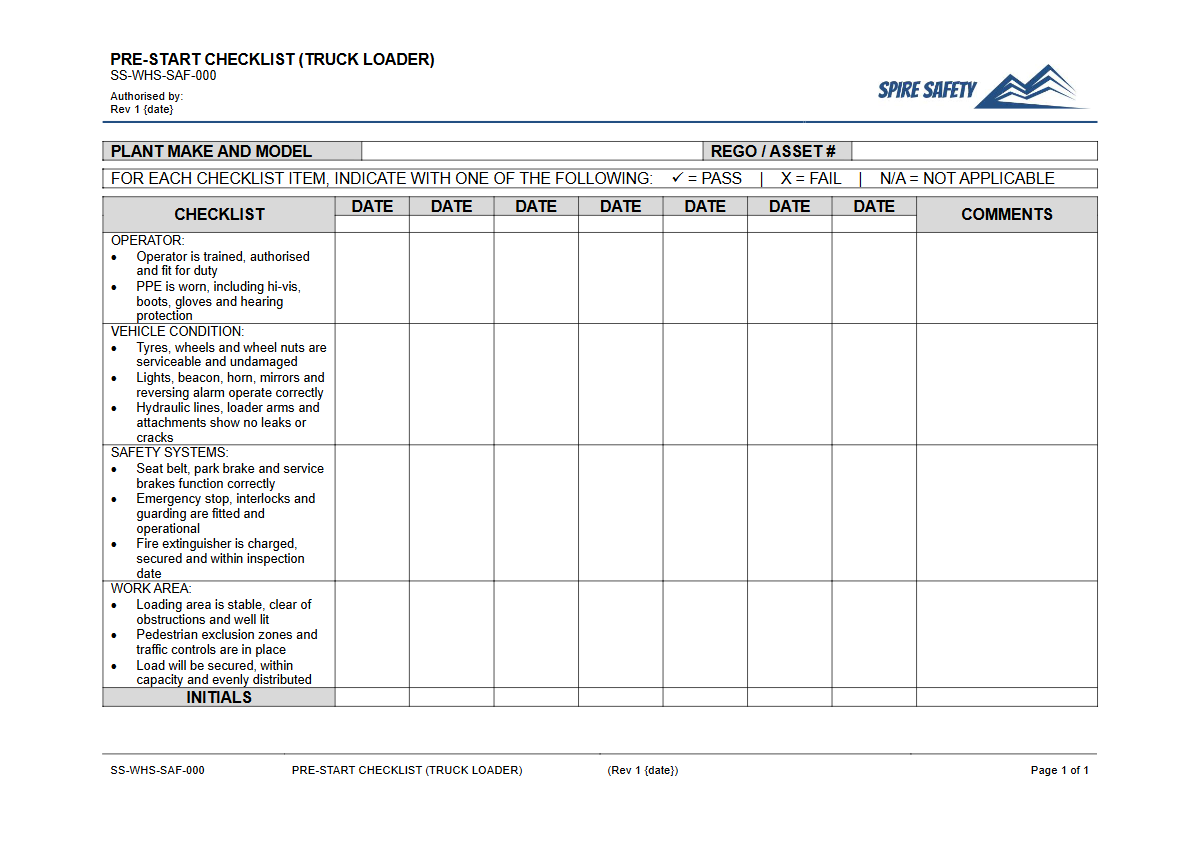
Download our free Pre-Start Checklist (Truck Loader) Template (DOCX/PDF). A structured starting point to formalise equipment inspections and manage WHS risks.
Free Pre-Start Checklist (Truck Loader) Template
DOCX • 125 KB + PDF
Updated Oct 2026
No signup required
Purpose of the Free Pre-Start Checklist (Truck Loader) Template
Operating a truck loader, like any heavy mobile plant, introduces significant risks into the workplace. A consistent inspection routine is a fundamental part of a safe system of work.
This free Pre-Start Checklist (Truck Loader) Template provides a structured format for operators to inspect equipment before each use, helping to identify and report potential faults, damage, or wear and tear before they can lead to an incident. Using this checklist helps your organisation demonstrate due diligence, prevent costly breakdowns, and most importantly, protect workers from harm. Integrating such checks is a core component of effective WHS management systems.
Video walkthrough
How to use the Free Pre-Start Checklist (Truck Loader) Template
This resource is available for download in both DOCX and PDF formats. The DOCX version is fully editable, allowing you to tailor it to your specific operational needs.
A robust pre-start checklist should be more than a generic document; it must reflect the unique characteristics and hazards of your machinery and work environment.
Important: This document is a template and must be customised to your specific workplace. We recommend a consultation process involving operators, supervisors, and safety personnel to ensure it covers all relevant hazards, controls, and equipment features unique to your truck loader models and operational environment.
It should be reviewed alongside the manufacturer’s operating manual and any site-specific requirements. Once customised, it can be integrated with other key documents, like a Front End Loader SOP (Safe Operating Procedure) Template, to build a comprehensive safety framework.
When to use a Pre-Start Checklist
A pre-start check is a routine activity that must be completed:
- Before the start of each shift.
- Before the equipment is used for the first time on a given day.
- After a change of operator during a shift.
- Following any significant maintenance or repair work before the plant is returned to service.
Regular checks ensure the ongoing safe condition of the loader and form part of the control measures you would identify in a risk assessment or a Safe Work Method Statement for Truck Operation.
Who should use it
The pre-start check must be carried out by a worker who is trained, licensed (where required), and deemed competent to operate the specific truck loader. They must understand what each item on the checklist means and how to inspect it properly.
Supervisors or managers also have a responsibility to ensure these checks are being completed correctly and that any reported defects are addressed promptly through a clear tag-out and repair procedure. Verifying operator competence is a critical step, and a formal process like a Skid-Steer Loader VOC (Verification of Competency) Template can be adapted for this purpose.
What to include in your Truck Loader Pre-Start Checklist
While you must customise the checklist, a comprehensive inspection typically covers several key areas. Use these points as a starting guide for developing your site-specific document:
- General Condition: Check for structural damage, cracks, fluid leaks (oil, coolant, hydraulic), and the cleanliness of the operator's cabin and windows.
- Safety Features: Verify the function of seatbelts, horns, reversing alarms, lights, mirrors, and the integrity of the Roll-Over Protective Structure (ROPS) and Falling Object Protective Structure (FOPS).
- Operator Controls: Test all controls for smooth operation, including steering, brakes (park and service), and hydraulic controls for the boom and bucket/attachment.
- Tyres and Wheels: Inspect for correct inflation, excessive wear, cuts, and ensure wheel nuts are secure.
- Engine and Fluids: Check levels for engine oil, coolant, hydraulic fluid, and fuel before starting the engine.
- Attachments: Inspect any buckets, forks, or other attachments for damage, wear, and secure locking pins. Competence to use specific attachments may require separate assessment, similar to how one might need a WHS compliance auditing for a truck-mounted cherry picker.
By formalising this process, you create a reliable record of equipment condition over time. These records are invaluable during safety investigations or when undergoing a WHS compliance auditing. For more tools to support your safety programs, explore our complete free WHS resources library.
Common mistakes
Common mistakes to avoid
- Treating the check as a "tick and flick" exercise without proper inspection.
- Failing to customise the template for specific truck loader models and attachments.
- Poor record-keeping or failing to act on reported defects in a timely manner.
- Operators not being adequately trained on what to look for during the inspection.
Legal references
Legal considerations
The following legal requirements may be relevant to this type of work.
- Work Health and Safety Act (Harmonised) — Provides the primary duties for protecting workers and other people from work health and safety risks.
- Work Health and Safety Regulations (Harmonised) — Sets out requirements supporting the management of workplace hazards and risks.
The following codes may be relevant to this type of work.
- Managing WHS Risks Code of Practice — Provides practical guidance on identifying hazards, assessing risks and applying effective controls.
- Work Health and Safety Consultation, Cooperation and Coordination Code of Practice — Provides practical guidance on consulting workers and coordinating with other duty holders.
- Managing the Work Environment and Facilities Code of Practice — Provides practical guidance on safe work environments, workplace facilities and related controls.
Did you know
The Hierarchy of Control
Pre-start checklists are an 'administrative' control, which is the fourth level in the hierarchy of control. They support higher-level controls like elimination and engineering (e.g., guards, ROPS) by ensuring they remain effective.
Mobile Plant Incidents
A significant portion of serious workplace incidents in Australia involve mobile plant, including trucks and loaders. Consistent pre-start inspections are a critical defence against equipment failure contributing to these events.
FAQ
Frequently asked questions
01What's the difference between a pre-start check and a periodic inspection?
02Is a paper-based pre-start checklist still acceptable?
03What should an operator do if they find a fault during a pre-start check?
04How long should we keep completed truck loader pre-start checklists?
Share this resource
Free Pre-Start Checklist (Truck Loader) Template
Browse Categories
How To Use It
- 1Download and open in Word or PDF.
- 2Replace the placeholders with your business details.
- 3Get it reviewed by a WHS specialist before rollout.
Need it customised?
Our WHS consultants can adapt this template to your site, run a gap analysis, or audit what you already have in place.
Book a Free Consultation WHS consulting servicesor call 1300 156 382