
Free Pre-Start Checklist (Tyre Changer) Template
Download our Free Pre-Start Checklist (Tyre Changer) Template to formalise daily equipment checks.
Free Pre-Start Checklist (Tyre Changer) Template
DOCX • 125 KB + PDF
Updated Oct 2026
No signup required
Purpose of the Free Pre-Start Checklist (Tyre Changer) Template
Operating a tyre changer involves significant risks, including high-pressure systems, powerful clamping mechanisms, and rotating components. This Free Pre-Start Checklist (Tyre Changer) Template provides a structured framework for operators to conduct consistent safety inspections before each use.
Systematically verifying the condition of guards, controls, air hoses, and emergency stops helps identify potential faults or hazards before they can lead to an incident. Integrating such checks into your daily routine is a fundamental part of proactive risk management and supports your broader safety framework.
Formalising this process demonstrates a commitment to workplace health and safety. The checklist prompts a thorough review of the machine's key safety features, helping to prevent equipment-related injuries and ensuring the plant is fit for service.
Regular documentation of these checks is a critical component of building and maintaining robust WHS management systems, creating a verifiable record of due diligence.
Video walkthrough
How to use the Free Pre-Start Checklist (Tyre Changer) Template
This checklist is provided as a user-friendly template in both DOCX and PDF formats. Its primary function is to serve as a starting point for your organisation's specific needs. To implement it effectively, follow these steps:
- Download: Select your preferred format (DOCX for easy editing or PDF for straightforward printing).
- Customise: This step is critical. Review the checklist and add, remove, or modify items to match the specific make, model, and configuration of the tyre changer(s) used in your workshop. Consider any unique environmental factors or operational tasks. We have provided a solid foundation based on common safety principles, but you must adapt it to reflect your actual workplace risks.
- Train: Ensure all operators are trained not only on how to use the tyre changer safely but also on the importance and correct procedure for completing this pre-start checklist.
- Implement: Integrate the checklist into your standard operating procedures. Make it a non-negotiable task to be completed before the first use of the equipment each day or at the start of every shift.
Completed checklists should be filed and stored as part of your safety records. These records are invaluable during safety consultations, incident investigations, or when undergoing internal or external WHS compliance audits. They provide tangible evidence of your hazard identification processes.
Key Areas Covered by the Checklist
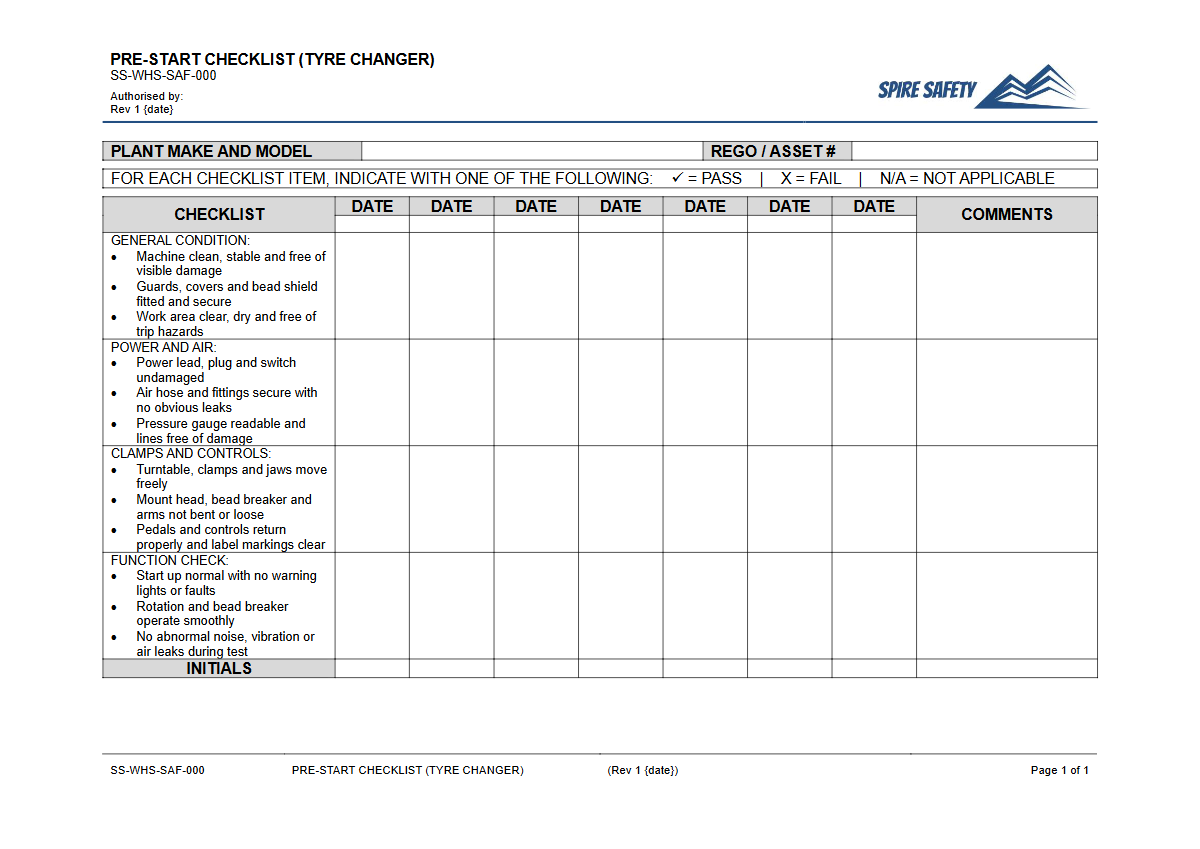
The template guides the operator through a logical inspection sequence, covering critical systems and components:
- General Area: Checks for a clear, unobstructed, and well-lit workspace free from slip or trip hazards.
- Guards and Shields: Verification that all physical guards, especially around rotating parts and clamping jaws, are secure and undamaged.
- Controls and E-Stops: Functional tests of start/stop controls, foot pedals, and the emergency stop button to ensure they are responsive.
- Pneumatic System: Inspection of air hoses, fittings, and regulators for leaks, cracks, or signs of wear. It also includes checking the function of the tyre inflation cage and pressure limiting device.
- Mechanical Components: Examination of the turntable, clamping jaws, mount/demount head (duckhead), and bead breaker for signs of damage, wear, or misalignment.
Many workshops contain a variety of equipment with overlapping risks. To ensure comprehensive safety coverage, you might also benefit from our Pre-Start Checklist (Bench Grinder) template for your grinding and tool sharpening stations.
When to use it
The pre-start checklist should be completed before the equipment is used for the first time on any given day or shift. This ensures that any damage or faults that may have occurred overnight, during a previous shift, or due to environmental changes are identified before work begins.
It should also be completed after any maintenance or repair work to verify the machine has been returned to a safe operational state. Regular use fosters a consistent safety-first mindset among all team members.
Who should use it
This checklist is designed to be completed by the person operating the tyre changer. Users must be deemed competent, meaning they have received the necessary training, instruction, and information to operate the machine safely.
This includes understanding the specific risks associated with the model in use, such as pinch points, stored energy, and tyre explosion hazards. Supervisors should also be familiar with the checklist to ensure it is being completed correctly and to action any faults that are reported promptly.
Maintaining a safe and organised workshop extends beyond the main equipment. Managing waste effectively is also crucial, and a tool like our Pre-Start Checklist (Bin Lifter) Template can help formalise safety checks on supporting equipment. For a wider selection of safety documents, you can browse our complete free WHS resources library.
Common mistakes
Common mistakes to avoid
- Neglecting to inspect the tyre inflation cage for cracks or damage.
- Failing to check pneumatic hoses and fittings for leaks, which can lead to unexpected pressure loss or failure.
- Overriding pressure limiting devices to inflate tyres faster, creating a severe explosion risk.
- Assuming all tyre changers operate the same way, and not seeking specific training on a new or unfamiliar model.
Legal references
Legal considerations
The following legal requirements may be relevant to this type of work.
- Work Health and Safety Act (Harmonised) — Provides the primary duties for protecting workers and other people from work health and safety risks.
- Work Health and Safety Regulations (Harmonised) — Sets out requirements supporting the management of workplace hazards and risks.
The following codes may be relevant to this type of work.
- Managing WHS Risks Code of Practice — Provides practical guidance on identifying hazards, assessing risks and applying effective controls.
- Work Health and Safety Consultation, Cooperation and Coordination Code of Practice — Provides practical guidance on consulting workers and coordinating with other duty holders.
- Managing the Work Environment and Facilities Code of Practice — Provides practical guidance on safe work environments, workplace facilities and related controls.
Did you know
Tyre Inflation Hazards
A 25cm truck tyre inflated to 100 psi contains an explosive force equivalent to over 1.5kg of dynamite. This is why using a safety cage and remote inflation equipment is a critical control measure.
The Value of Simple Checks
A significant percentage of workplace incidents involving machinery are not caused by major failure, but by bypassed guards or faulty emergency stops. These are two key items verified in a daily pre-start checklist.
FAQ
Frequently asked questions
01What are the biggest risks when using a tyre changer?
02How often should a tyre changer be formally inspected?
03Is training required to use a tyre changer?
04Can I use this checklist for different types of tyre changers?
Share this resource
Free Pre-Start Checklist (Tyre Changer) Template
Browse Categories
How To Use It
- 1Download and open in Word or PDF.
- 2Replace the placeholders with your business details.
- 3Get it reviewed by a WHS specialist before rollout.
Need it customised?
Our WHS consultants can adapt this template to your site, run a gap analysis, or audit what you already have in place.
Book a Free Consultation WHS consulting servicesor call 1300 156 382