
Free Pre-Start Checklist (UPS Unit) Template
Ensure your critical power systems are safe and operational.
Free Pre-Start Checklist (UPS Unit) Template
DOCX • 125 KB + PDF
Updated Oct 2026
No signup required
Purpose of the Free Pre-Start Checklist (UPS Unit) Template
An Uninterruptible Power Supply (UPS) is critical for protecting sensitive equipment and ensuring business continuity during power fluctuations or outages. However, it also introduces electrical and chemical hazards into the workplace.
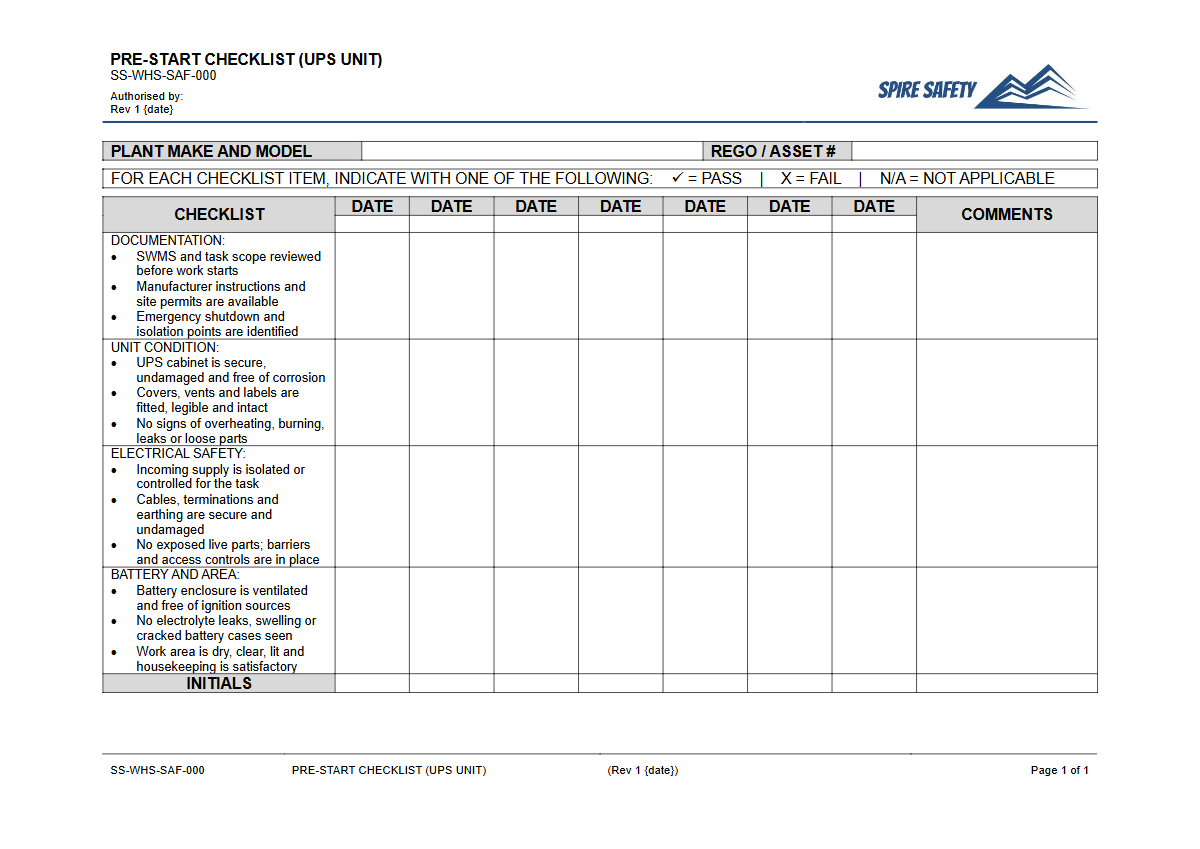
This Free Pre-Start Checklist (UPS Unit) Template provides a structured framework for conducting regular safety and operational checks before use. Formalising this process helps your organisation identify potential faults, such as battery leaks, overheating, or cable damage, before they lead to equipment failure, data loss, or a safety incident.
Using a consistent checklist ensures that inspections are thorough and documented, forming a key part of your overall safety management approach.
Integrating systematic checks like this one is a fundamental component of proactive safety management. A well-documented pre-start process demonstrates due diligence and supports the continuous improvement cycle within your broader WHS management systems.
Video walkthrough
How to use the Free Pre-Start Checklist (UPS Unit) Template
This template is designed for ease of use and customisation. After downloading the DOCX or PDF file, the first step is to conduct a thorough review and adapt the checklist to your specific operational context.
This involves adding or removing items to align with the make and model of your UPS units, the environment they are located in, and your organisation’s specific safety procedures. Once customised, the checklist should be used by competent personnel to inspect the UPS unit before the start of each day or shift.
Important: This template provides a solid foundation, but it is not a complete, out-of-the-box solution. We have designed it to be customised.
You must adapt it to your specific UPS models, workplace environment, and organisational procedures to ensure it is effective. Training your team on how to use the finalised checklist is essential for its success; our Pre-Start Checks and Plant Maintenance Toolbox Talk Template can help facilitate this training.
What the checklist covers:
- Visual Inspection: Checking for physical damage, signs of corrosion, or fluid leaks from the battery compartment.
- Indicator Status: Verifying the status of indicator lights (e.g., Online, On Battery, Fault, Replace Battery) to ensure the unit is operating as expected.
- Ventilation and Environment: Ensuring air vents are clear of obstructions and the surrounding area is free from dust, moisture, and flammable materials.
- Cables and Connections: Inspecting power cords and connections for signs of wear, fraying, or loose fittings.
- Audible Alarms: Noting any unusual noises or active audible alarms from the unit.
When to use it
A UPS pre-start check should be conducted at the beginning of each day or shift where the integrity of the power supply is critical. It is also essential to perform an inspection after any maintenance work, following a significant power event (like a prolonged outage), or if the unit has been relocated.
Consistent, routine checks are far more effective at preventing incidents than infrequent or random inspections. This regularity helps build a historical record of the unit's condition, making it easier to spot developing faults.
Who should use it
This checklist should be used by personnel who have been deemed competent to inspect and manage UPS equipment. This may include IT technicians, data centre staff, facilities managers, or other workers specifically trained in the electrical hazards and operational characteristics of your UPS systems.
The user must be able to recognise potential defects and understand the appropriate steps to take if a fault is identified, such as isolating the unit and reporting the issue according to company procedure. Just as you would for other critical equipment, ensuring operators are competent is vital, similar to checks outlined in our Free Pre-Start Checklist (Air Handler) Template.
Maintaining accurate records of these checks is not just good practice; it's a critical compliance activity. These documents provide tangible proof that your organisation is proactively managing risks associated with its electrical plant.
During a formal safety review, these records are invaluable. An external reviewer conducting WHS compliance auditing will look for evidence of consistent, documented safety procedures like this one.
Similar principles of routine inspection apply to a wide range of workplace equipment. For instance, workshops using advanced machinery would benefit from our Free Pre-Start Checklist (3D Printer) Template to manage different but equally important operational risks.
You can explore our complete free WHS resources library for more tools to support your safety management activities.
Common mistakes
Common mistakes to avoid
- Ignoring minor alarms or 'replace battery' indicators from the unit.
- Blocking ventilation ports by placing objects or papers on or around the UPS.
- Failing to document the pre-start checks, leaving no record for maintenance or safety audits.
- Treating the checklist as a 'tick-and-flick' exercise without proper visual and functional inspection.
Legal references
Legal considerations
The following legal requirements may be relevant to this type of work.
- Work Health and Safety Act (Harmonised) — Provides the primary duties for protecting workers and other people from work health and safety risks.
- Work Health and Safety Regulations (Harmonised) — Sets out requirements supporting the management of workplace hazards and risks.
The following codes may be relevant to this type of work.
- Managing WHS Risks Code of Practice — Provides practical guidance on identifying hazards, assessing risks and applying effective controls.
- Work Health and Safety Consultation, Cooperation and Coordination Code of Practice — Provides practical guidance on consulting workers and coordinating with other duty holders.
- Managing the Work Environment and Facilities Code of Practice — Provides practical guidance on safe work environments, workplace facilities and related controls.
Did you know
Battery Lifespan
The valve-regulated lead-acid (VRLA) batteries found in most UPS units have a typical design life of 3-5 years. Battery failure is one of the most common causes of UPS load loss and system downtime.
Phantom Load
A UPS unit consumes power even when the equipment it's protecting is turned off. This 'phantom load' is necessary to keep the batteries charged and the inverter ready, but it contributes to overall energy consumption.
FAQ
Frequently asked questions
01What are the main hazards associated with a UPS unit?
02How often should a UPS pre-start check be performed?
03Can this template be used for any brand of UPS?
04What should an operator do if a fault is found during a pre-start check?
Share this resource
Free Pre-Start Checklist (UPS Unit) Template
Browse Categories
How To Use It
- 1Download and open in Word or PDF.
- 2Replace the placeholders with your business details.
- 3Get it reviewed by a WHS specialist before rollout.
Need it customised?
Our WHS consultants can adapt this template to your site, run a gap analysis, or audit what you already have in place.
Book a Free Consultation WHS consulting servicesor call 1300 156 382