
Free Pre-Start Checklist (Vac Loader) Template
Download our free Pre-Start Checklist (Vac Loader) Template in DOCX & PDF. This structured document helps formalise safety inspections. Customise it today.
Free Pre-Start Checklist (Vac Loader) Template
DOCX • 125 KB + PDF
Updated Oct 2026
No signup required
Purpose of the Free Pre-Start Checklist (Vac Loader) Template
Operating a vacuum loader, or vac truck, involves managing high-pressure systems, heavy machinery, and potentially hazardous materials. A systematic inspection before each use is a critical control measure to ensure the equipment is safe to operate.
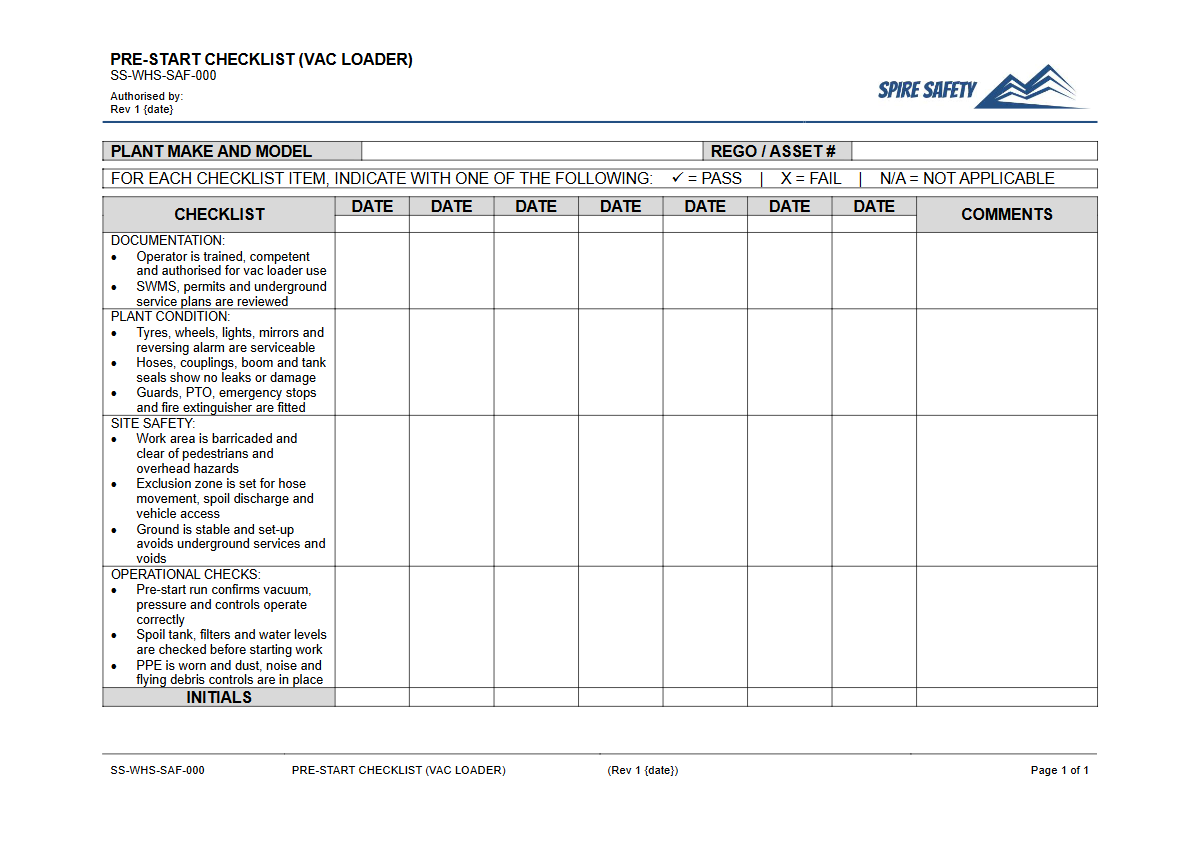
This free Pre-Start Checklist (Vac Loader) Template provides a structured framework for operators to conduct thorough, repeatable safety checks.
Using a checklist formalises the inspection process, helping to identify potential faults, damage, or wear and tear before they lead to an incident, equipment failure, or costly downtime. It creates a documented record that the machine was in a safe condition at the start of the shift, which forms an important part of your safety management system. Reinforcing this process is essential for building a strong safety culture, which can be supported with regular training sessions like a Pre-Start Checks and Plant Maintenance Toolbox Talk.
Video walkthrough
How to use the Free Pre-Start Checklist (Vac Loader) Template
This template is provided as a starting point. First, download the file in your preferred format (DOCX for easy editing or PDF).
Next, you must review and adapt the checklist items to suit the specific requirements of your workplace.
IMPORTANT: This template provides a solid foundation, but it is not a complete, out-of-the-box solution. You must customise this document to reflect the specific make and model of your vacuum loader, its attachments, your operational environment, and your organisation's specific risk controls.
We are not liable for any incidents arising from the use of this template.
Your customised checklist should be integrated into your site's operational procedures. For high-risk activities, pre-start checks are often a prerequisite control measure listed within a Safe Work Method Statement (SWMS) for backhoe loader operation or a similar planning document.
Ensure the customised checklist is readily available to all operators.
When to use it
A vac loader pre-start inspection should be completed:
- Before the start of every shift or each use.
- After the equipment has been idle for an extended period.
- Following any significant maintenance, repair, or modification.
- If there is any reason to suspect the equipment's condition has changed (e.g., after an unusual noise or jolt during operation).
Consistency is key to an effective pre-start program. Making the check a non-negotiable first step of the job helps embed safe behaviour into your team's daily routine.
Integrating these checks into broader WHS management systems ensures they are scheduled, completed, and reviewed effectively.
Who should use it
The pre-start checklist must be completed by a worker who is trained, competent, and authorised to operate the specific vacuum loader. The operator's familiarity with the machine is crucial for identifying subtle signs of a developing fault, such as a slight change in hydraulic hose condition or an unusual engine sound.
Supervisors and managers also have a role in periodically reviewing completed checklists to ensure they are being filled out correctly and that any reported issues are being addressed in a timely manner. Verifying that operators have the necessary skills is also vital; for other types of plant, a document like our free Front End Loader VOC (Verification of Competency) Template can be used to formalise this assessment.
The process of completing, reviewing, and actioning these checks provides valuable data for your maintenance program and can be a key point of evidence during WHS compliance auditing to demonstrate proactive risk management. For more tools to support your safety processes, you can browse our complete free WHS resources library.
Common mistakes
Common mistakes to avoid
- Using a generic checklist that doesn't match the specific make and model of the vac loader.
- "Pencil-whipping" the checklist — ticking boxes without physically inspecting the items.
- Failing to immediately report and tag out the equipment when a safety-critical defect is found.
- Not retaining completed checklists as a record for maintenance and compliance purposes.
Legal references
Legal considerations
The following legal requirements may be relevant to this type of work.
- Work Health and Safety Act (Harmonised) — Provides the primary duties for protecting workers and other people from work health and safety risks.
- Work Health and Safety Regulations (Harmonised) — Sets out requirements supporting the management of workplace hazards and risks.
The following codes may be relevant to this type of work.
- Managing WHS Risks Code of Practice — Provides practical guidance on identifying hazards, assessing risks and applying effective controls.
- Work Health and Safety Consultation, Cooperation and Coordination Code of Practice — Provides practical guidance on consulting workers and coordinating with other duty holders.
- Managing the Work Environment and Facilities Code of Practice — Provides practical guidance on safe work environments, workplace facilities and related controls.
Did you know
Industrial Vacuum Power
Industrial vacuum loaders can move more than just liquids. Many are powerful enough to suction heavy sludge, rocks, and debris over significant distances, operating with vacuum levels that can exceed 25 inches of mercury (inHg).
FAQ
Frequently asked questions
01What items should be on a vac loader pre-start checklist?
02How often should vacuum loader pre-start checks be done?
03Who is responsible for ensuring vac loader pre-starts are completed?
04Is a digital pre-start checklist better than a paper one?
Share this resource
Free Pre-Start Checklist (Vac Loader) Template
Browse Categories
How To Use It
- 1Download and open in Word or PDF.
- 2Replace the placeholders with your business details.
- 3Get it reviewed by a WHS specialist before rollout.
Need it customised?
Our WHS consultants can adapt this template to your site, run a gap analysis, or audit what you already have in place.
Book a Free Consultation WHS consulting servicesor call 1300 156 382