
Free Pre-Start Checklist (Vaccine Fridge) Template
Download our free Pre-Start Checklist (Vaccine Fridge) Template to ensure your medical refrigeration units are safe and functional before use.
Free Pre-Start Checklist (Vaccine Fridge) Template
DOCX • 125 KB + PDF
Updated Oct 2026
No signup required
Purpose of the Free Pre-Start Checklist (Vaccine Fridge) Template
Ensuring the correct storage of vaccines is critical for public health and safety. A dedicated vaccine fridge is a vital piece of equipment, and its consistent, correct operation is non-negotiable.
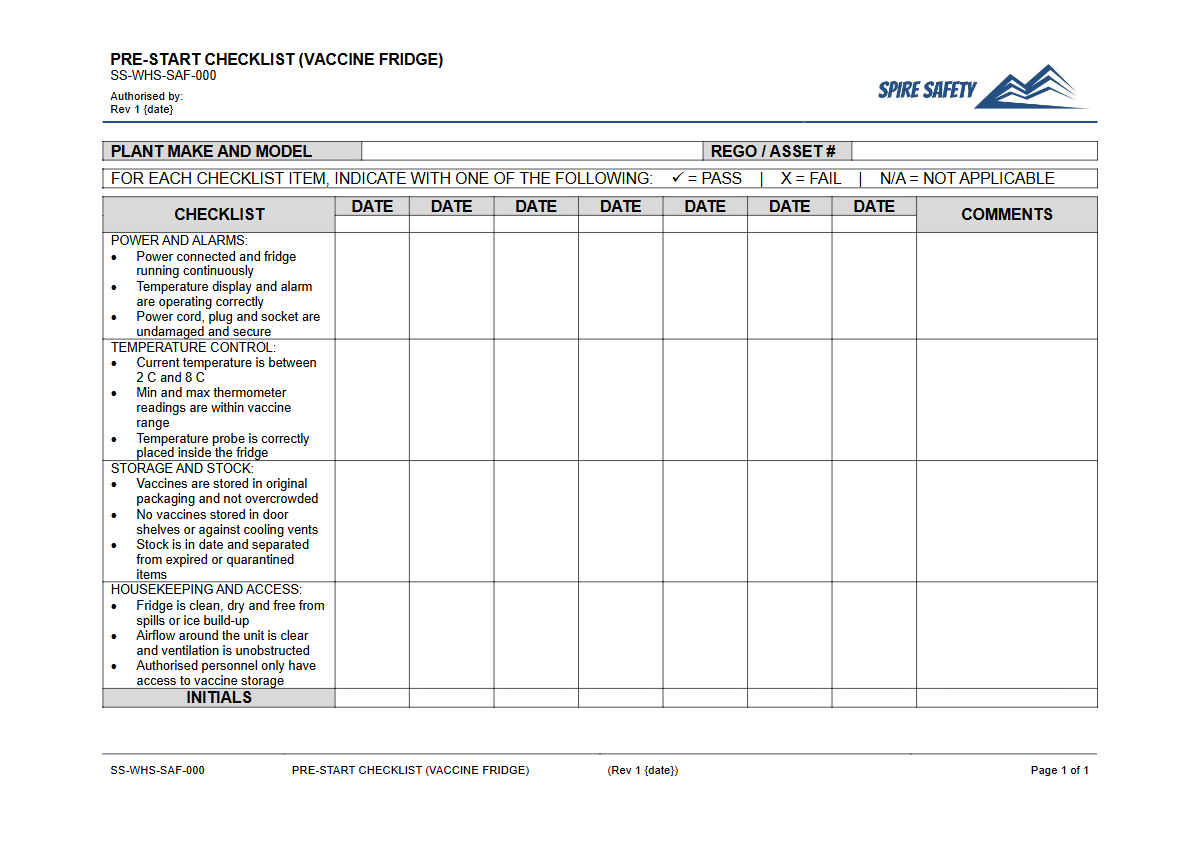
This free Pre-Start Checklist (Vaccine Fridge) Template provides a structured format for conducting daily inspections before the unit is used. The primary purpose is to verify that the fridge is functioning correctly, maintaining the required temperature range (the 'cold chain'), and is safe for operators to use.
Formalising this process helps prevent equipment failure, protects valuable vaccine stock from spoilage, and creates a documented record of due diligence. Integrating such checks is a fundamental part of robust WHS management systems in any healthcare or clinical setting.
Video walkthrough
How to use the Free Pre-Start Checklist (Vaccine Fridge) Template
This resource is available as a fully editable Microsoft Word (DOCX) document and a printable PDF. To use the template, simply download your preferred format and integrate it into your daily operational procedures.
The checklist guides the user through essential checks, including temperature verification, physical inspection of seals and doors, power supply confirmation, and checking for obstructions or alarms. A key part of using this template effectively is ensuring all relevant personnel are trained on how to complete it accurately and what actions to take if a fault is identified.
Important: This document provides a starting point aligned with Australian WHS principles. We cannot know the specific hazards of your workplace.
You must customise this template by adding or removing items to reflect the specific make and model of your equipment, your facility's layout, and your organisation's internal procedures. A generic checklist is not sufficient for managing risk effectively.
What's included in the checklist?
The template is designed to be comprehensive yet straightforward. It covers key areas essential for the safe and effective operation of a vaccine refrigerator, including:
- Temperature Monitoring: Prompts to check and record the current, minimum, and maximum temperatures to ensure they are within the critical +2°C to +8°C range.
- Equipment Integrity: Checks for the physical condition of the unit, such as the door seal, power cord integrity, and general cleanliness.
- Alarm Systems: Verification that audible and visual alarms are functional.
- Airflow and Loading: Checks to ensure the fridge is not over-packed and that there is adequate space for air circulation.
- Documentation: A section for the operator to sign off, date the check, and record any corrective actions taken. This information is crucial for team handovers and can be discussed using a Pre-Start Meeting Template.
When to use it
A pre-start check on a vaccine fridge should be conducted at the beginning of every workday or shift before any vaccines are accessed. It should also be performed immediately following any event that could affect its performance, such as a power outage, after scheduled maintenance, or if the unit has been moved.
Consistency is key; making this check a non-negotiable daily habit is the best way to catch potential issues early. This routine inspection is a core component of plant safety, a topic further explored in our Pre-Start Checks and Plant Maintenance Toolbox Talk.
Who should use it
This checklist is designed for any person responsible for managing or using a vaccine refrigerator. This includes a wide range of roles across various sectors:
- Nurses and clinical staff in hospitals, medical centres, and immunisation clinics.
- Pharmacists and pharmacy technicians.
- Aged care workers and facility managers.
- Laboratory technicians and research staff.
- Veterinarians and veterinary nurses.
Supervisors and WHS managers should also use the completed checklists to monitor compliance and identify recurring equipment issues. In environments like residential care, these checks complement other safety procedures, such as those covered in an Aged Care Manual Handling Toolbox Talk.
By implementing this checklist, organisations demonstrate a proactive approach to risk management, safeguarding both their staff and the viability of their vaccine inventory. Regular reviews of these records can also provide valuable data during formal WHS compliance auditing, highlighting a commitment to safety and quality control.
You can explore similar templates for other equipment, such as our Pre-Start Checklist (Air Handler) Template, in our extensive resources library.
Common mistakes
Common mistakes to avoid
- Ignoring minor temperature fluctuations or intermittent alarms.
- Placing the temperature data logger probe too close to the cooling element or door, giving inaccurate readings.
- Over-packing the fridge, which restricts air circulation and can create warm or frozen spots.
- Failing to check door seals for gaps or wear, leading to temperature instability.
Legal references
Legal considerations
The following legal requirements may be relevant to this type of work.
- Work Health and Safety Act (Harmonised) — Provides the primary duties for protecting workers and other people from work health and safety risks.
- Work Health and Safety Regulations (Harmonised) — Sets out requirements supporting the management of workplace hazards and risks.
The following codes may be relevant to this type of work.
- Managing WHS Risks Code of Practice — Provides practical guidance on identifying hazards, assessing risks and applying effective controls.
- Work Health and Safety Consultation, Cooperation and Coordination Code of Practice — Provides practical guidance on consulting workers and coordinating with other duty holders.
- Managing the Work Environment and Facilities Code of Practice — Provides practical guidance on safe work environments, workplace facilities and related controls.
Did you know
Cold Chain Integrity
The "cold chain" is the system of storing and transporting vaccines at recommended temperatures from manufacturer to patient. A single break in this chain can render expensive vaccines ineffective, leading to significant financial loss and public health risks.
Strive for 5
Australia's National Vaccine Storage Guidelines are often summarised as 'Strive for 5'. This refers to the ideal vaccine storage temperature of +5°C, which sits centrally within the mandatory +2°C to +8°C range.
FAQ
Frequently asked questions
01Why is a pre-start check for a vaccine fridge necessary?
02How often should a vaccine fridge pre-start check be completed?
03What happens if a problem is found during the vaccine fridge check?
04Can this template be used for other types of medical fridges?
Share this resource
Free Pre-Start Checklist (Vaccine Fridge) Template
Browse Categories
How To Use It
- 1Download and open in Word or PDF.
- 2Replace the placeholders with your business details.
- 3Get it reviewed by a WHS specialist before rollout.
Need it customised?
Our WHS consultants can adapt this template to your site, run a gap analysis, or audit what you already have in place.
Book a Free Consultation WHS consulting servicesor call 1300 156 382