
Free Pre-Start Checklist (Ventilator) Template
Download our free Pre-Start Checklist for Ventilators (DOCX & PDF). A structured template to formalise safety inspections and manage WHS risks. Get started now.
Free Pre-Start Checklist (Ventilator) Template
DOCX • 125 KB + PDF
Updated Oct 2026
No signup required
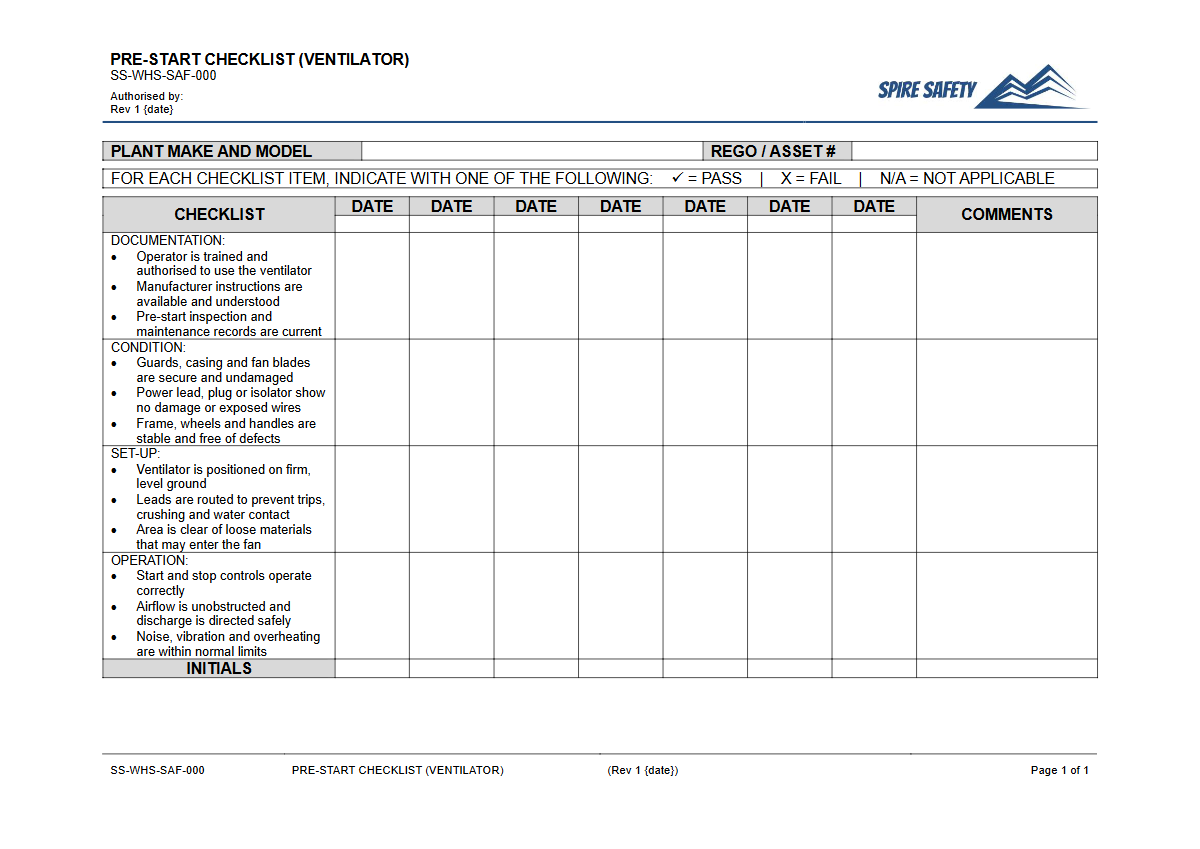
Purpose of the Free Pre-Start Checklist (Ventilator) Template
A ventilator is a critical piece of equipment where failure can have severe consequences. Implementing routine inspections with a formal checklist is a fundamental safety measure.
Using this Free Pre-Start Checklist (Ventilator) Template helps your organisation standardise and document the safety verification process before the equipment is used. Regular checks ensure the ventilator is in safe working order, identifying potential hazards such as blocked filters, power supply issues, incorrect settings, or damaged components before they lead to an incident.
This proactive approach not only protects operators and any persons reliant on the equipment but also helps in meeting the primary duty of care obligations under Australian WHS laws.
Formalising this process demonstrates a commitment to operational safety and helps maintain the equipment's integrity and lifespan. It forms an essential part of your daily plant safety procedures and can be a key discussion point during safety meetings.
For a structured way to run these discussions, you can use our Pre-Start Checks and Plant Maintenance Toolbox Talk Template to reinforce safe work practices.
Video walkthrough
How to use the Free Pre-Start Checklist (Ventilator) Template
This template provides a structured starting point for developing a site-specific checklist. To implement it effectively, follow these steps:
- Download: Select the DOCX file for easy editing or the PDF for immediate use.
- Customise: This is the most critical step. You must adapt this document to suit your specific operational needs. Review the checklist against the manufacturer’s instructions and the specific environment where the ventilator is used (e.g., industrial, medical, confined space). Add or remove checks to reflect the unique features and risks of your ventilator model. We cannot guarantee this template covers all hazards for your specific situation; customisation is essential.
- Train: Ensure all operators are trained on how to properly complete the checklist, what each item means, and the procedure for reporting any identified faults or 'No' answers.
- Implement: Integrate the checklist into the daily workflow. It should be completed by a competent person before every shift or prior to each use.
- Review: Store completed checklists as a record of your safety diligence. These records are invaluable for incident investigations and safety audits.
Integrating these checks into your daily operations is a key component of robust WHS management systems, providing a clear record of safety compliance activities and due diligence.
When to use it
A ventilator pre-start check should be conducted before the equipment is first used on any given day or shift. In situations where the ventilator is used intermittently, a check should be performed before each use.
The goal is to create a consistent and non-negotiable safety habit within your organisation. If the equipment is moved or has undergone maintenance, a pre-start check is also recommended to ensure it remains in a safe condition for operation.
This process is similar for related equipment; for example, our Free Pre-Start Checklist (Air Handler) Template follows the same principle of pre-use verification.
Who should use it
The checklist should be completed by a person who is competent to operate the specific type of ventilator. This includes having the necessary training, experience, and knowledge to identify potential faults and understand the associated risks.
Supervisors or team leaders should also be familiar with the checklist to ensure it is being completed correctly and to follow up on any reported issues. These daily checks are often reviewed during morning briefings, which can be documented using a Free Pre-Start Meeting Template to keep a record of safety communications.
Periodically, a manager or safety officer should review the completed checklists to identify recurring issues or patterns that may indicate a need for further training or more comprehensive maintenance. This review process can form part of your internal safety review cycle or be a key document examined during a formal WHS compliance auditing program.
By equipping your team with the right tools, you foster a proactive safety culture. For more templates and safety documents to support your operations, explore our complete free WHS resources library.
Common mistakes
Common mistakes to avoid
- Using a generic checklist without customising it for the specific ventilator model and work environment.
- Operators 'pencil-whipping' the form—signing it off without performing the actual checks.
- Failing to have a clear procedure for taking faulty equipment out of service immediately.
- Not retaining completed checklists as evidence of due diligence and for safety analysis.
Legal references
Legal considerations
The following legal requirements may be relevant to this type of work.
- Work Health and Safety Act (Harmonised) — Provides the primary duties for protecting workers and other people from work health and safety risks.
- Work Health and Safety Regulations (Harmonised) — Sets out requirements supporting the management of workplace hazards and risks.
The following codes may be relevant to this type of work.
- Managing WHS Risks Code of Practice — Provides practical guidance on identifying hazards, assessing risks and applying effective controls.
- Work Health and Safety Consultation, Cooperation and Coordination Code of Practice — Provides practical guidance on consulting workers and coordinating with other duty holders.
- Managing the Work Environment and Facilities Code of Practice — Provides practical guidance on safe work environments, workplace facilities and related controls.
Did you know
Airborne Contaminants
Inadequate ventilation is a leading cause of occupational illness. Safe Work Australia notes that poor air quality can lead to a range of health problems, reinforcing the need for correctly functioning ventilation equipment.
The Iron Lung
One of the first modern mechanical ventilators was the 'iron lung', developed in the 1920s. It worked by changing the pressure inside a sealed chamber, forcing the patient's lungs to expand and contract.
FAQ
Frequently asked questions
01Is a pre-start checklist for a ventilator a legal requirement in Australia?
02How does a pre-start check differ from scheduled maintenance?
03What are the biggest risks when operating a ventilator?
04Can I use this template for both medical and industrial ventilators?
Share this resource
Free Pre-Start Checklist (Ventilator) Template
Browse Categories
How To Use It
- 1Download and open in Word or PDF.
- 2Replace the placeholders with your business details.
- 3Get it reviewed by a WHS specialist before rollout.
Need it customised?
Our WHS consultants can adapt this template to your site, run a gap analysis, or audit what you already have in place.
Book a Free Consultation WHS consulting servicesor call 1300 156 382