
Free Pre-Start Checklist (Vertical Lift) Template
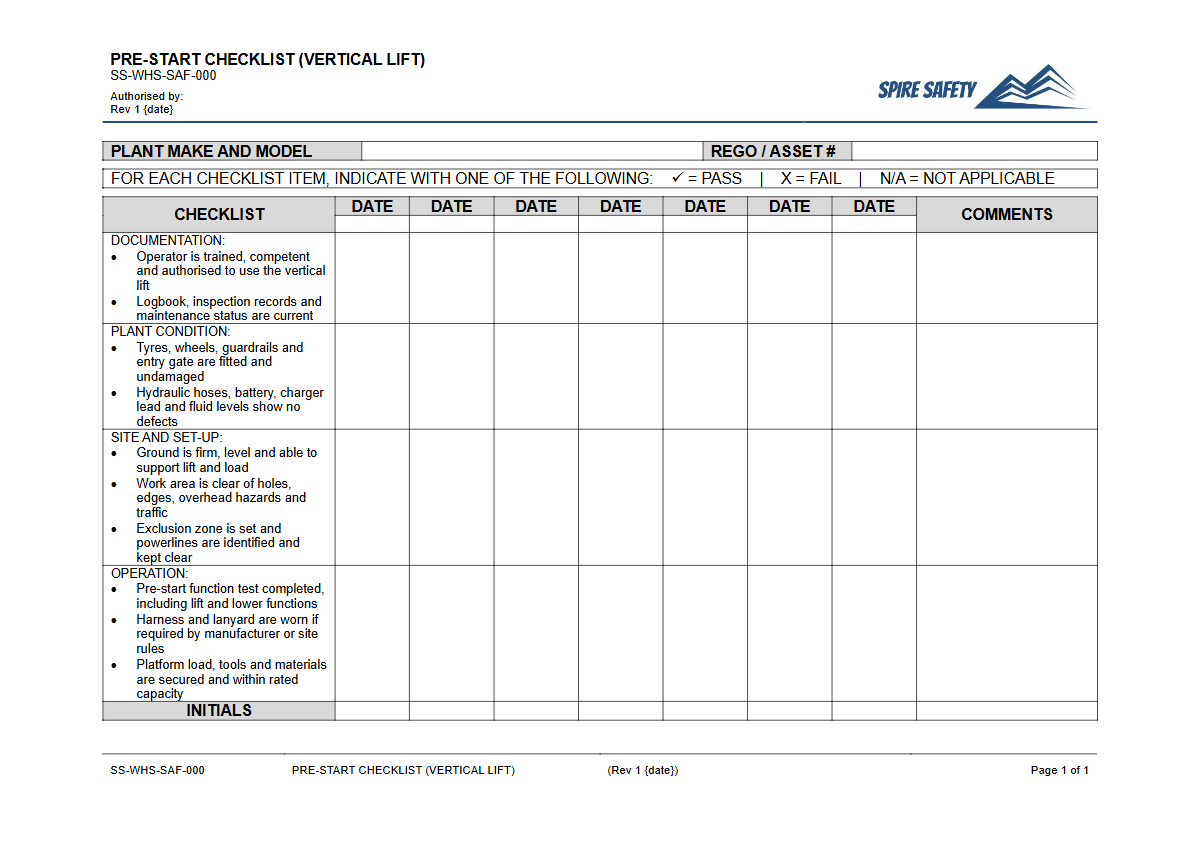
Download our Free Pre-Start Checklist (Vertical Lift) Template. Aligned with Australian WHS practice, this DOCX & PDF resource helps formalise safety checks.
Free Pre-Start Checklist (Vertical Lift) Template
DOCX • 125 KB + PDF
Updated Oct 2026
No signup required
Purpose of the Free Pre-Start Checklist (Vertical Lift) Template
Operating a vertical lift, a common type of Elevating Work Platform (EWP), involves significant risks if the equipment is not in safe working order. This Free Pre-Start Checklist (Vertical Lift) Template provides a structured framework for operators to conduct thorough, systematic inspections before each use.
Its primary purpose is to proactively identify mechanical faults, structural damage, or other safety hazards that could lead to equipment failure, property damage, or serious injury, including falls from height.
By formalising the inspection process, this Pre-Start Checklist helps Persons Conducting a Business or Undertaking (PCBUs) fulfil their duty of care under WHS law. It serves as a practical tool for risk management, ensuring the plant is safe to operate and creating a documented record of due diligence.
Regular, disciplined checks are a fundamental part of any safe system of work involving mobile plant. To reinforce this behaviour, you can incorporate this topic into your regular safety meetings using our Pre-Start Checks and Plant Maintenance Toolbox Talk Template.
Video walkthrough
How to use the Free Pre-Start Checklist (Vertical Lift) Template
This template is available in both DOCX and PDF formats for ease of use. The DOCX file can be customised to suit your operational needs, while the PDF is ready for immediate printing and use.
The process is straightforward: download the file, adapt it to your specific equipment and site, and integrate it into your daily safety procedures.
Important: This document is a template and must be customised to your specific workplace. We've included common checks based on Australian WHS practice, but you must add, remove, or modify items to reflect the exact make and model of your vertical lift, the operating environment, and your organisation's specific procedures.
Key Inspection Areas
A comprehensive vertical lift inspection should cover all critical systems. While your customised checklist will be specific to your equipment, key areas for inspection generally include:
- Controls: Check both ground and platform controls for proper function, including travel, steering, and elevation.
- Emergency Systems: Verify the emergency stop buttons and emergency lowering functions are operational.
- Structural Components: Inspect the mast sections, platform, and guardrails for any signs of damage, cracks, or deformation.
- Power Systems: Check hydraulic fluid levels, look for leaks, and inspect electrical wiring and batteries for damage.
- Base and Stabilisers: Examine wheels, tyres, and any outriggers or stabilisers for wear and correct operation.
- Safety and Warning Devices: Ensure alarms, horns, and safety decals are present and functional.
Integrating this checklist into your safe operating procedures is essential. These procedures are often documented in a Safe Work Method Statement (Scissor Lift Operation) Template, which outlines the high-risk work steps from start to finish for similar plant.
When to use it
The pre-start inspection is a high-frequency check designed to catch issues that can arise from one day to the next. This Pre-Start Checklist should be completed:
- At the beginning of every shift before the vertical lift is used for the first time.
- After the equipment has been transported to a new worksite.
- Before use if the equipment has been idle for an extended period.
- Following any repair or maintenance work to verify its readiness for service.
Scheduling and tracking these daily checks is a feature of a well-organised safety program. A formal WHS management system helps embed these activities into standard procedure, ensuring consistency and accountability.
Who should use it
The primary user of this Pre-Start Checklist is the licensed and competent operator assigned to the vertical lift. They have the hands-on responsibility for ensuring the machine they are about to use is safe.
Supervisors also have a role in reviewing completed checklists to verify that inspections are being performed correctly and that any identified faults are being addressed promptly.
Ensuring the operator is competent is a critical prerequisite. Competency involves more than just holding a licence; it means having the specific skills and knowledge to operate the particular make and model of equipment safely. For related EWPs, this can be formally assessed using a document like our Free Scissor Lift VOC (Verification of Competency) Template.
Ultimately, a disciplined approach to pre-start inspections transforms a simple checklist from a piece of paper into a life-saving tool. For businesses needing support to implement effective plant safety procedures or build a stronger safety culture, Spire Safety's WHS consulting team can provide expert assistance.
Explore our entire free WHS resources library for more tools to enhance your safety management system.
Common mistakes
Common mistakes to avoid
- Rushing through the checklist without physically verifying each item ('pencil-whipping').
- Using a generic EWP checklist that doesn't cover the specific controls and features of the vertical lift model.
- Identifying a fault but failing to tag the equipment out of service and report the issue to a supervisor.
- Not retaining completed checklists as a record of inspection and due diligence.
Legal references
Legal considerations
The following legal requirements may be relevant to this type of work.
- Work Health and Safety Act (Harmonised) — Provides the primary duties for protecting workers and other people from work health and safety risks.
- Work Health and Safety Regulations (Harmonised) — Sets out requirements supporting the management of workplace hazards and risks.
The following codes may be relevant to this type of work.
- Managing WHS Risks Code of Practice — Provides practical guidance on identifying hazards, assessing risks and applying effective controls.
- Work Health and Safety Consultation, Cooperation and Coordination Code of Practice — Provides practical guidance on consulting workers and coordinating with other duty holders.
- Managing the Work Environment and Facilities Code of Practice — Provides practical guidance on safe work environments, workplace facilities and related controls.
Did you know
EWP Classification
Vertical lifts fall under the EWP (Elevating Work Platform) category. In Australia, operating most types of EWPs, including boom-type lifts with a capacity over 11 metres, requires a specific High Risk Work Licence.
A Leading Cause of Fatalities
Falls from height remain a leading cause of fatalities in the construction industry. Consistent use of pre-start checklists on equipment like vertical lifts is a key control measure to prevent equipment failure that could lead to a fall.
FAQ
Frequently asked questions
01What is a vertical lift pre-start checklist?
02Is it a legal requirement to use a pre-start checklist for vertical lifts?
03How often should a vertical lift be inspected?
04What's the difference between a vertical lift and a scissor lift?
Share this resource
Free Pre-Start Checklist (Vertical Lift) Template
Browse Categories
How To Use It
- 1Download and open in Word or PDF.
- 2Replace the placeholders with your business details.
- 3Get it reviewed by a WHS specialist before rollout.
Need it customised?
Our WHS consultants can adapt this template to your site, run a gap analysis, or audit what you already have in place.
Book a Free Consultation WHS consulting servicesor call 1300 156 382