
Free Pre-Start Checklist (Wall Saw) Template
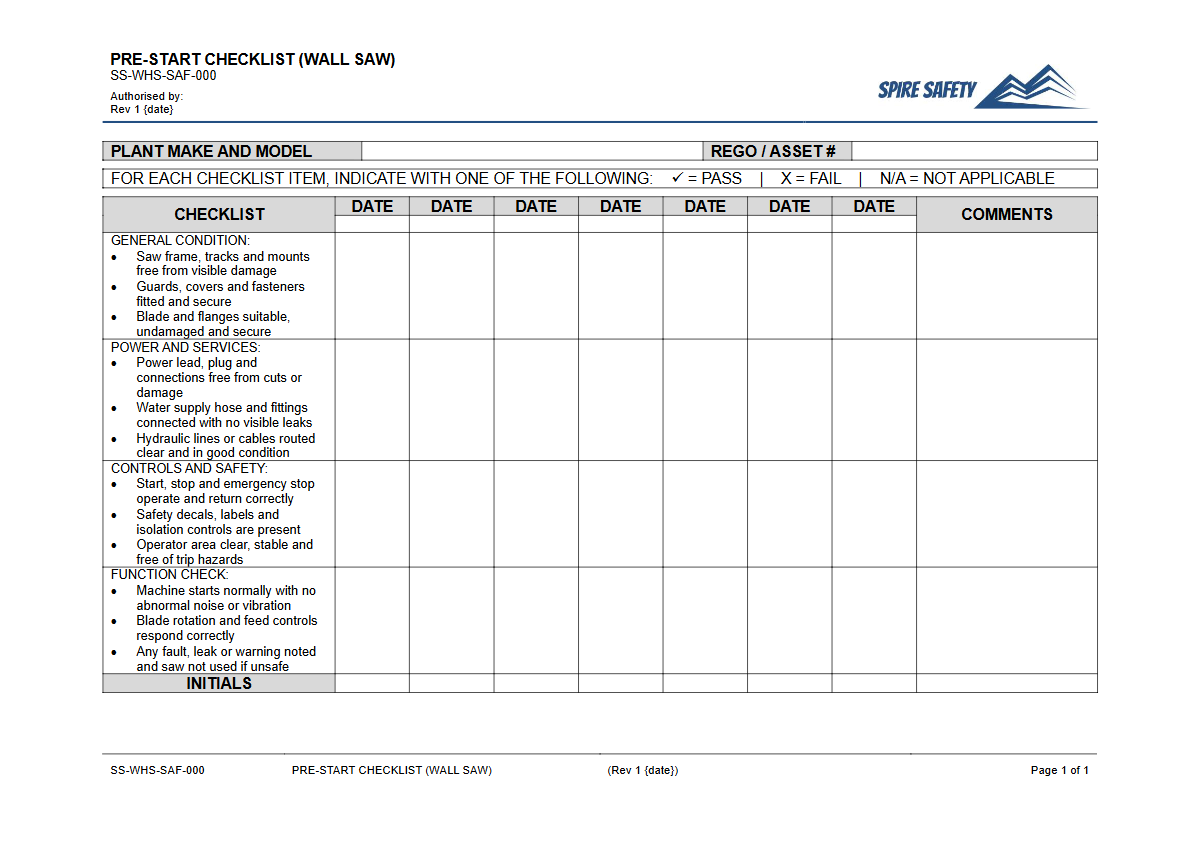
Download our Free Pre-Start Checklist (Wall Saw) Template (DOCX & PDF). This structured checklist helps formalise daily equipment inspections. Get started.
Free Pre-Start Checklist (Wall Saw) Template
DOCX • 125 KB + PDF
Updated Oct 2026
No signup required
Purpose of the Free Pre-Start Checklist (Wall Saw) Template
Wall saws are powerful and specialised pieces of equipment used for creating precise cuts in concrete, brick, and other masonry. Due to their power and the environments in which they operate, they pose significant risks if not properly maintained and inspected.
This Free Pre-Start Checklist (Wall Saw) Template provides a structured framework for operators to conduct thorough, documented inspections before each use. Implementing these checks helps identify potential defects, mechanical faults, or damage that could lead to catastrophic failure, operator injury, or exposure to hazards like silica dust.
Using a formal checklist helps move your organisation beyond ad-hoc inspections, creating a consistent record of due diligence. It reinforces safe work habits and ensures that critical safety components—such as blade guards, emergency stops, and hydraulic systems—are functioning correctly.
Integrating this process is a key component of effective WHS management systems, demonstrating a proactive approach to risk management for high-risk plant.
Video walkthrough
How to Use the Free Pre-Start Checklist (Wall Saw) Template
This template is designed for ease of use and integration into your daily operational workflow. After downloading the DOCX or PDF file, you can adapt it to fit the specific requirements of your workplace. The process typically involves:
- Customisation: Modify the checklist to include items specific to the make and model of your wall saw, including its power pack, tracks, and remote-control unit.
- Training: Ensure all operators are trained not only on how to use the wall saw safely but also on the importance and correct procedure for completing the pre-start checklist.
- Implementation: Make the checklist a mandatory step before any cutting operations begin. The check should be conducted by the operator at the start of their shift or before using the equipment for the first time that day.
- Action and Reporting: Establish a clear procedure for what operators must do if they identify a fault. This must include stopping work, tagging the equipment as 'out of service', and immediately reporting the issue to a supervisor for repair.
Important: This document is a template and serves as a starting point. We strongly recommend that you customise it to be specific to your equipment, operational risks, and internal procedures.
It is your responsibility to ensure it aligns with your site-specific safety requirements. For expert assistance in tailoring safety documents, consider our WHS consulting services.
When to Use This Pre-Start Checklist
A pre-start check for a wall saw should be completed before each use or at the beginning of each shift. The condition of construction equipment can change quickly due to transport, heavy use, and exposure to harsh site conditions. A check that was satisfactory yesterday does not guarantee the equipment is safe today.
Regular inspections are critical for identifying issues like hydraulic fluid leaks, blade damage from a previous cut, or electrical cord damage that may have occurred overnight. Documenting these daily checks creates a valuable maintenance and safety log, which can be reviewed during a WHS compliance auditing process to verify that safety procedures are being followed consistently.
Who Should Use This Pre-Start Checklist
This checklist should be completed by a worker who is deemed competent to operate a wall saw. Competency involves more than just knowing how to perform a cut; it includes comprehensive training on the specific model, understanding its mechanics, recognising potential hazards, and knowing the correct emergency procedures.
While the operator is responsible for conducting the physical inspection, supervisors and managers also have a duty. They must ensure that operators are completing the checks correctly and that any reported faults are addressed promptly before the equipment is returned to service.
The principles of pre-start inspections apply to a wide range of machinery, including those covered by our free Pre-Start Checklist for Floor Saws, which addresses similar cutting hazards.
Beyond saws, similar principles of operator-led inspections are vital for other workshop equipment. Regularly checking guards, emergency stops, and power supplies is a universal safety practice.
For example, our free Pre-Start Checklist (Bench Grinder) Template applies this same logic to fixed plant. You can explore our entire free WHS resources library to find more tools to support your safety programs.
Common mistakes
Common mistakes to avoid
- Completing the checklist from memory without physically inspecting the saw.
- Ignoring 'minor' issues such as frayed electrical cords or small hydraulic drips, which can escalate into major failures.
- Failing to check the saw blade's condition for cracks, warping, or missing segments.
- Not formally reporting identified faults or removing the faulty equipment from service immediately.
Legal references
Legal considerations
The following legal requirements may be relevant to this type of work.
- Work Health and Safety Act (Harmonised) — Provides the primary duties for protecting workers and other people from work health and safety risks.
- Work Health and Safety Regulations (Harmonised) — Sets out requirements supporting the management of workplace hazards and risks.
The following codes may be relevant to this type of work.
- Managing WHS Risks Code of Practice — Provides practical guidance on identifying hazards, assessing risks and applying effective controls.
- Work Health and Safety Consultation, Cooperation and Coordination Code of Practice — Provides practical guidance on consulting workers and coordinating with other duty holders.
- Managing the Work Environment and Facilities Code of Practice — Provides practical guidance on safe work environments, workplace facilities and related controls.
Did you know
Silica Dust Hazard
Wall saws cutting concrete can generate high concentrations of respirable crystalline silica (RCS) dust, a hazardous substance that can cause silicosis. Effective wet cutting methods are a primary engineering control used to suppress dust at the source.
FAQ
Frequently asked questions
01What are the most critical items on a wall saw pre-start checklist?
02What should an operator do if a defect is found during a pre-start check?
03Is a daily pre-start check for a wall saw legally required in Australia?
04How long should completed wall saw pre-start checklists be kept?
Share this resource
Free Pre-Start Checklist (Wall Saw) Template
Browse Categories
How To Use It
- 1Download and open in Word or PDF.
- 2Replace the placeholders with your business details.
- 3Get it reviewed by a WHS specialist before rollout.
Need it customised?
Our WHS consultants can adapt this template to your site, run a gap analysis, or audit what you already have in place.
Book a Free Consultation WHS consulting servicesor call 1300 156 382