
Free Pre-Start Checklist (Water Blaster) Template
Download our free Pre-Start Checklist (Water Blaster) Template. This structured DOCX & PDF resource helps formalise safety checks and manage WHS risks.
Free Pre-Start Checklist (Water Blaster) Template
DOCX • 125 KB + PDF
Updated Oct 2026
No signup required
Purpose of the Free Pre-Start Checklist (Water Blaster) Template
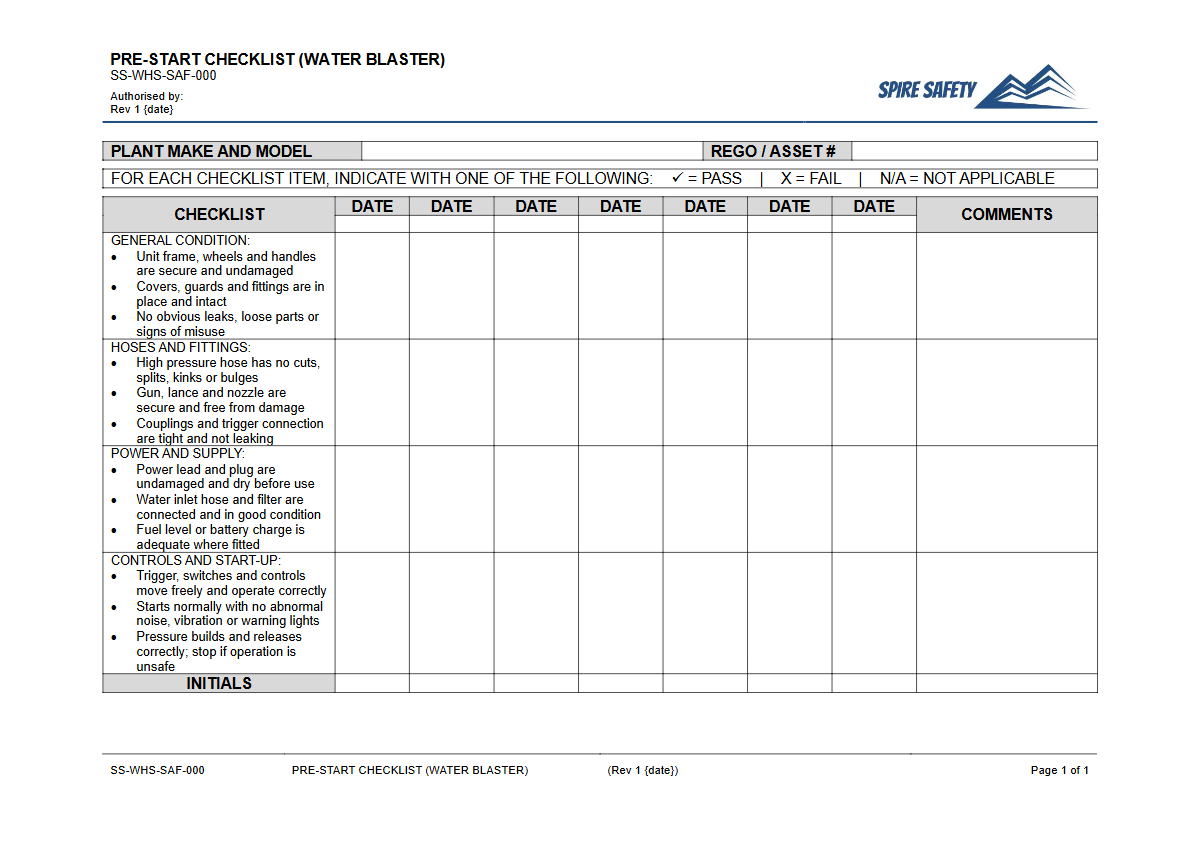
High-pressure water blasters are powerful tools that pose significant safety risks if not properly maintained and inspected. This free Pre-Start Checklist (Water Blaster) Template provides a structured framework for operators to conduct consistent, thorough inspections before each use.
Using a checklist helps formalise the inspection process, creating a verifiable record that equipment was in a safe condition before work commenced. It prompts the user to systematically check critical components like hoses, nozzles, pressure gauges, and safety features, helping to identify potential defects before they can lead to catastrophic failure, equipment damage, or serious injury.
Implementing a routine check is a key part of a proactive approach to safety management. It assists a Person Conducting a Business or Undertaking (PCBU) in meeting their primary duty of care under WHS legislation by ensuring plant is safe to use.
Regularly documenting these checks is a fundamental component of effective WHS management systems, demonstrating due diligence and a commitment to workplace safety.
Video walkthrough
How to use the Free Pre-Start Checklist (Water Blaster) Template
To get started, download the template in your preferred format (DOCX or PDF). The DOCX version is fully editable, allowing you to tailor it to your operational needs.
It is crucial that the checklist accurately reflects the specific equipment used on site, as different models have unique features and failure points. Integrate the customised checklist into your daily operational procedures and ensure all operators are trained on how to complete it correctly.
The checklist guides the operator through a series of visual and functional inspections. This includes checking for leaks in fuel or hydraulic lines, ensuring guards are in place, verifying the condition of high-pressure hoses and fittings, and testing safety mechanisms like emergency stops and pressure relief valves.
The process concludes with the operator signing off that the equipment is safe to use or has been tagged out for maintenance if faults are found. If you require assistance adapting this document for high-risk environments, consider engaging specialist WHS consulting services.
A Note on Customisation
Important: This document is a starting-point template aligned with Australian WHS principles. We have designed it to be a helpful base, but it is not a substitute for a risk-assessment process.
You must customise this checklist to address the specific make and model of your water blaster, your unique site conditions, relevant Australian Standards, and your organisation’s own safe work procedures.
When to use the Pre-Start Checklist
The pre-start checklist should be completed by the operator at the beginning of every shift or before using the water blaster for the first time that day. It should also be used whenever a new operator takes over the equipment during a shift.
Much like conducting checks on other hazardous plant, such as those detailed in our Free Pre-Start Checklist (Floor Saw) Template, this diligence is critical for identifying issues that may have developed overnight or during previous use.
Additional situations requiring a pre-start check include after the equipment has undergone maintenance or repairs, before it is used for a particularly demanding task, or when it is being used in a new or unfamiliar environment. This disciplined routine helps ensure the equipment remains in a safe and reliable condition, minimising the chance of unexpected failures. For a wider selection of safety documents, you can browse our complete free WHS resources library.
Who should use the Pre-Start Checklist
This checklist is designed to be completed by workers who are trained, competent, and authorised to operate the specific water blaster. The operator has the most hands-on interaction with the machine and is best positioned to notice small changes in its condition or performance.
Supervisors and managers should also be familiar with the checklist content to effectively oversee its correct use and verify that safety procedures are being followed.
In the event of an incident or audit, these completed checklists form part of the organisation's safety records. They can be reviewed during a WHS compliance audit to verify that plant inspection procedures are being consistently implemented as required by law. The process also ensures accountability, as the operator's sign-off confirms they have taken responsibility for verifying the equipment's safety. This is a similar principle applied to other workshop equipment, as outlined in our Free Pre-Start Checklist (Bench Grinder) Template.
Common mistakes
Common mistakes to avoid
- Treating the checklist as a 'tick and flick' exercise without physically performing each check.
- Failing to customise the template for the specific make, model, and pressure rating of the water blaster.
- Neglecting to check the condition and suitability of personal protective equipment (PPE), like rated gloves and face shields.
- Continuing to use equipment after a 'minor' fault, such as a weeping hose fitting, has been identified.
Legal references
Legal considerations
The following legal requirements may be relevant to this type of work.
- Work Health and Safety Act (Harmonised) — Provides the primary duties for protecting workers and other people from work health and safety risks.
- Work Health and Safety Regulations (Harmonised) — Sets out requirements supporting the management of workplace hazards and risks.
The following codes may be relevant to this type of work.
- Managing WHS Risks Code of Practice — Provides practical guidance on identifying hazards, assessing risks and applying effective controls.
- Work Health and Safety Consultation, Cooperation and Coordination Code of Practice — Provides practical guidance on consulting workers and coordinating with other duty holders.
- Managing the Work Environment and Facilities Code of Practice — Provides practical guidance on safe work environments, workplace facilities and related controls.
Did you know
Injection Injury Risk
A high-pressure water jet can penetrate skin and tissue even from a distance, causing severe injection injuries that may not appear serious initially but can lead to amputation. This is always a medical emergency.
Pressure Classes
In Australia, water jetting equipment is often categorised by pressure and flow rate into classes. Operating high-pressure units (typically Class B) requires specific national training and competency verification (RIWHS205E).
FAQ
Frequently asked questions
01What is the difference between a pre-start checklist and a Safe Work Method Statement (SWMS)?
02How often should high-pressure water blaster hoses be inspected?
03Is this water blaster checklist suitable for all types of units?
04What happens if a fault is found during the pre-start check?
Share this resource
Free Pre-Start Checklist (Water Blaster) Template
Browse Categories
How To Use It
- 1Download and open in Word or PDF.
- 2Replace the placeholders with your business details.
- 3Get it reviewed by a WHS specialist before rollout.
Need it customised?
Our WHS consultants can adapt this template to your site, run a gap analysis, or audit what you already have in place.
Book a Free Consultation WHS consulting servicesor call 1300 156 382