
Free Pre-Start Checklist (Water Truck) Template
Formalise your daily equipment safety checks with our free Pre-Start Checklist (Water Truck) Template.
Free Pre-Start Checklist (Water Truck) Template
DOCX • 125 KB + PDF
Updated Oct 2026
No signup required
Purpose of the Free Pre-Start Checklist (Water Truck) Template
A water truck, or water cart, is essential heavy machinery on construction, mining, and civil works sites, primarily used for dust suppression and soil compaction. To ensure safe operation and prevent incidents, regular inspections are critical.
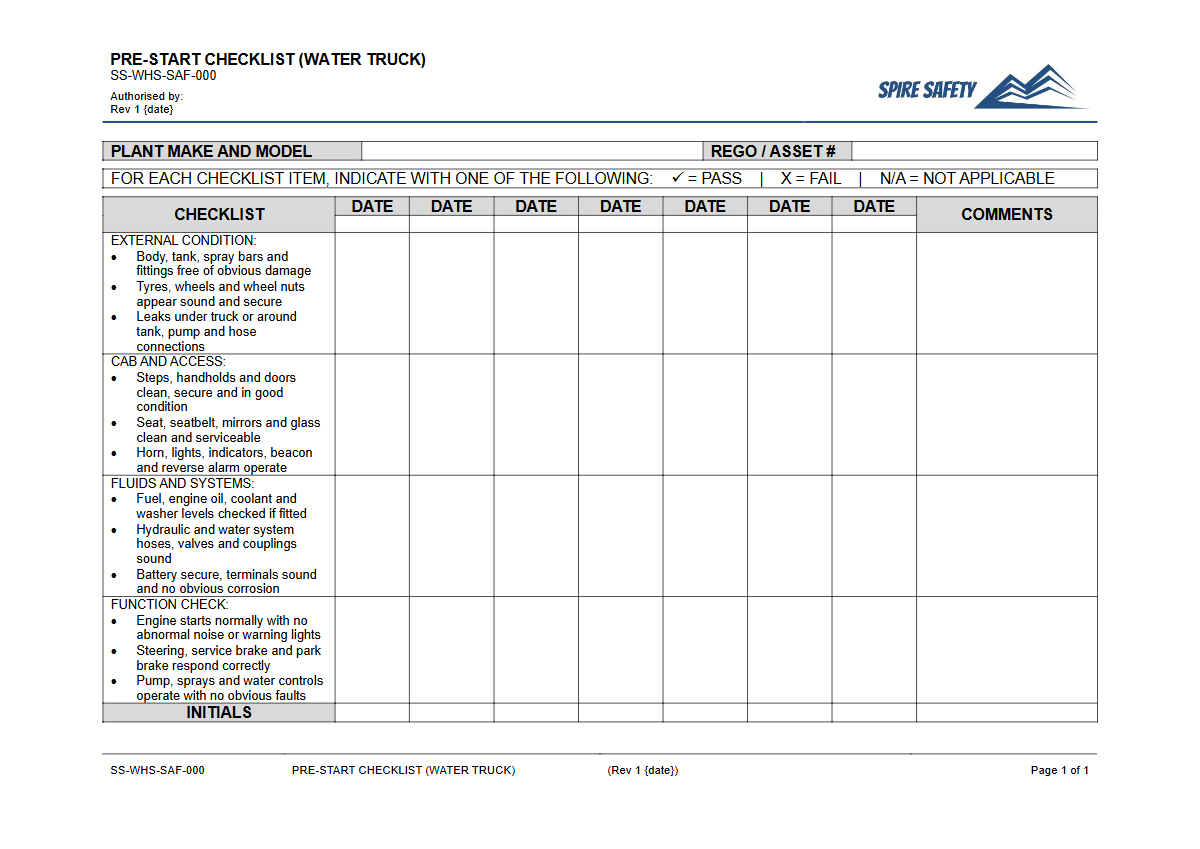
This free Pre-Start Checklist (Water Truck) Template provides a structured framework for operators to conduct thorough pre-operational checks, identify potential faults, and document the equipment's fitness for use before each shift begins.
Using a standardised checklist helps formalise your safety procedures and demonstrates a commitment to proactive risk management. It prompts operators to systematically inspect key components like brakes, steering, tyres, lights, and the water delivery system itself.
Integrating such checks is a fundamental part of building robust WHS management systems, creating a safer work environment for everyone on site.
What this Pre-Start Checklist covers:
This template is designed as a comprehensive starting point. It includes sections for checking:
- General vehicle condition (leaks, damage, cleanliness)
- Cabin controls and safety features (seatbelt, horn, gauges)
- Fluid levels (engine oil, coolant, hydraulic fluid)
- Wheels, tyres, and brakes
- Lights, indicators, and mirrors
- Water system components (pump, spray heads, valves, controls)
- Emergency and safety equipment (fire extinguisher, first aid kit)
By systematically reviewing these items, operators can identify and report defects before they escalate into more significant mechanical failures or safety incidents. This process is similar for other types of heavy machinery, as seen in our Free Pre-Start Checklist (Forwarder) Template, which also focuses on operational safety through inspection.
Video walkthrough
How to use the Free Pre-Start Checklist (Water Truck) Template
Implementing this checklist is a straightforward process. First, download the template in your preferred format (DOCX for easy customisation or PDF for immediate printing).
The next step is crucial for ensuring its effectiveness and relevance to your specific operational context.
Please note: This document is a template and must be customised to suit the specific make and model of your water truck, your site conditions, and your organisation's unique operational risks. We recommend a competent person, such as a site supervisor or equipment specialist, reviews and tailors the checklist before use.
Add your company branding, specific site hazards, and any unique checks required for your particular water cart model.
Once customised, ensure all operators are trained on how to use the checklist correctly. The process should be simple: the operator completes the check, signs and dates it, and reports any identified faults to their supervisor immediately.
A process should be in place to tag out and remove unsafe equipment from service until repairs are made. Regular reviews, perhaps as part of a WHS compliance auditing program, can ensure the procedure is being followed correctly.
When to use it
The Pre-Start Checklist should be completed at the beginning of every shift or before the water truck is operated for the first time on any given day. This routine ensures that the equipment is verified as safe before work commences.
Additionally, a pre-start check is advisable after any significant maintenance event or if the equipment has been idle for an extended period, to ensure it is still in safe working order.
Who should use it
This checklist is designed to be used by trained and competent water truck operators. These are the individuals with hands-on control of the equipment and are best placed to notice subtle changes or developing faults.
Supervisors and site managers are responsible for ensuring these checks are consistently performed and that any documented defects are addressed promptly. Maintenance personnel will also use the completed checklists to understand and action required repairs. Establishing clear roles and responsibilities is key, a principle that applies to all plant, including smaller equipment covered by resources like our Pre-Start Checklist for Floor Saws.
For organisations needing assistance with implementing such procedures or developing comprehensive safe work method statements, seeking expert WHS consulting can help bridge gaps in your safety framework. If you are looking for other document templates, feel free to browse our complete free WHS resources library for more checklists, policies, and forms.
Common mistakes
Common mistakes to avoid
- "Pencil-whipping" the checklist without physically inspecting each item.
- Failing to report or follow up on identified defects, rendering the check ineffective.
- Using a generic heavy vehicle checklist that doesn't cover the specific features of the water delivery system.
- Inadequate training for operators on how to properly conduct each check and what constitutes a 'defect'.
Legal references
Legal considerations
The following legal requirements may be relevant to this type of work.
- Work Health and Safety Act (Harmonised) — Provides the primary duties for protecting workers and other people from work health and safety risks.
- Work Health and Safety Regulations (Harmonised) — Sets out requirements supporting the management of workplace hazards and risks.
The following codes may be relevant to this type of work.
- Managing WHS Risks Code of Practice — Provides practical guidance on identifying hazards, assessing risks and applying effective controls.
- Work Health and Safety Consultation, Cooperation and Coordination Code of Practice — Provides practical guidance on consulting workers and coordinating with other duty holders.
- Managing the Work Environment and Facilities Code of Practice — Provides practical guidance on safe work environments, workplace facilities and related controls.
Did you know
Spray Control
Modern water trucks often feature computerised spray systems that can be programmed to adjust water flow based on the truck's speed, ensuring more efficient and consistent dust suppression.
Beyond Dust Control
Besides dust control on mine and construction sites, water trucks are critical for soil compaction during road building and are also used for firefighting support in rural areas.
FAQ
Frequently asked questions
01What should a water truck pre-start inspection include?
02How often should a water truck pre-start check be done?
03Who is responsible for ensuring pre-start checks are completed?
04Is this water truck checklist a legal document?
Share this resource
Free Pre-Start Checklist (Water Truck) Template
Browse Categories
How To Use It
- 1Download and open in Word or PDF.
- 2Replace the placeholders with your business details.
- 3Get it reviewed by a WHS specialist before rollout.
Need it customised?
Our WHS consultants can adapt this template to your site, run a gap analysis, or audit what you already have in place.
Book a Free Consultation WHS consulting servicesor call 1300 156 382