
Free Pre-Start Checklist (Wet Vac) Template
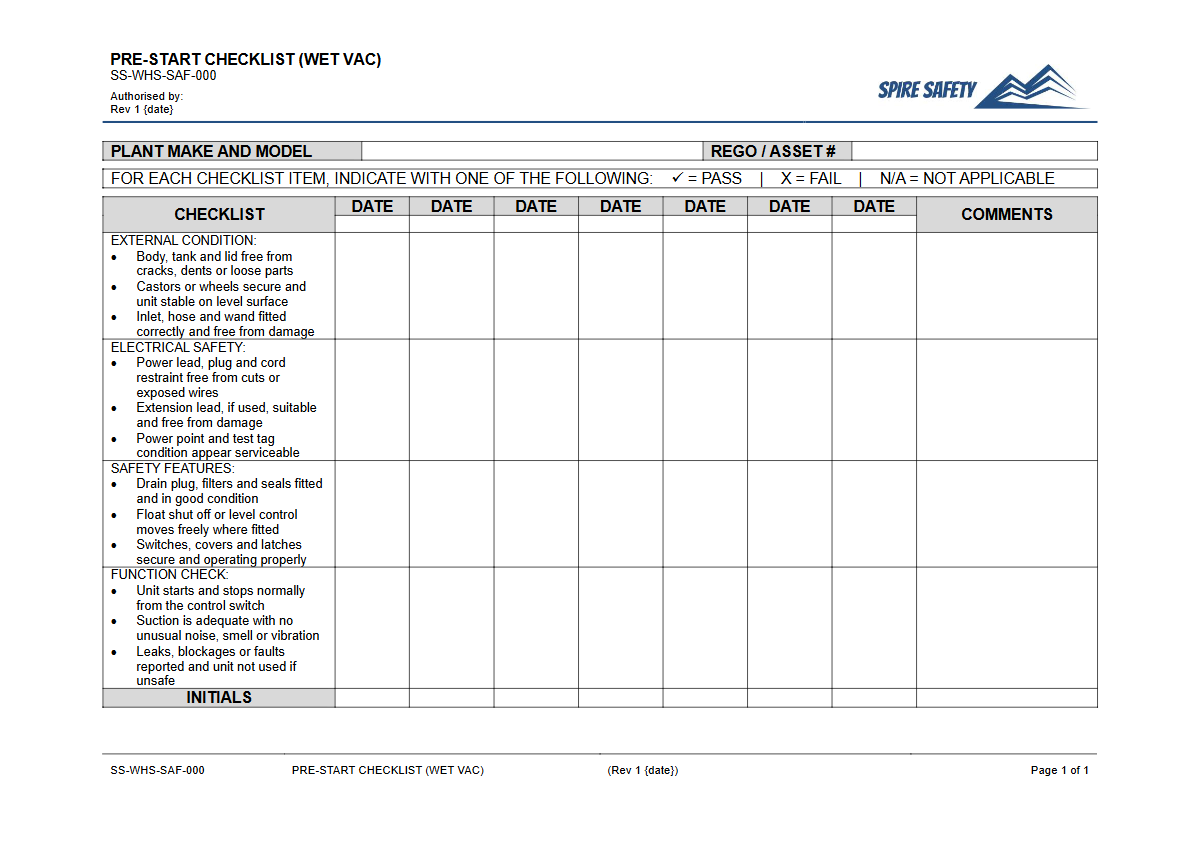
Download our Free Pre-Start Checklist (Wet Vac) Template to formalise daily equipment inspections and manage WHS risks associated with wet vacuums.
Free Pre-Start Checklist (Wet Vac) Template
DOCX • 125 KB + PDF
Updated Oct 2026
No signup required
Purpose of the Free Pre-Start Checklist (Wet Vac) Template
This Free Pre-Start Checklist (Wet Vac) Template provides a structured framework for operators to conduct consistent safety and operational checks before using a wet vacuum cleaner. Using a pre-start checklist helps formalise the inspection process, ensuring that potential hazards such as electrical faults, damaged components, or incorrect filter configurations are identified and addressed before the equipment is operated.
By documenting these checks, organisations create a verifiable record of due diligence, demonstrating a proactive approach to risk management. Integrating such procedures is a fundamental component of robust WHS management systems, helping to prevent incidents, protect workers, and minimise equipment downtime.
Key Inspection Points
A thorough wet vacuum inspection should cover several critical areas to ensure safe operation. This template prompts the user to examine:
- Electrical Components: Inspect the power cord for any cuts, abrasions, or exposed wires. Check the plug for damage, and verify that the built-in or plug-in Residual Current Device (RCD) is tested and functional.
- Filters and Collection Tank: Ensure the correct filter is installed for wet operation to prevent motor damage and electrical hazards. The collection tank should be empty, clean, and free from cracks or leaks.
- Hoses and Attachments: Check that hoses, wands, and nozzles are securely connected and free from blockages, splits, or other damage that could affect performance or create tripping hazards.
- Physical Condition: Examine the unit's wheels, casters, and housing for stability and integrity. Ensure all guards and safety features are in place and functioning as intended by the manufacturer.
- Operational Controls: Confirm that power switches and any other controls are working correctly and are clearly labelled.
Proper management of collected waste is also critical. In environments where wet vacuums are part of a broader waste management process, ensuring other equipment is also inspected is essential.
For instance, a similar level of diligence should be applied by using a pre-start checklist for bin lifters if they are used to handle the collected waste.
Video walkthrough
How to use the Free Pre-Start Checklist (Wet Vac) Template
This checklist is provided as a starting point, available for download in both DOCX for easy editing and PDF for immediate printing. It is designed to be adapted to the specific context of your workplace and the equipment in use.
We strongly advise that you customise this checklist before implementation. Your modifications should account for the specific make and model of your wet vacuum, the unique environmental conditions of your workplace (e.g., indoor, outdoor, hazardous areas), and any internal company procedures. Add fields for the operator's name, date, equipment ID, and location to ensure clear and useful records. The effectiveness of these records can be verified during routine safety reviews or a formal WHS compliance audit.
When to use it
A pre-start check should be completed before the first use of the wet vacuum on any given day or at the beginning of each shift where the equipment is used. This frequency ensures that any damage or faults that may have occurred overnight, during transport, or during a previous shift are identified before the machine is energised.
In high-use environments like construction sites, where equipment is subjected to more demanding conditions, daily checks are non-negotiable. This process mirrors the safety diligence required for other site equipment, such as that outlined in a pre-start checklist for floor saws, where daily inspections are vital for preventing serious incidents.
Who should use it
The pre-start checklist should be completed by the person operating the wet vacuum. Operators have the most hands-on interaction with the equipment and are best placed to notice subtle changes, new sounds, or minor damage that could indicate a developing fault.
It is the responsibility of supervisors and managers to ensure that operators are properly trained not only on how to use the wet vacuum safely but also on the importance and correct procedure for completing the checklist. Completed checklists should be reviewed periodically by a supervisor to identify recurring issues and ensure the process is being followed correctly. In a workshop setting, this responsibility is similar to that required for other powered tools, which may also have their own inspection protocols like a bench grinder pre-start checklist.
By embedding this practice into your daily operations, you can foster a stronger safety culture and systematically reduce risk. You can explore more templates and tools in our complete free WHS resources library to support your safety management efforts.
Common mistakes
Common mistakes to avoid
- Failing to test the RCD (safety switch) before use.
- Using a dry-use filter for wet pick-up, which can lead to motor failure and electrical hazards.
- Ignoring nicks, cuts, or fraying on the electrical cord.
- Not customising the generic checklist for the specific make, model, and work environment.
Legal references
Legal considerations
The following legal requirements may be relevant to this type of work.
- Work Health and Safety Act (Harmonised) — Provides the primary duties for protecting workers and other people from work health and safety risks.
- Work Health and Safety Regulations (Harmonised) — Sets out requirements supporting the management of workplace hazards and risks.
The following codes may be relevant to this type of work.
- Managing WHS Risks Code of Practice — Provides practical guidance on identifying hazards, assessing risks and applying effective controls.
- Work Health and Safety Consultation, Cooperation and Coordination Code of Practice — Provides practical guidance on consulting workers and coordinating with other duty holders.
- Managing the Work Environment and Facilities Code of Practice — Provides practical guidance on safe work environments, workplace facilities and related controls.
Did you know
Electrical Safety
Using portable electrical equipment like wet vacuums in damp or wet environments significantly increases the risk of electric shock. A functioning Residual Current Device (RCD) can disconnect the power in as little as 30 milliseconds if it detects a fault, preventing a fatal shock.
Slip Hazards
Slips, trips, and falls are a leading cause of workplace injuries in Australia. Leaking wet vacuums or improper water management during cleaning are common contributors to slip hazards on smooth floor surfaces.
FAQ
Frequently asked questions
01What specific hazards should a wet vac pre-start check cover?
02How often should a wet vac pre-start checklist be completed?
03Who is responsible for conducting the pre-start check on a wet vacuum?
04Can this template be used for a standard dry vacuum cleaner?
Share this resource
Free Pre-Start Checklist (Wet Vac) Template
Browse Categories
How To Use It
- 1Download and open in Word or PDF.
- 2Replace the placeholders with your business details.
- 3Get it reviewed by a WHS specialist before rollout.
Need it customised?
Our WHS consultants can adapt this template to your site, run a gap analysis, or audit what you already have in place.
Book a Free Consultation WHS consulting servicesor call 1300 156 382