
Free Pre-Start Checklist (Wheelchair Lift) Template
Download our free Pre-Start Checklist for Wheelchair Lifts. This structured DOCX & PDF template helps formalise daily safety inspections.
Free Pre-Start Checklist (Wheelchair Lift) Template
DOCX • 125 KB + PDF
Updated Oct 2026
No signup required
Purpose of the Free Pre-Start Checklist (Wheelchair Lift) Template
A wheelchair lift is a critical piece of equipment for ensuring accessibility and mobility. Regular inspections are essential to guarantee it operates safely and reliably.
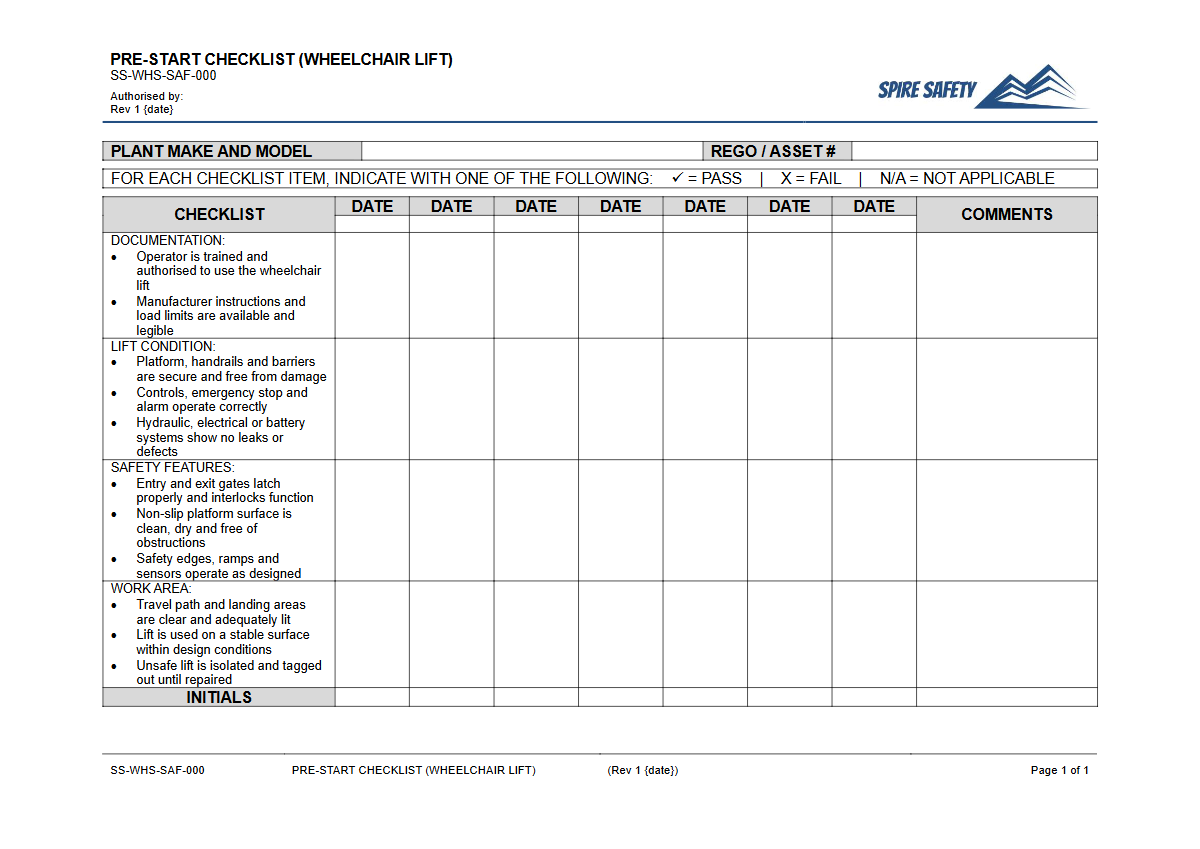
This Free Pre-Start Checklist (Wheelchair Lift) Template provides a structured format for conducting and recording daily safety checks. Its primary purpose is to help operators identify potential hazards, defects, or mechanical faults before the lift is used, preventing incidents and equipment failure.
Formalising this process helps a Person Conducting a Business or Undertaking (PCBU) meet their primary duty of care under Australian WHS laws.
Using this checklist consistently promotes a proactive safety culture within your organisation. It's particularly vital in environments such as aged care facilities, hospitals, public transport vehicles, and community centres where vulnerable people rely on this equipment.
Documented checks create a clear record of due diligence and can highlight recurring maintenance needs. For related safety topics in care settings, consider our Aged Care Manual Handling Toolbox Talk to further support staff training.
Video walkthrough
How to use the Free Pre-Start Checklist (Wheelchair Lift) Template
This resource is available for immediate download in both DOCX (Microsoft Word) and PDF formats. The DOCX file is fully editable, allowing you to tailor the checklist to your specific needs.
It is crucial to customise this template to reflect the exact make and model of the wheelchair lift(s) in use at your workplace, as well as the unique environmental and operational risks of your site.
Important: This document is a template, not a finished product. We are not familiar with your specific equipment or operational context.
You must adapt this checklist by adding, removing, or modifying items to ensure it is comprehensive for your situation. Integrating customised documents like this into broader WHS management systems ensures safety procedures are systematically applied and reviewed across the organisation.
What to Include in Your Pre-Start Checklist
When customising your wheelchair lift checklist, ensure it covers all critical safety and operational components. A thorough check should be organised into logical sections for clarity. Key areas to inspect include:
- Controls and Operation: Verify that all operating controls (e.g., up, down, fold, unfold buttons) function correctly and smoothly. Check emergency stop buttons and any key switches.
- Platform and Safety Barriers: Inspect the platform surface for damage or slip hazards. Ensure safety rails, entry/exit ramps, and roll-stops deploy correctly and are not damaged.
- Hydraulic and Electrical Systems: Look for any signs of hydraulic fluid leaks, frayed electrical wiring, or damaged connections. Listen for any unusual noises from the motor or pump during operation.
- Structural Components: Check the frame, lifting arms, and mounting points for any signs of cracking, bending, corrosion, or loose bolts.
- Signage and Labels: Ensure all safety warnings, instructional decals, and the load capacity plate are legible and securely attached. A comprehensive procedure for using equipment is often detailed in a Safe Work Method Statement, like the one in our Safe Work Method Statement (Scissor Lift Operation) template.
When to Use the Checklist
The pre-start inspection should be completed before the wheelchair lift is used for the first time each day or at the beginning of each shift. This routine ensures that the equipment's condition is verified before it is put into service.
A check should also be performed after any maintenance or repair work has been completed to confirm it is safe to return to operation.
If the equipment has been idle for an extended period or if an issue was reported during its last use, a pre-start check is mandatory. Reinforcing the importance of these checks can be achieved through regular training sessions, such as those covered in our Pre-Start Checks and Plant Maintenance Toolbox Talk.
Who Should Use the Checklist
The checklist should be completed by a person who is trained and competent to operate the specific wheelchair lift. This is typically the designated operator for the vehicle or facility.
They must have the knowledge to identify the faults and defects listed on the form. Supervisors should periodically review completed checklists to ensure they are being filled out correctly and to identify any recurring issues that may require further investigation or a change in maintenance schedules.
Verifying that an operator has the required skills is a key part of WHS management. This process of confirming skills is often formalised through a Verification of Competency (VOC), a process detailed in resources like our free Scissor Lift VOC template. Regular WHS compliance auditing can also help confirm that procedures like pre-start checks and competency assessments are being followed correctly.
Common mistakes
Common mistakes to avoid
- Using a generic checklist without customising it for the specific lift model and workplace risks.
- Operators 'pencil-whipping' the form without physically performing each inspection item.
- Failing to immediately remove faulty or damaged equipment from service and clearly tag it.
- Poor record-keeping or not reviewing completed checklists to identify recurring faults or operator knowledge gaps.
Legal references
Legal considerations
The following legal requirements may be relevant to this type of work.
- Work Health and Safety Act (Harmonised) — Provides the primary duties for protecting workers and other people from work health and safety risks.
- Work Health and Safety Regulations (Harmonised) — Sets out requirements supporting the management of workplace hazards and risks.
The following codes may be relevant to this type of work.
- Managing WHS Risks Code of Practice — Provides practical guidance on identifying hazards, assessing risks and applying effective controls.
- Work Health and Safety Consultation, Cooperation and Coordination Code of Practice — Provides practical guidance on consulting workers and coordinating with other duty holders.
- Managing the Work Environment and Facilities Code of Practice — Provides practical guidance on safe work environments, workplace facilities and related controls.
Did you know
Accessibility is a Right
The Disability Discrimination Act 1992 (DDA) makes it unlawful to discriminate against a person on the grounds of disability. Properly maintained accessibility equipment like wheelchair lifts is crucial for organisations to meet their legal obligations.
Plant Inspection
Under the model WHS Regulations, specific types of plant, including lifts, require regular inspection and maintenance by a competent person to ensure they remain safe to operate.
FAQ
Frequently asked questions
01Is a pre-start checklist for a wheelchair lift a legal requirement in Australia?
02How often should a wheelchair lift pre-start check be performed?
03What should happen if a fault is found during a wheelchair lift inspection?
04Can this template be used for all types of wheelchair lifts?
Share this resource
Free Pre-Start Checklist (Wheelchair Lift) Template
Browse Categories
How To Use It
- 1Download and open in Word or PDF.
- 2Replace the placeholders with your business details.
- 3Get it reviewed by a WHS specialist before rollout.
Need it customised?
Our WHS consultants can adapt this template to your site, run a gap analysis, or audit what you already have in place.
Book a Free Consultation WHS consulting servicesor call 1300 156 382