
Free Pre-Start Checklist (Wood Lathe) Template
Download our free Pre-Start Checklist for Wood Lathes. This template helps formalise daily equipment checks and manage WHS risks for woodworking machinery.
Free Pre-Start Checklist (Wood Lathe) Template
DOCX • 125 KB + PDF
Updated Oct 2026
No signup required
Purpose of the Free Pre-Start Checklist (Wood Lathe) Template
Operating a wood lathe introduces significant workplace hazards, including entanglement with rotating parts, projectiles from improperly secured workpieces, and exposure to wood dust. This Free Pre-Start Checklist (Wood Lathe) Template provides a structured method to formalise daily safety inspections, helping to identify and control these risks before work commences.
By using a consistent checklist, organisations can systematically verify that crucial safety features are in place and the equipment is in safe working order, creating a safer environment for operators.
This document serves as a practical tool to support your risk management process for workshop machinery. It helps create a documented record of due diligence and encourages a proactive safety culture where equipment condition is actively monitored.
It is designed as a starting point, aligned with Australian WHS principles, to be adapted to your specific operational needs.
Video walkthrough
How to use the Free Pre-Start Checklist (Wood Lathe) Template
Using this template effectively involves more than just downloading the file. First, download the template in your preferred format (DOCX for easy editing or PDF).
The next step is crucial for its effectiveness and your compliance.
Important: This document is a template and must be customised. We recommend you adapt it to reflect the specific make and model of the wood lathe in your workplace, the types of tasks performed, and any unique environmental or operational factors.
Your customisation should be based on the manufacturer's instructions and a comprehensive risk assessment.
Once customised, operators should be trained on how to complete the checklist correctly. Completed checklists should be reviewed by a supervisor and kept as a record.
These records form a vital part of your overall WHS management systems, providing evidence of safety monitoring and helping to track recurring equipment issues.
What's covered in the template?
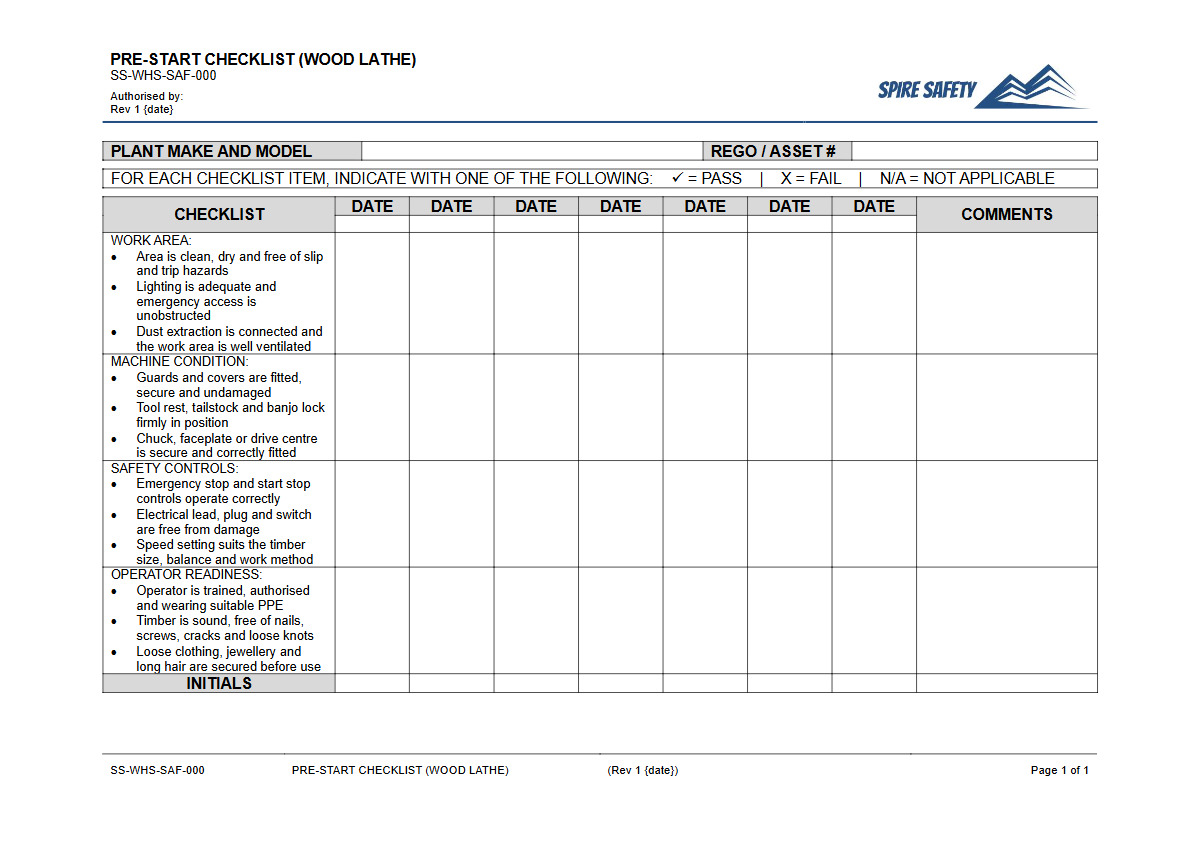
Our template prompts operators to inspect key areas critical to the safe operation of a wood lathe. These include:
- Guards and Safety Devices: Ensuring all guards (e.g., chuck guards, belt guards) are secure and interlocks are functional.
- Emergency Stops: Verifying the E-stop button is accessible and functions correctly.
- Tool Rest and Tailstock: Checking for secure clamping and correct positioning.
- Chuck and Spindle: Confirming the chuck key has been removed and the workpiece is securely mounted.
- General Condition: Looking for signs of damage, wear, excessive vibration, or fluid leaks.
- Work Area: Ensuring the surrounding area is clear of trip hazards, clutter, and flammable materials.
These checks are fundamental for most workshop equipment. For other common machinery, you might find our Pre-Start Checklist (Bench Grinder) Template useful as well.
When to use it
A pre-start checklist for a wood lathe should be completed before the first use of the equipment on any given day or at the beginning of each shift. It is a pre-operational check designed to catch faults that may have developed since the last use.
It is not a replacement for scheduled preventative maintenance, but rather a supplementary daily safety measure. Establishing this as a routine behaviour is a simple and effective way to reinforce safety protocols.
Who should use it
The pre-start check should be conducted by a trained and competent operator who will be using the wood lathe. This person is best placed to notice subtle changes in the machine's condition or performance. A supervisor or manager should be responsible for reviewing the completed checklists, ensuring they are being filled out correctly, and taking prompt action to address any faults or defects identified. These records can be an important input for periodic WHS compliance auditing to verify that procedures are being followed. For more tools to help manage your workplace safety, browse our complete free WHS resources library.
Common mistakes
Common mistakes to avoid
- Failing to remove the chuck key from the chuck before starting the lathe.
- Using a generic checklist that hasn't been customised for the specific lathe model.
- Ignoring minor issues like excessive vibration or worn belts, which can indicate a larger problem.
- Not retaining completed checklists as a record for safety audits and maintenance tracking.
Legal references
Legal considerations
The following legal requirements may be relevant to this type of work.
- Work Health and Safety Act (Harmonised) — Provides the primary duties for protecting workers and other people from work health and safety risks.
- Work Health and Safety Regulations (Harmonised) — Sets out requirements supporting the management of workplace hazards and risks.
The following codes may be relevant to this type of work.
- Managing WHS Risks Code of Practice — Provides practical guidance on identifying hazards, assessing risks and applying effective controls.
- Work Health and Safety Consultation, Cooperation and Coordination Code of Practice — Provides practical guidance on consulting workers and coordinating with other duty holders.
- Managing the Work Environment and Facilities Code of Practice — Provides practical guidance on safe work environments, workplace facilities and related controls.
Did you know
A Hidden Hazard
Wood dust is not just an irritant; certain hardwood dusts are classified as Group 1 carcinogens by the International Agency for Research on Cancer (IARC), meaning they are known to cause cancer in humans.
The Chuck Key Danger
Forgetting to remove the chuck key before starting the lathe is one of the most common and dangerous mistakes. When the machine powers on, the key can be ejected at high velocity, becoming a lethal projectile.
FAQ
Frequently asked questions
01Why is a pre-start checklist important for a wood lathe?
02Can I use this template for any type of wood lathe?
03Who is responsible for signing off on a wood lathe pre-start check?
04Does a pre-start check replace scheduled maintenance?
Share this resource
Free Pre-Start Checklist (Wood Lathe) Template
Browse Categories
How To Use It
- 1Download and open in Word or PDF.
- 2Replace the placeholders with your business details.
- 3Get it reviewed by a WHS specialist before rollout.
Need it customised?
Our WHS consultants can adapt this template to your site, run a gap analysis, or audit what you already have in place.
Book a Free Consultation WHS consulting servicesor call 1300 156 382