
Free Pre-Start Checklist (Zero Turn) Template
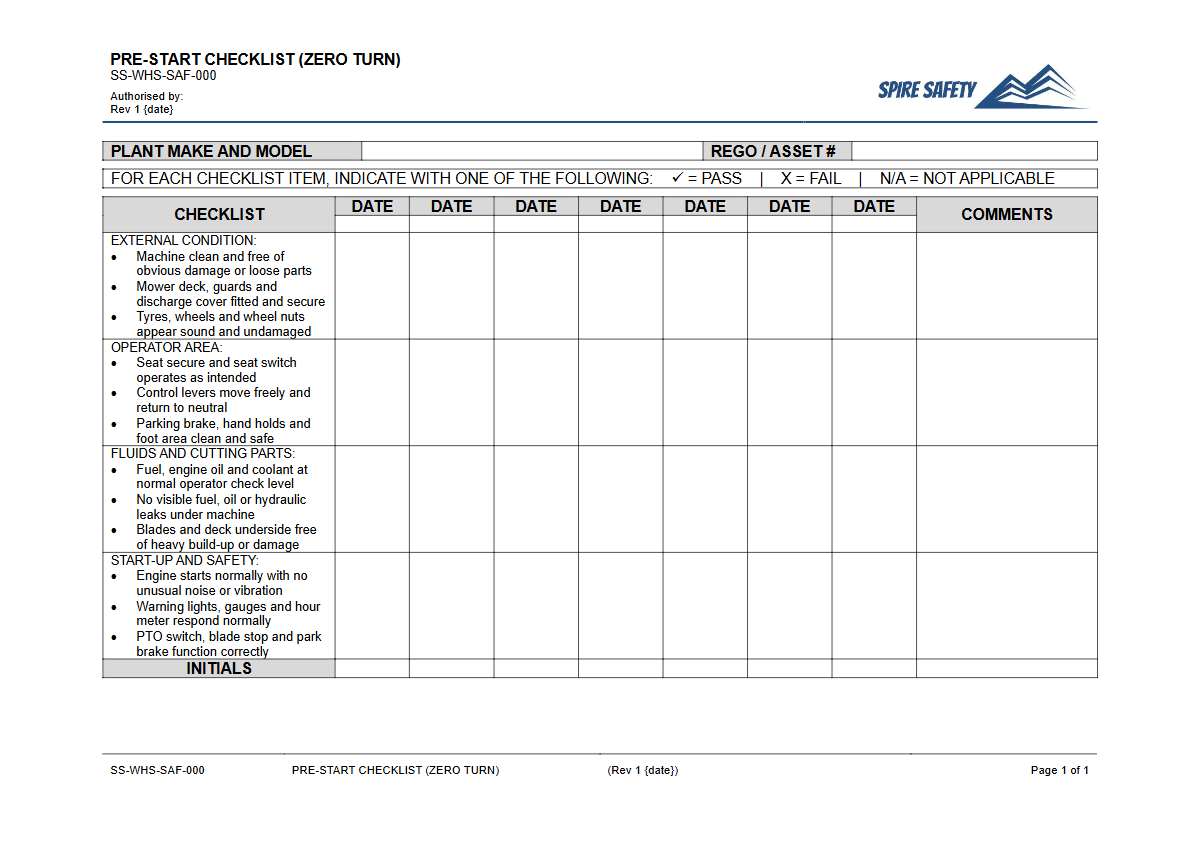
Download our Free Pre-Start Checklist (Zero Turn) Template to formalise equipment inspections and manage WHS risks. A structured DOCX & PDF resource. Get yours.
Free Pre-Start Checklist (Zero Turn) Template
DOCX • 125 KB + PDF
Updated Oct 2026
No signup required
Purpose of the Free Pre-Start Checklist (Zero Turn) Template
Using a zero-turn mower involves significant risks, including rollovers, blade contact, and projectiles. This Free Pre-Start Checklist (Zero Turn) Template provides a structured framework for operators to conduct thorough, documented inspections before each use.
Its primary purpose is to systematically identify potential mechanical faults, damage, or fluid leaks that could lead to an incident. Regular use of this checklist helps ensure the equipment is safe to operate, reduces the risk of injury, and provides a clear record of due diligence.
Implementing documented safety checks is a fundamental component of effective risk management. By formalising the inspection process, you create a consistent standard across all operators and shifts, which is essential for maintaining robust WHS management systems. The checklist prompts operators to verify critical safety features, such as the Roll-Over Protective Structure (ROPS), seatbelts, braking systems, and blade guards, reinforcing safe work practices and minimising operational hazards.
Video walkthrough
How to use the Free Pre-Start Checklist (Zero Turn) Template
Our template is designed for immediate use and straightforward customisation. It guides operators through a logical sequence of checks covering all major components of a typical zero-turn mower. Follow these steps to integrate it into your operations:
- Download: Choose between the DOCX format for easy editing or the PDF for direct printing.
- Customise: This is a critical step. We have designed this template as a starting point, not a finished document. You must adapt it to your specific make and model of zero-turn mower, its unique features, the operating environment (e.g., terrain, proximity to public), and your organisation’s safety procedures.
- Train: Ensure all operators are trained not just on how to operate the mower, but also on how to complete the pre-start check correctly. They must understand what each item means and what constitutes a pass or fail.
- Implement: Make the pre-start check a non-negotiable task before the first use of the mower each day or at the start of every shift.
- Review: Supervisors should periodically review completed checklists to identify recurring faults, operator knowledge gaps, or a need for further maintenance.
For organisations that use various types of landscaping equipment, maintaining consistent safety documentation is key. You may find our Free Pre-Start Checklist (Lawn Tractor) Template useful for standardising your inspection processes across different machinery.
When to use it
A pre-start checklist should be completed at several key moments to ensure ongoing equipment safety. The most important time is before the first use of the day or at the beginning of an operator's shift.
This establishes a baseline for the equipment's condition before any work commences. Additionally, a check should be performed if the operator changes mid-shift, as the new operator needs to verify the mower's safety for themselves.
It is also good practice to conduct an inspection after any significant maintenance or repair work to confirm the equipment is ready to be returned to service.
Integrating this check into your daily routine is a proactive safety measure. The same principle applies to workshop tools used for maintenance.
For example, using a bench grinder pre-start checklist before sharpening blades ensures the maintenance tools themselves are safe to use.
Who should use it
The pre-start checklist must be completed by a person who is competent to operate the zero-turn mower. This means they have received the necessary training, instruction, and information to understand both how to use the machine and how to identify the hazards associated with it.
The operator is in the best position to notice subtle changes in the mower's performance or condition.
Supervisors and managers also have a role. They are responsible for ensuring the pre-start system is implemented correctly, that operators are completing the checks diligently, and that any reported faults are actioned immediately.
Records from these checklists are valuable documents during safety reviews or a formal WHS compliance auditing process, as they demonstrate a systematic approach to managing plant safety. If you work with other powerful cutting tools, consider applying similar safety checks, such as those outlined in a floor saw checklist, to ensure all equipment is managed with the same level of care.
You can find many other useful documents in our free WHS resources library to support your safety program.
Common mistakes
Common mistakes to avoid
- Operating on slopes or embankments that exceed the manufacturer's specified gradient limit.
- Disabling or ignoring safety features like the ROPS, seatbelt, or operator-presence controls.
- Failing to walk the mowing area beforehand to check for hidden objects like rocks, pipes, or debris that could become projectiles.
- Performing a 'tick and flick' inspection without physically and visually checking each item on the list.
Legal references
Legal considerations
The following legal requirements may be relevant to this type of work.
- Work Health and Safety Act (Harmonised) — Provides the primary duties for protecting workers and other people from work health and safety risks.
- Work Health and Safety Regulations (Harmonised) — Sets out requirements supporting the management of workplace hazards and risks.
The following codes may be relevant to this type of work.
- Managing WHS Risks Code of Practice — Provides practical guidance on identifying hazards, assessing risks and applying effective controls.
- Work Health and Safety Consultation, Cooperation and Coordination Code of Practice — Provides practical guidance on consulting workers and coordinating with other duty holders.
- Managing the Work Environment and Facilities Code of Practice — Provides practical guidance on safe work environments, workplace facilities and related controls.
Did you know
Rollover Protection
Many commercial zero-turn mowers are fitted with a Roll-Over Protective Structure (ROPS). It is critical that the ROPS is always in the raised position and the seatbelt is worn during operation on uneven ground to create a protective zone for the operator.
FAQ
Frequently asked questions
01What is the biggest safety risk when using a zero-turn mower?
02Is a pre-start checklist a legal requirement in Australia?
03What should an operator do if a fault is found during a pre-start check?
04How often should a pre-start check be performed on a zero-turn mower?
Share this resource
Free Pre-Start Checklist (Zero Turn) Template
Browse Categories
How To Use It
- 1Download and open in Word or PDF.
- 2Replace the placeholders with your business details.
- 3Get it reviewed by a WHS specialist before rollout.
Need it customised?
Our WHS consultants can adapt this template to your site, run a gap analysis, or audit what you already have in place.
Book a Free Consultation WHS consulting servicesor call 1300 156 382