
Free Pre-Start Checklist (Wood Mulcher) Template
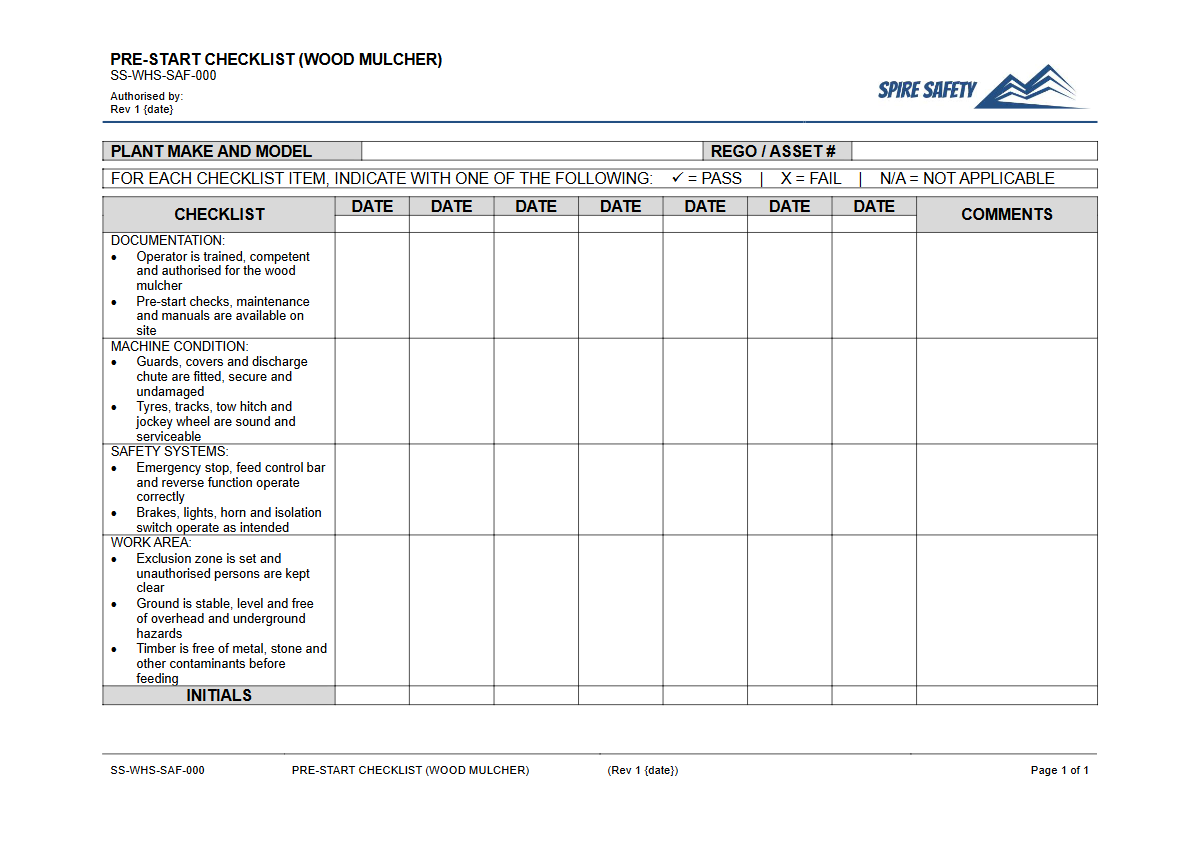
Download our free Pre-Start Checklist (Wood Mulcher) Template. This structured DOCX & PDF helps formalise equipment safety checks and manage WHS risks.
Free Pre-Start Checklist (Wood Mulcher) Template
DOCX • 125 KB + PDF
Updated Oct 2026
No signup required
Purpose of the Free Pre-Start Checklist (Wood Mulcher) Template
Operating a wood mulcher or chipper involves significant safety risks, including entanglement with rotating parts, being struck by ejected debris, and mechanical or hydraulic failure. A systematic pre-start inspection is a critical control measure to ensure the equipment is in safe working order before each use.
This free Pre-Start Checklist (Wood Mulcher) Template provides a structured framework to formalise these essential checks, helping your organisation meet its WHS obligations and protect its workers.
Using this checklist helps verify that key safety features, such as guards, emergency stops, and infeed chute controls, are present and functional. It encourages operators to proactively identify and report hazards before they lead to an incident.
The completed document serves as a practical tool within your organisation's overall WHS management system, providing documented evidence that safety checks are being consistently performed.
Video walkthrough
How to use the Free Pre-Start Checklist (Wood Mulcher) Template
This resource is available as a fully editable DOCX file and a print-ready PDF. To use it, simply download the file and integrate it into your operational procedures.
The checklist guides the operator through a logical inspection sequence, covering critical components from the engine and hydraulics to the cutting drum and safety guards.
Please note: This template is a starting point. We have designed it to be aligned with Australian WHS principles, but it is not a complete, out-of-the-box solution.
You MUST customise it to reflect the specific make, model, and configuration of your wood mulcher, as well as your site-specific hazards and operational procedures. Just as you would tailor a pre-start checklist for a lawn tractor to its specific features, this mulcher checklist requires the same level of customisation to be effective.
When to use a Pre-Start Checklist
The Pre-Start Checklist should be completed before the wood mulcher is used for the first time each day or at the beginning of each shift. It is also best practice to conduct a post-use inspection to identify any damage or faults that may have occurred during operation.
If the equipment has been inactive for an extended period or has undergone maintenance or repairs, a full pre-start check must be completed before it is returned to service.
Who should use it
The checklist should be completed by a worker who is trained and competent in the safe operation of the specific wood mulcher. This person must have the knowledge to identify faults and understand the potential risks associated with the equipment.
Supervisors should periodically review completed checklists to ensure they are being filled out correctly and to monitor the condition of the machinery. This principle of operator-led checks applies across various types of heavy machinery, as detailed in our Pre-Start Checklist (Forwarder) Template for forestry equipment.
Key Inspection Areas
While your customised checklist will be more detailed, it should cover several core areas:
- Guards and Shields: All guards, particularly around the infeed chute, discharge chute, and drive belts, must be secure and undamaged.
- Emergency Stops: Test all emergency stop buttons, bars, and safety trip devices to ensure they function correctly and immediately stop the machine.
- Cutting System: A visual inspection of the cutting drum, knives, or hammers for signs of damage, wear, or looseness.
- Hydraulics: Check for any leaks in hoses, fittings, or rams. Ensure fluid levels are correct.
- General Condition: Inspect tyres, lights, chassis, and hitches for any signs of damage or wear.
The inspection process shares similarities with checking other high-risk cutting equipment, such as that covered in our Pre-Start Checklist for Floor Saws, where blade and guard integrity are paramount.
Record Keeping and Follow-Up
Completed checklists form a vital part of your safety records. They should be retained and periodically reviewed by supervisors to identify recurring issues or gaps in maintenance procedures.
These records are invaluable during internal reviews or formal WHS compliance auditing, demonstrating due diligence in managing plant safety.
By integrating this checklist into your daily routine, you strengthen your safety culture and reduce the risk of serious incidents. For more tools to support your safety management system, explore our comprehensive free WHS resources library.
Common mistakes
Common mistakes to avoid
- Using a generic checklist that doesn't match the specific mulcher model's features.
- Skipping checks on guards and emergency stops, assuming they are always functional.
- Failing to formally tag out and report faulty equipment, leaving it available for others to use.
- Becoming complacent and rushing through the checklist without proper visual and physical inspection.
Legal references
Legal considerations
The following legal requirements may be relevant to this type of work.
- Work Health and Safety Act (Harmonised) — Provides the primary duties for protecting workers and other people from work health and safety risks.
- Work Health and Safety Regulations (Harmonised) — Sets out requirements supporting the management of workplace hazards and risks.
The following codes may be relevant to this type of work.
- Managing WHS Risks Code of Practice — Provides practical guidance on identifying hazards, assessing risks and applying effective controls.
- Work Health and Safety Consultation, Cooperation and Coordination Code of Practice — Provides practical guidance on consulting workers and coordinating with other duty holders.
- Managing the Work Environment and Facilities Code of Practice — Provides practical guidance on safe work environments, workplace facilities and related controls.
Did you know
Infeed Speed
The feed rollers on many commercial wood mulchers can pull in material at speeds of 30 metres per minute or more, making entanglement an almost instantaneous event.
Projectile Risk
Objects can be ejected from a wood mulcher's infeed or discharge chute at speeds exceeding 160 km/h, creating a significant risk zone around the machine.
FAQ
Frequently asked questions
01What are the main hazards of operating a wood mulcher?
02What should an operator do if a fault is found during a pre-start check?
03Who is a 'competent person' to operate a wood mulcher?
04How often should a wood mulcher undergo formal maintenance?
Share this resource
Free Pre-Start Checklist (Wood Mulcher) Template
Browse Categories
How To Use It
- 1Download and open in Word or PDF.
- 2Replace the placeholders with your business details.
- 3Get it reviewed by a WHS specialist before rollout.
Need it customised?
Our WHS consultants can adapt this template to your site, run a gap analysis, or audit what you already have in place.
Book a Free Consultation WHS consulting servicesor call 1300 156 382