
Free Pre-Start Checklist (Wrap Machine) Template
Download our free Pre-Start Checklist (Wrap Machine) Template (DOCX & PDF). This resource helps formalise daily equipment checks and supports WHS management.
Free Pre-Start Checklist (Wrap Machine) Template
DOCX • 125 KB + PDF
Updated Oct 2026
No signup required
Purpose of the Free Pre-Start Checklist (Wrap Machine) Template
Improve workplace safety and operational efficiency with our free Pre-Start Checklist (Wrap Machine) Template. This downloadable DOCX and PDF resource provides a structured framework for conducting essential daily checks on your wrapping equipment, helping to identify potential faults before they lead to incidents, downtime, or costly repairs.
Systematically inspecting your wrap machine is a fundamental part of managing risks associated with plant and machinery in Australian workplaces.
Integrating this checklist into your daily routine helps your organisation meet its primary duty of care under WHS legislation. It encourages a proactive safety culture by empowering operators to take ownership of their equipment's condition.
For other types of industrial machinery, you might find our Free Pre-Start Checklist (Granulator) Template equally useful in formalising your inspection processes.
Video walkthrough
How to use the Free Pre-Start Checklist (Wrap Machine) Template
This template is designed for immediate use and customisation. After downloading the DOCX or PDF file, you can print it for manual completion or adapt the Word document to create a digital form.
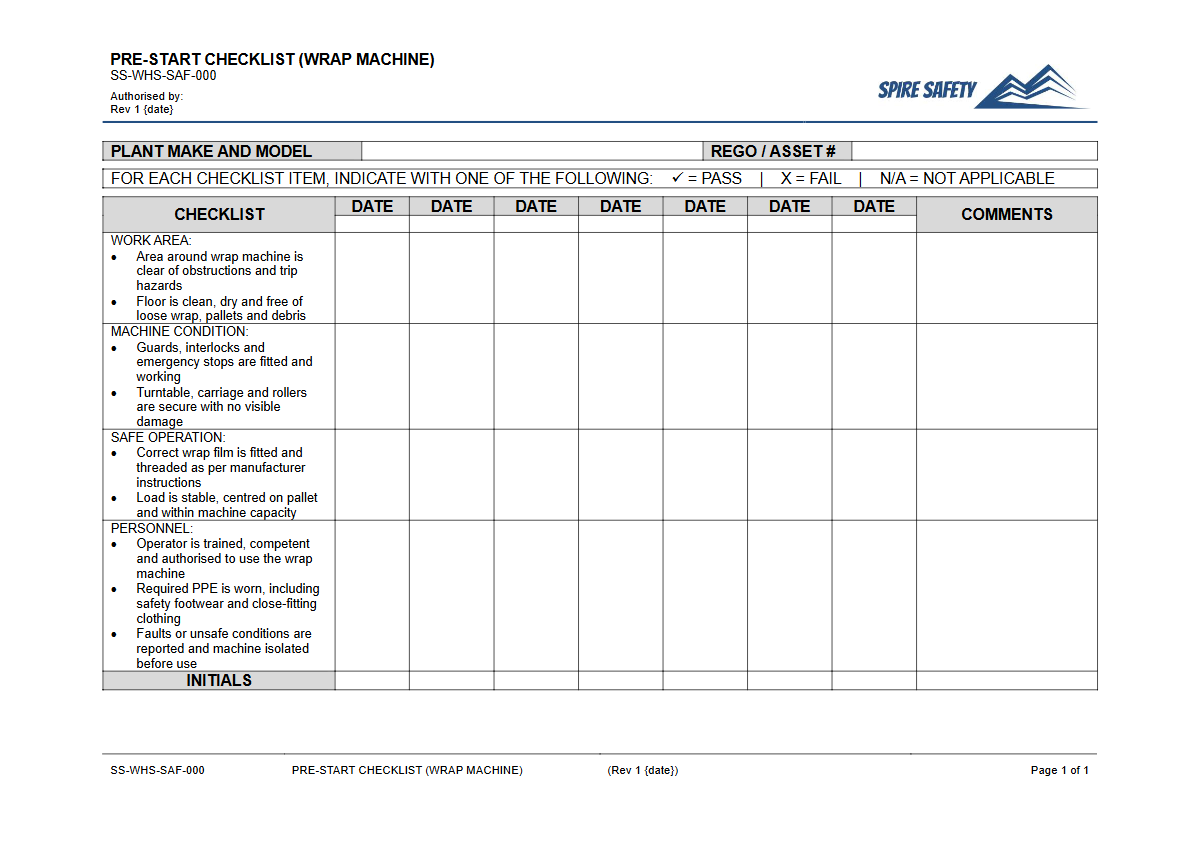
The checklist guides operators through critical inspection points, including emergency stops, guards, rollers, film carriage, and turntable operation.
IMPORTANT: This document is a template. We have designed it to be a comprehensive starting point, but it must be customised to reflect the specific make, model, and configuration of your wrap machine, as well as your site-specific operational risks and procedures.
It is a tool to support your safety processes, not a complete system in itself. Integrating this checklist is a key activity within broader WHS management systems that govern how your organisation operates safely.
What the Pre-Start Checklist Covers
- General Condition: Checking for leaks, damage, and cleanliness.
- Safety Features: Verifying that emergency stops, safety interlocks, and physical guards are functional and in place.
- Operational Controls: Inspecting control panels, foot pedals, and automatic sensors for correct operation.
- Mechanical Components: Examining the turntable, film carriage, rollers, and mast for signs of wear, damage, or misalignment.
- Work Area: Ensuring the area around the machine is clear of obstructions, slip hazards, and unauthorised personnel.
When to use it
A wrap machine pre-start check should be conducted at the beginning of every shift or before the first use of the day. It should also be performed if a new operator takes over during a shift.
This frequency ensures that any issues that may have developed overnight or during previous use are identified before the machine is put into operation, minimising the risk of incidents.
Regularly completing and archiving these checklists creates a valuable historical record of the equipment's condition. This documentation can be invaluable during safety investigations, maintenance planning, and formal WHS compliance auditing.
Who should use it
The pre-start checklist should be completed by a person who is trained, competent, and authorised to operate the specific wrap machine. This is typically the machine operator assigned to the task for that shift.
Supervisors should also be familiar with the checklist to verify its completion and address any reported faults.
It is crucial that operators not only know how to fill out the form but also understand the function of each item they are inspecting and the potential hazards if a fault exists. If your team requires broader safety support, consider engaging professional WHS consulting to enhance your organisation's safety framework.
This template serves as a robust starting point for one piece of equipment. For a wider selection of safety documentation, you can browse our complete free WHS resources library, which contains checklists and templates for various tasks and machinery.
Common mistakes
Common mistakes to avoid
- Using a generic checklist without customising it for the specific machine model and workplace risks.
- Operators 'pencil-whipping' the form without performing the actual physical and visual checks.
- Failing to implement and enforce a clear 'tag out' and 'do not operate' procedure for faulty equipment.
- Not providing adequate operator training on what to check, why it's important, and what to do if a fault is found.
Legal references
Legal considerations
The following legal requirements may be relevant to this type of work.
- Work Health and Safety Act (Harmonised) — Provides the primary duties for protecting workers and other people from work health and safety risks.
- Work Health and Safety Regulations (Harmonised) — Sets out requirements supporting the management of workplace hazards and risks.
The following codes may be relevant to this type of work.
- Managing WHS Risks Code of Practice — Provides practical guidance on identifying hazards, assessing risks and applying effective controls.
- Work Health and Safety Consultation, Cooperation and Coordination Code of Practice — Provides practical guidance on consulting workers and coordinating with other duty holders.
- Managing the Work Environment and Facilities Code of Practice — Provides practical guidance on safe work environments, workplace facilities and related controls.
Did you know
Entanglement Hazard
Entanglement in rotating parts is one of the most severe risks associated with wrap machines. The force generated by the rotating arm or turntable can cause serious injuries like amputations, fractures, or crush injuries in a fraction of a second.
FAQ
Frequently asked questions
01Is a pre-start checklist for a wrap machine legally required in Australia?
02What happens if a fault is found during the check?
03How often should our wrap machine checklist be reviewed and updated?
04Can this template be used for both pallet wrappers and stretch wrappers?
Share this resource
Free Pre-Start Checklist (Wrap Machine) Template
Browse Categories
How To Use It
- 1Download and open in Word or PDF.
- 2Replace the placeholders with your business details.
- 3Get it reviewed by a WHS specialist before rollout.
Need it customised?
Our WHS consultants can adapt this template to your site, run a gap analysis, or audit what you already have in place.
Book a Free Consultation WHS consulting servicesor call 1300 156 382